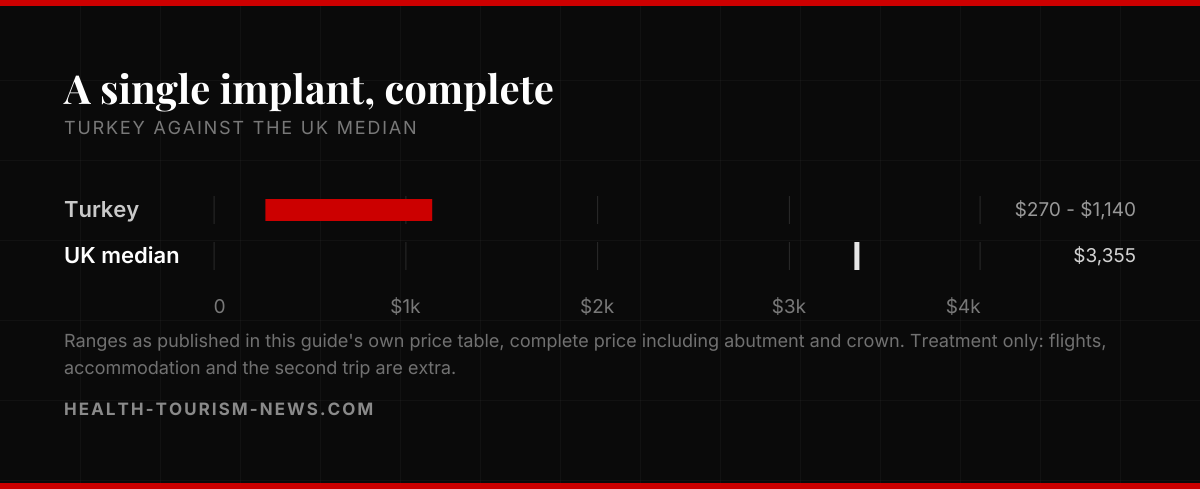
A single dental implant in Turkey costs $270 to $1,140 on published clinic lists, depending on the implant brand, against a UK median of $3,355. The catch is not the price. Implants need two trips separated by months of healing, and the packages promising a full mouth in a week are fitting temporary teeth on the first visit. This guide sets out the brand-tier prices, the per-arch trap in full-mouth quotes, the survival numbers and the paperwork that makes a warranty travel.
Health Tourism News is a trade publication and sells no treatment. Prices below are attributed to their publishers, and their limitations are stated where they matter.
How much do dental implants cost in Turkey?
Published Turkish clinic lists price by implant brand, and the tier matters more than the city, whether Istanbul, Antalya or Izmir. Entry-tier systems in the Turkish market, such as Osstem and Neodent, ran from $270 to $535 per implant with crown in mid-2026, mid-tier brands such as Medentika from $605 to $805, and premium Swiss and Swedish systems from $940 to $1,140. The figures come from three providers publishing itemised sterling lists between September 2025 and May 2026, names on file, and ceramic specialty implants reached $1,810 to $1,880. Aggregator listings quote single implants from about $300 to $900, with the usual caution that platform floors bundle hotels and skew low.
TreatCompare, a UK price-comparison service drawing on 1,125 practices, puts the UK median at £2,500 ($3,355) for a single implant, with complete treatments running £2,000 to £3,500. A premium-brand fixture in Istanbul therefore costs roughly a third of the UK median, and the fixture itself is the same manufacturer’s product in both places. The saving sits in the labour, the laboratory and the lira rather than in the metal.
| Tier | Example systems | Turkey, per implant | UK reference |
|---|---|---|---|
| Entry tier | Osstem, Neodent, local brands | $270 - $535 £200 - £400 | - |
| Mid | Medentika, Megagen | $605 - $805 £450 - £600 | - |
| Premium | Straumann, Nobel Biocare, Astra Tech | $940 - $1,140 £700 - £850 | UK median $3,355 £2,500 |
| Ceramic specialty | metal-free lines | $1,810 - $1,880 | - |
Three Turkish providers’ itemised price lists, held on file. Full methodology under Sources.
Whether a home insurer will cover a complication traceable to treatment bought abroad is not settled, and is worth asking before booking rather than after.
All-on-4 prices, and the per-arch trap
All-on-4 quotes are the least comparable numbers in this market, because the same label covers two different products. One panel provider publishes All-on-4 at $2,150 (£1,600) for a single arch with a temporary bridge; another publishes $7,500 (£5,600) for both jaws in porcelain. Neither is wrong, and a reader comparing the two without checking is off by more than a factor of three, part unit and part material.
Full mouth dental implants in Turkey: prices by material
Full-mouth packages from acrylic to porcelain ran $4,400 to $7,500 across the panel, zirconia versions roughly $5,350 to $9,950, and premium-brand full-mouth work reached $13,150 to $14,250. UK clinics price a single arch at £12,000 to £25,000 ($16,100 to $33,500) on 2026 UK lists. Three words belong in writing on every quote: per arch or full mouth, acrylic or zirconia, and which implant brand.
| Offer | Turkey panel | Notes |
|---|---|---|
| All-on-4, per arch | from $2,150 £1,600 | budget brand, acrylic, temporary bridge included |
| Full mouth, acrylic to porcelain | $4,400 - $7,500 £3,280 - £5,600 | both jaws, 8 implants and up |
| Full mouth, zirconia | $5,350 - $9,950 £4,000 - £7,400 | final bridges |
| Full mouth, premium brands | $13,150 - $14,250 £9,800 - £10,600 | named Swiss and Swedish systems |
| UK, per arch | $16,100 - $33,500 £12,000 - £25,000 | per jaw, 2026 lists |
Same panel; units as each provider publishes them.
Why dental implants in Turkey need two trips
The biology does not negotiate. An implant fuses to the jaw over three to six months, a process called osseointegration, and the final bridge belongs on a healed fixture. Published packages reflect this honestly enough: visit one runs five to seven days for extractions, scans and placement, with a temporary bridge fitted within about 48 hours, and visit two runs two to seven days some months later for the final zirconia teeth. The phrase teeth in a day describes the temporaries, not the result. Two trips also mean two sets of flights, from about £85 ($115) per return out of London, a line the one-trip marketing quietly halves.
Same-day loading is legitimate when the implant is stable enough at placement, and the evidence, largely from single-implant studies, shows survival close to staged treatment when surgeons measure that stability first. Smoking, uncontrolled diabetes, soft bone and bruxism, the habit of heavy grinding, all push the decision towards waiting, which is exactly the conversation a compressed package has no room for. Bone grafts and sinus lifts add months more when they are needed, and they are needed in a substantial share of full-mouth cases, so a quote that survives the scan unchanged is worth more than a cheap one that grows on arrival.
Is it safe to have dental implants in Turkey?
Implant surgery carries strong numbers wherever it is done well. Ten-year implant survival runs about 93 to 96 per cent in the systematic reviews, depending on how dropouts are counted, and a 2024 meta-analysis following implants for twenty years reported 92 per cent survival in prospective cohorts, falling to 78 per cent once dropouts were counted. The crowns fail faster than the fixtures beneath them. Peri-implantitis, gum and bone infection around an implant, affects roughly one patient in five over time, which is why the guidance everywhere assumes lifelong monitoring. All-on-4 shows the same split: implant survival above 99 per cent at two years in a pooled review of 11,743 fixtures, while the bridge on top is the weak point: nearly a quarter of patients in the same pooled review had a fracture of the definitive prosthesis.
The UK aftermath data are blunt. A 2022 British Dental Association survey of 1,000 UK dentists, examined in a 2025 British Dental Journal review of the coverage, found 86 per cent had treated the consequences of dental work done abroad. Crowns and implants were judged the treatments most at risk of failure, and one in five remediation estimates ran above £5,000 ($6,700). None of this makes Turkey the variable. Survival tracks the implant system, the surgeon and the aftercare rather than the country, and the risk concentrates in compressed protocols and in flying home with nobody contracted to watch the healing.
The implant passport, and knowing what you were given
Premium manufacturers back their fixtures with lifetime guarantees that travel: a Straumann or Nobel Biocare implant can be serviced through authorised clinics in the patient’s home country, subject to each country’s programme terms, with replacement fixtures covered. The guarantee follows the paperwork. An implant passport recording the brand, model and lot number of every fixture is what makes a warranty claim straightforward, and it answers a home dentist’s first question without them having to work it out. It is not, though, what makes later servicing possible: a dentist presented with implants they did not place will image the site and identify the system themselves, because that is what the situation requires. The passport saves them that step and saves you the delay. Paid-for-premium, given-unknown is a reported pattern in patient forums, which is the better reason to insist on one: the document tells you what you actually received. Ask for it before the deposit, and keep it.
The manufacturer guarantee covers the fixture and the abutment, the connector between implant and crown. The visible teeth carry a separate clinic guarantee, commonly five to ten years, and one panel provider publishes complication insurance that covers travel costs for warranty work, which is the exception worth noticing rather than the rule.
Ask for the implant passport. Then plan on the basis that it may not change anything.
Dental was never my main flow, but across years of coordinating patients I heard the document mentioned rarely and saw one come back almost never. Clinics issue them. Patients lose them, or leave without them, or never learn they exist.
What matters more is what the receiving dentist does. They will image the site and verify what is there for themselves, because that is what a clinician does with work they did not perform. The passport speeds that up. It does not replace it.
So: get it, keep it, and understand you are not stranded without it. The paperwork that determines whether someone at home can help you is broader than one card. It is the operative note, the imaging, the materials record, and whether anyone told you to keep them.
How to check a clinic and dentist
The verification pathway for Turkish dentistry is covered in this publication’s veneers guide and applies unchanged here: the Ministry of Health publishes lists of authorised facilities, the Turkish Dental Association holds the statutory register, and the register check takes minutes. For implants the additional questions are volume and evidence. Ask how many fixtures the treating dentist places in a year, which brands the clinic is an authorised partner for, and what stability reading gated any same-day teeth. Written answers are what good clinics provide in the normal course of business; reluctance is the clearest red flag this market offers.
If an implant fails at home
The question forums ask most and packages answer least is what happens when a fixture fails during the healing months at home. The honest sequence: a failed implant is usually removed, the site heals for weeks or months, and osseointegration starts again from placement, which means another trip whether or not the warranty covers a replacement fixture. Travel and accommodation for the redo sit outside most guarantees, the one published insurance aside. NHS emergency care treats infection and pain whatever their origin; routine repair of private work done abroad is not funded, and UK dentists who take on a failing case take responsibility for it, which is why many decline. A named aftercare plan at home, priced before the deposit, is as much a part of the purchase as the implant brand.
What this means for patients
A premium-brand implant at a third of the UK median is a rational purchase, and a full mouth at a fifth to a quarter of UK prices is the reason this market exists. The conditions are the ones this series keeps finding, sharpened here by the calendar: two trips honestly scheduled, a brand worth warranting, the passport that proves it, and a named plan for the healing year and the decades of maintenance after it. The per-arch question, the brand question and the passport question cost nothing to ask in writing. Patients who ask them are buying an operation. Patients who do not are flying home on temporary teeth either way.