What is Longevity Tourism?
Longevity tourism is travel for the purpose of extending healthy lifespan, optimising biological age, and accessing preventive medicine programmes that go beyond the scope of conventional healthcare. It encompasses advanced diagnostics designed to detect disease risk decades before clinical presentation, regenerative therapies aimed at repairing cellular and organ-level damage, hormonal and metabolic optimisation protocols, and personalised lifestyle interventions grounded in individual biomarker data.
Longevity tourism is where preventive medicine, regenerative science, and high-end health travel converge. Its patients are not ill. They are investing in not becoming ill, and they are willing to travel and pay substantially to do it right.
The sub-sector sits at the clinical end of the wellness tourism spectrum, with significantly higher medical complexity than standard wellness retreats and in some cases overlapping with experimental medicine. Treatments such as stem cell therapy, peptide protocols, and novel diagnostic technologies occupy regulatory grey areas in many home countries but are available in jurisdictions with more permissive frameworks for experimental or emerging therapies.
Longevity tourism is distinct from both medical tourism, which treats existing illness, and wellness tourism, which focuses on general health maintenance. Its defining characteristic is proactive clinical investment in future health, typically by patients who are already in good health by conventional measures and whose goal is to extend the period of vigorous, high-functioning life.
The Science and the Speculation
The longevity medicine field spans a wide continuum of scientific rigour. At one end sit evidence-based interventions with robust clinical trial data: continuous glucose monitoring, advanced lipid panels, whole genome sequencing, and hormonal optimisation within therapeutic ranges. At the other sit commercially marketed interventions whose claimed benefits significantly outpace the available evidence. Patients entering this market need to distinguish between the two, as providers do not always make this easy.
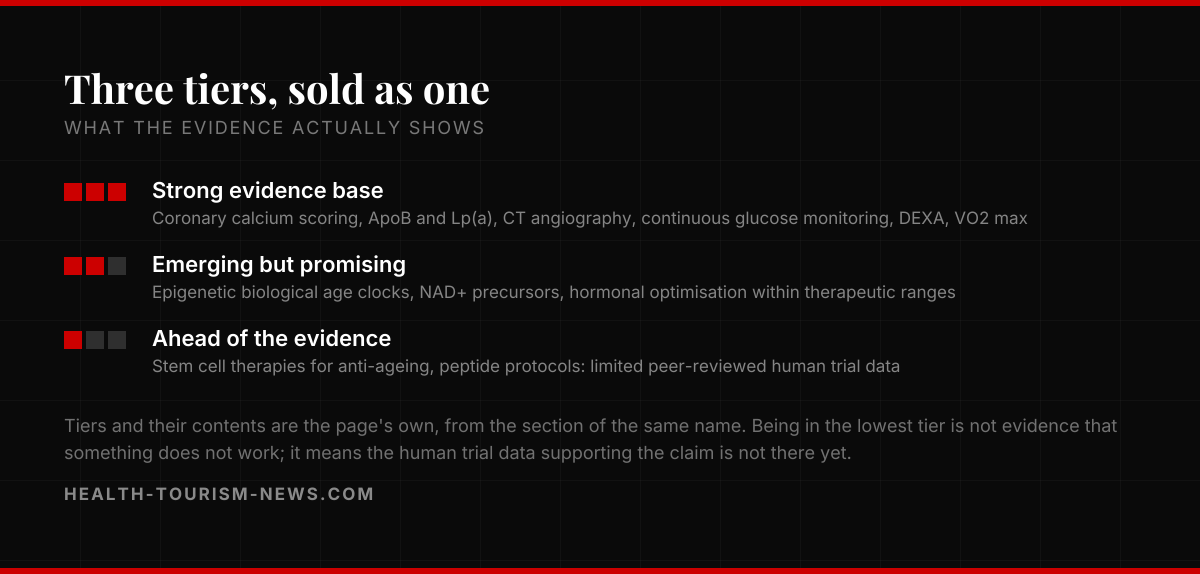
Three tiers, sold as one
What the evidence actually shows
Download this chart PNG, free to republish with attribution
Common Longevity Tourism Treatments
Longevity tourism programmes vary considerably in depth, clinical rigour, and cost. The following categories represent the major treatment modalities currently offered across leading destinations.
Who Travels for Longevity Medicine
The longevity tourism patient profile is among the most clearly defined in health tourism. Patients are predominantly aged 35-65, predominantly male, and in the top income decile of their home market. A significant proportion come from the technology, finance, and professional services sectors, reflecting a demographic that applies an engineering and optimisation mindset to health.
The motivations break into three overlapping categories. The first is early disease detection: patients who want to know as early as possible whether they carry risk factors for cancer, cardiovascular disease, or neurodegenerative conditions that conventional annual health checks will not identify. The second is performance: patients who want to maintain and extend peak cognitive and physical function beyond conventional age-related norms. The third is longevity proper: patients following the science of ageing biology and seeking to intervene in the cellular and systemic processes that drive biological ageing.
Longevity tourism patients typically arrive with more research behind them than any other patient type in health travel. They have read the literature, followed the leading researchers, and come with specific questions. The best longevity clinics are built to match that level of engagement.
A secondary and growing cohort, as these programmes are marketed and staffed, is younger, roughly 25 to 40, and motivated primarily by performance optimisation and preventive screening rather than anti-ageing in the traditional sense. This cohort is more price-sensitive and is driving demand for accessible longevity programmes at lower price points than the premium clinic model.
Top Longevity Tourism Destinations
Longevity tourism destinations are fewer and more concentrated than other health tourism sub-sectors, reflecting the high infrastructure requirements and specialist staffing demands of the sector.
| Destination | Primary Offerings | Key Source Markets | Positioning |
|---|---|---|---|
| Switzerland | Precision medicine, executive health programmes, cellular therapy, advanced diagnostics | GCC, UK, Russia, USA, Asia-Pacific | Premium global benchmark; discretion and trust; long history of providing high-end health programmes to global elites |
| Germany | Regenerative medicine, integrative oncology, hormonal optimisation, advanced diagnostics | GCC, Russia, Eastern Europe, UK | Strong clinical rigour; integration of conventional and complementary approaches; trusted by high-acuity patients |
| Austria | Medical wellness, metabolic health, thermal therapy, integrative medicine | Germany, Russia, GCC, Eastern Europe | Intersection of medical tradition and contemporary longevity science; strong hospitality infrastructure |
| UAE | Diagnostics, longevity clinics, biohacking, executive health | GCC, South Asia, East Africa, Russia | Rapidly developing hub; government strategic priority; hub positioning for regional patients |
| Thailand | Integrated longevity resorts, stem cell programmes, wellness-longevity hybrids | USA, UK, Australia, GCC, China | Combining longevity medicine with high-end wellness infrastructure; cost advantage over European destinations |
| South Korea | Advanced diagnostics, stem cell research, precision oncology, anti-ageing dermatology | China, USA, Southeast Asia, Japan | Technology-led; strong in diagnostics and cellular medicine; K-Medicine emerging brand |
| USA (selected states) | Full longevity programme, cutting-edge trials, regenerative medicine, executive health | Global high-net-worth | Access to the most advanced longevity science globally; highest cost; some treatments available only here |
| Mexico | Stem cell therapy, peptide protocols, regenerative treatments | USA, Canada | Cost advantage for North American patients; permissive regulatory environment for experimental therapies |
What the Evidence Actually Shows
The longevity medicine field has a mixed evidence base that patients need to navigate carefully. Some interventions are grounded in decades of research with clear clinical utility. Others are commercially marketed ahead of the evidence that would justify their use. Understanding which is which is the central challenge for any longevity tourist.
Strong Evidence Base
Advanced cardiovascular screening, including coronary artery calcium scoring, ApoB and Lp(a) measurement, and coronary CT angiography, has robust evidence for detecting subclinical disease and for stratifying risk. The 2019 ACC/AHA primary prevention guideline gives calcium scoring a Class IIa recommendation, narrowly scoped to adults at intermediate risk where a statin decision is genuinely uncertain, and a 2025 systematic review pooling 53 studies and more than 240,000 participants finds detectable calcium strongly associated with events and mortality.
It is worth separating that from a claim these clinics often make on top of it. Detecting disease is not the same as improving an outcome, and on the second question the evidence is thinner than the marketing. A 2022 systematic review in JAMA Internal Medicine found that adding a calcium score to a standard risk calculator improves discrimination only modestly and concluded, in its own words, that no evidence suggests this provides clinical benefit. The US Preventive Services Task Force grades exactly this use, in asymptomatic adults, as insufficient evidence. DANCAVAS, the one large randomised trial of a screening programme built around calcium scoring, did not significantly reduce all-cause mortality. The test is well evidenced for what it measures. Whether measuring it makes you live longer is a different question and not a settled one.
Emerging but Promising
Biological age clocks based on epigenetic methylation patterns are scientifically legitimate tools for assessing biological versus chronological age, and the research field is advancing rapidly. Epigenetic clocks predict mortality and disease risk at population level across multiple systematic reviews, which is what puts them in this tier; whether an individual can move their clock score and benefit from doing so is not established.
Ahead of the Evidence
Stem cell therapies for anti-ageing purposes, peptide protocols for longevity, NAD+ precursor supplementation, and several other interventions marketed heavily in the longevity tourism sector have limited peer-reviewed human trial data supporting their claimed benefits. NAD+ has moved into this tier since this page was first written, and the reason is worth stating: that nicotinamide riboside and nicotinamide mononucleotide raise NAD+ levels is well established, but that raising them delivers the rejuvenation, energy or healthspan benefit clinics sell is not. Those are two different claims and only the first has good evidence behind it. This does not mean they are ineffective, but it means patients should approach marketing claims with proportionate scepticism and ensure they understand the difference between what has been demonstrated in controlled trials and what is being extrapolated from animal models or small observational studies.
How to Evaluate a Longevity Tourism Provider
Provider quality in longevity tourism varies more than in most health tourism sub-sectors, and the gap between the best and worst operators is substantial. The following criteria provide a framework for evaluation.
- Confirm the medical director's qualifications, research background, and specific expertise in the interventions being offered, not just general medicine
- Ask which interventions are evidence-based and which are experimental, and expect transparent, referenced answers
- Request a preliminary consultation before any financial commitment, and assess whether the clinical team engages seriously with your specific health history and goals
- Be cautious of programmes that offer identical protocols to all patients: legitimate longevity medicine is highly personalised to individual biomarker profiles
- Confirm which diagnostic tests are included in the programme and which laboratory systems are used for analysis
- Ask how findings will be communicated and what follow-up support is provided after you return home
- Understand the regulatory status of any experimental therapies being offered in the destination country and in your home country
- Obtain a full written protocol, including all interventions, dosing, and monitoring schedule, before travel
- Confirm that your home country physician will receive a complete clinical report and can support ongoing implementation of any protocols after your return
Longevity Tourism: Common Questions
Sources
The tier placements on this page are editorial judgements about the state of the human trial evidence, and each is now cited. Two moved when we checked them, which is recorded in the corrections log. Prices on this page remain advertised starting figures published by operators, not a surveyed panel: unlike our treatment guides, this sub-sector has no Health Tourism News price panel behind it, and where we could not state a range honestly we have said so instead of estimating.
- Coronary artery calcium, the guideline position. Arnett DK, Blumenthal RS, Albert MA, et al. "2019 ACC/AHA Guideline on the Primary Prevention of Cardiovascular Disease." Class IIa, Level B-NR, for adults at intermediate risk where a statin decision is uncertain. pmc.ncbi.nlm.nih.gov/articles/PMC7685565
- Coronary artery calcium, prognostic strength. Al Hennawi H, et al. "Impact of coronary artery calcium scores on cardiovascular risk and preventive therapies: a systematic review and meta-analysis." Global Cardiology Science & Practice, 2025. 53 studies, over 240,000 participants. pmc.ncbi.nlm.nih.gov/articles/PMC13070238
- Coronary artery calcium, the counterweight. Bell KJL, White S, Hassan O, et al. "Evaluation of the Incremental Value of a Coronary Artery Calcium Score Beyond Traditional Cardiovascular Risk Assessment." JAMA Internal Medicine, 2022. Concludes that no evidence suggests the added discrimination provides clinical benefit. pmc.ncbi.nlm.nih.gov/articles/PMC9039826
- Coronary artery calcium, the randomised evidence. Sogaard R, Lindholt JS, Diederichsen ACP, et al. "User-defined outcomes of the Danish cardiovascular screening (DANCAVAS) trial." PLoS Medicine, 2024. The screening programme did not reduce all-cause mortality. pmc.ncbi.nlm.nih.gov/articles/PMC11132442
- Lipoprotein(a). "Lipoprotein(a) in atherosclerotic cardiovascular disease and aortic stenosis: a European Atherosclerosis Society consensus statement", 2022. pmc.ncbi.nlm.nih.gov/articles/PMC9639807
- Epigenetic clocks. Chen BH, Marioni RE, Colicino E, et al. "DNA methylation-based measures of biological age: meta-analysis predicting time to death", Aging, 2016; and Fransquet PD, et al. "The epigenetic clock as a predictor of disease and mortality risk: a systematic review and meta-analysis", Clinical Epigenetics, 2019. PMC5076441 and PMC6458841
- Cardiorespiratory fitness. Ross R, Blair SN, Arena R, et al. "Importance of Assessing Cardiorespiratory Fitness in Clinical Practice", American Heart Association scientific statement, 2016; and Kodama S, et al. on cardiorespiratory fitness as a quantitative predictor of all-cause mortality, 2009. PMID 27881567 and PMID 19454641
- Continuous glucose monitoring outside diabetes. "Continuous glucose monitoring in non-diabetic populations: a systematic review", European Journal of Medical Research, 2026, and expert-interpretation work on CGM reports from people without diabetes. pmc.ncbi.nlm.nih.gov/articles/PMC11822776
- NAD+ precursors. "NAD+ supplementation for anti-aging and wellness: a PRISMA-guided systematic review", 2026; and a 2025 meta-analysis of nicotinamide mononucleotide and riboside on skeletal muscle mass and function. The precursors raise NAD+; the anti-ageing benefit is not established. pmc.ncbi.nlm.nih.gov/articles/PMC12022230
- Peptides and stem cell protocols. "Therapeutic peptides in gerontology: mechanisms and applications for healthy ageing", 2026; and "Regeneration or Risk? A narrative review of BPC-157 for musculoskeletal healing", 2025. PMC13095733 and PMC12446177