What Cosmetic Tourism Is
Cosmetic tourism is travel abroad for elective aesthetic procedures, surgical or not, undertaken to change how a healthy body looks rather than to treat anything wrong with it. A rhinoplasty in Istanbul, a hair transplant flown in for from across Europe, a body-contouring trip to Mexico, a facial procedure in Seoul: all of it is cosmetic tourism, and what unites it is a motive that is, at bottom, about appearance.
I have spent more time than is probably healthy on the question of where this sits in the wider field, because it is genuinely awkward to place, and getting the placement right tells you most of what you need to know about it. Cosmetic tourism belongs on the same spectrum as the rest of health travel, under the same umbrella, and I set that spectrum out on the health tourism page. But it sits in the uneasy middle of it, and the unease is the point. At one pole is medical tourism, which is reactive, clinical and undertaken out of necessity by someone with a real problem to fix. At the other is wellness travel, which is proactive, non-clinical and chosen by someone with nothing wrong who wants to feel better. Cosmetic tourism borrows from both, and in a combination that should make anyone pause. It takes the means of the medical pole, real surgery, real anaesthetic, real and occasionally fatal risk, and puts them in service of the motive of the wellness pole, the wish to improve on a body that was not broken to begin with.
That is the whole tension, and it is worth stating plainly before anything else. In every other part of medical travel, the risk you take is justified by a need: you accept the danger of surgery because the alternative, the heart condition, the failing joint, the cancer, is worse. Cosmetic tourism is the one corner of the field where people accept genuine surgical risk for something they do not medically need at all. It carries, in other words, the highest ratio of risk to necessity anywhere in health travel. None of which makes it illegitimate, and I want to be clear about that. People have always wanted to look better, the wish is old and human and not to be sneered at, and for many the gain is real, often less in the mirror than in how they carry themselves afterwards. The health benefit of cosmetic surgery, where there is one, is usually psychological rather than physical, a lifting of something that weighed on a person. That is a real benefit. It is simply not the same kind of benefit as fixing a diseased body, and pretending otherwise is where a good deal of the trouble starts.
Two distinctions keep the definition clean. Cosmetic tourism is not wellness tourism, whatever the marketing of a "surgical retreat" implies, because wellness carries no scalpel and no anaesthetic and cosmetic surgery carries both: a spa week and a tummy tuck are not the same category of risk, and no amount of soft lighting changes that. And it is not the non-medical beauty trade either, the facials and the treatments you could have at home, because those are not surgery and not medicine. What makes something cosmetic tourism is precisely that a qualified clinician is doing something invasive to your body, for reasons that are nonetheless about how you look. Hold those two lines and the field stays in focus.
The last thing to know at the outset is the one the industry works hardest to obscure, and it follows from everything above. Because the motive is appearance and the mood is aspirational, cosmetic tourism is sold not as surgery but as a consumer experience, a new face and a fortnight in the sun, a fresh start with airport transfers included. That framing is not harmless. It is precisely the surgical reality, the thing that most deserves a patient's sober attention, that the holiday packaging is designed to soften. This guide keeps the packaging and the scalpel firmly apart, takes the wish to look better seriously, and stays honest throughout about the fact that surgery is surgery wherever in the world, and however pleasantly, it is sold.
Why People Travel for Cosmetic Surgery
The five reasons people travel for medical care, which I set out on the medical tourism page, all appear here too, but cosmetic tourism weights them differently from the rest of the field, and adds a couple of its own. The honest order, for cosmetic specifically, runs roughly like this.
Cost leads, and it leads more decisively than in serious medicine. This is a real difference, and one I have written about before: when the procedure is a matter of necessity, people weigh quality first and price second, because the stakes demand it. When the procedure is elective, the weighting flips, and cost moves to the front. A cosmetic patient is, by and large, a shopper in a way a cardiac patient is not, and the savings on offer are large enough to shop for, half to four-fifths off the home price across the main destinations. That is the engine, and there is nothing wrong with it in itself. It becomes a problem, as I will come to, only when the cheapest option is chased past the point where it is safe.
Appearance is the motive underneath the money, and it has a character all its own. Unlike the conditions that drive medical travel, which do not come and go with the seasons, what people want done to their faces and bodies shifts constantly, pulled by beauty standards, by celebrity, and above all now by social media and the filtered images people measure themselves against. The procedure in demand one year is not the one in demand the next. This is the most fashion-driven corner of health travel by a distance, and that matters more than it first appears, because a decision made under the pressure of a passing trend, on a body alteration that may well be permanent, has a particular capacity for later regret.
Beneath appearance sits something more personal still, which the trade rarely names directly. A good deal of cosmetic travel is driven less by a specific flaw than by the gap between how a person sees themselves and how they wish to be, and that gap is psychological before it is physical. For many this is perfectly healthy, the ordinary wish to feel better in one's own skin. For some it is not, and shades into a genuine disturbance of body image that no surgeon's work will ever satisfy. I come back to this when I reach the risks, because it is the reason a technically perfect operation can still leave a patient unhappy, and the reason the most important assessment a good clinic makes is not always of the body.
Then the two that are easy to forget. The first is simple proximity. A great deal of cosmetic travel is not long-haul at all but a short hop across a nearby border, North Americans to Mexico, Western Europeans to the closer and cheaper parts of the continent, and proximity does more than save on the flight. It lowers the whole barrier to a decision, makes the trip feel casual, a weekend rather than an expedition, and casualness, around surgery, is not always a friend. The second is the legal and regulatory dimension, which cuts in a direction people rarely expect. Some cosmetic travel is driven by a procedure being restricted, or held to slower and stricter standards, at home, so the traveller goes abroad to find it more freely available. That sounds like liberation, and is sometimes sold as such. But it is worth sitting with the obvious thought the marketing skips: where a thing you want is forbidden or tightly controlled at home and freely sold abroad, the home restriction was, often as not, put there to protect you, and the looser regime abroad is looser in ways that include the ones meant to keep you safe. Travelling to escape your own country's caution is not always the bargain it looks.
Those are the drivers: a price worth shopping for, a wish about appearance, a deeper wish about the self, the ease of a nearby border, and the pull of looser rules. The first four are human and, handled with care, entirely reasonable. The last deserves the most suspicion, because the freedom it offers is sometimes precisely the absence of the protections a person most needs when a knife is involved.
What Cosmetic Surgery Abroad Costs
Here are the numbers, with the same warning I attach to every price table on this site: these are indicative ranges, not quotes, and cosmetic pricing moves by clinic, surgeon, technique and what a particular body actually needs. The American figures are anchored to the average surgeon's fees published by the United States plastic-surgery bodies; the figures abroad are typical all-inclusive package prices drawn from across the main destinations. Both deserve a closer look than the headline gap invites.
| Procedure | Where | Price panel | Home-market anchor | Difference |
|---|---|---|---|---|
| Rhinoplasty, primary | South Korea | $2,100 - $7,000 | $8,000 - $15,000 US private typical | -60% |
| Tummy tuck, full | Türkiye | $3,900 - $4,950 | $9,400 - $11,600 UK hospital groups | -58% |
A facelift, five ways
Total cost, indicative ranges
Download this chart PNG, free to republish with attribution
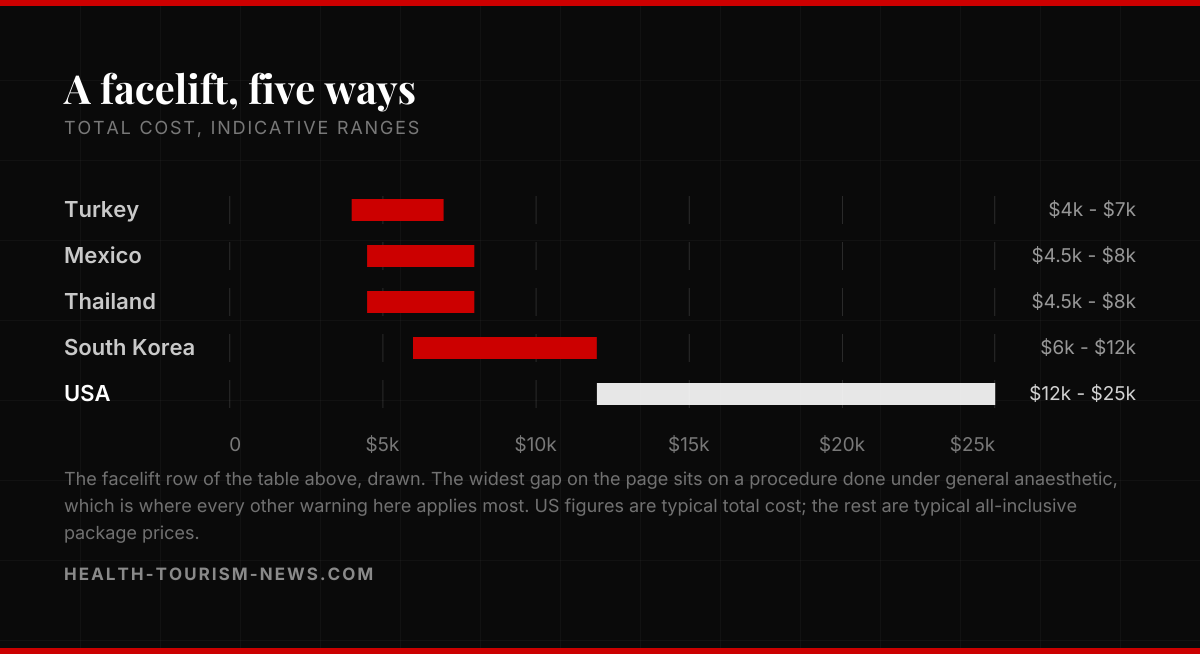
Two rows, not thirty. Both are drawn from the Health Tourism News treatment guide linked in the destination cell, where the provider panel, the reading dates and the conversion rates are set out. This table previously priced six procedures across five countries from figures we could not trace to any panel we hold; those cells have been removed rather than re-sourced, because we have no price panel for hair transplants, breast augmentation, liposuction or facelifts in any destination. Anchors are what a patient actually pays, never a list price. A shorter sourced table is worth more than a longer unsourced one, and the gap tells you where our pricing work has and has not reached.
The first thing to understand is that the comparison is slipperier than it looks, in a way that runs both for the patient and against. The "average cost" of cosmetic surgery quoted in most American coverage is the surgeon's fee alone, the figure the surgical bodies publish, and it leaves out the anaesthetist, the operating facility and the rest, which together add thousands to the real bill. The price quoted abroad, by contrast, is usually all-inclusive, the surgery and the hotel and the transfers and the aftercare folded into a single number. So if you set the American surgeon's fee against the foreign package, you are not comparing like with like, and the true home total is higher than the headline suggests. Done honestly, total against total, the saving is real and large: on the two procedures this guide prices itself, a primary rhinoplasty in South Korea and a full tummy tuck in Türkiye, close to 60 per cent off. I will not pretend that gap away. It is the reason the planes are full.
But the package that makes the saving so clean is also where the danger gathers, and this is the part worth slowing down for. An all-inclusive price is a wonderful thing when you are buying a holiday and a worrying one when you are buying surgery, for two reasons. The first is that a single bundled number obscures the things you most need to see: which surgeon, specifically, will operate, what implants or materials are included, and how much genuine aftercare, as opposed to a farewell coffee, the price actually covers. A bundle is built to be bought whole, and surgery is precisely the thing you should be buying in parts, examining each. The second reason is sharper. The economics of the package quietly push you towards having more done. When the facility and the recovery and the flights are already paid for, a second procedure looks cheap at the margin, and the clinic has every reason to propose one, so the nose becomes the nose and the eyes, the tummy tuck acquires a round of liposuction and a lift. This is not a free upgrade. Combining procedures in a single operative session lengthens the time under anaesthetic and compounds the load on the body, and it is one of the recognised ways cosmetic surgery turns fatal. The bundle's logic is the seller's logic, and it runs directly against the patient's.
Two costs, finally, sit outside every package, and they are the ones that undo the arithmetic when they land. The first is the cost of a complication, which is not in the price and which, as the next section sets out, can run to many times the original saving once a home health system is cleaning up an infection or a wound that will not heal. The second is the cost of revision, the operation to correct or redo the first, which is rarely covered, hard to obtain from another country, and often declined by surgeons at home. So the all-inclusive price is all-inclusive only as long as nothing goes wrong. The moment something does, the saving can vanish and then some.
And there is a quieter point underneath all of this, about who the cheapest price selects for. The patient who shops purely on price, who picks the lowest package on offer, is by that same disposition, and often by that same budget, the one least likely to fly back for a follow-up, to fund a revision, or to absorb the cost of putting a problem right. The cut-price deal and the inability to deal with its consequences tend to travel together. That is not a reason cost should not matter. It is a reason that chasing the very cheapest number, in a field where the consequences of a bad outcome are surgical, is a worse bet than the headline saving makes it look.
The Risks That Matter
Now the part the holiday packaging is built to keep you from dwelling on. Cosmetic surgery is surgery, with everything that word carries: anaesthetic risk, infection risk, the chance of a result you did not want and cannot easily undo, and, at its worst, death. The four risks I set out on the medical tourism page all apply, judging quality from afar, infection, who cares for you afterwards, who pays when it goes wrong, and I will not restate them. What follows is what is particular to having your appearance altered abroad, and the first thing to grasp is that "cosmetic surgery" is not a single level of risk at all.
It is a gradient, and a steep one. At the gentle end sits something like a hair transplant, a long and tedious procedure but a genuinely low-risk one, done under local anaesthetic, from which serious harm is rare. At the other end sit the major body operations, performed under general anaesthetic, opening the body and moving fat and tissue in quantity, and these are dangerous in the way all major surgery is dangerous. Lumping them together under one reassuring word is the first mistake, because it lets the risk profile of a hair transplant stand in, in a patient's mind, for the risk profile of a tummy tuck. They are not the same, and the further up the gradient you go, the more every other warning on this page applies.
Not one level of risk
Deaths per 100,000 operations
Download this chart PNG, free to republish with attribution
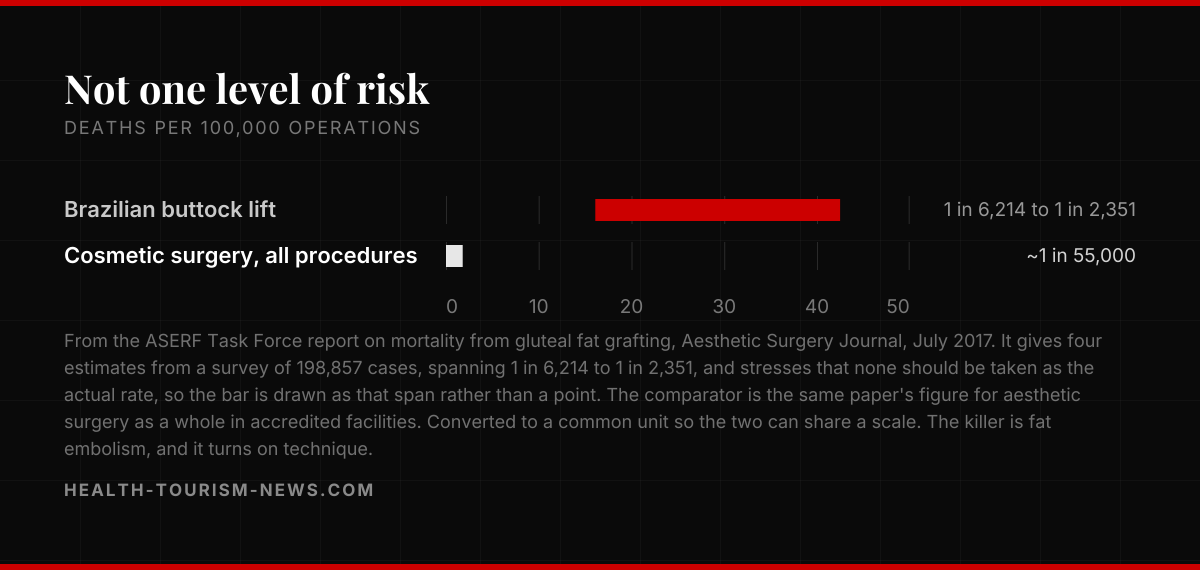
At the very top of that gradient sits one procedure that deserves to be named on its own, because it is one of the most dangerous cosmetic operations there is, and probably the most dangerous of all. The Brazilian buttock lift, which moves fat from elsewhere on the body into the buttocks, carries a mortality rate that the plastic-surgery bodies have put at roughly one death in every three thousand operations. To see how stark that is, set it against the figure for cosmetic surgery as a whole in properly accredited settings, which is closer to one in fifty thousand. The killer is fat embolism, fat entering the bloodstream during injection and travelling to the lungs, and the danger turns heavily on technique, on the fat being placed above the muscle rather than into it. That makes the procedure especially unforgiving of the rushed, high-volume, under-supervised conditions the cheapest end of cosmetic tourism is built on, and it is no accident that it has drawn specific safety warnings and, in Britain, a proposed law to restrict who may perform it at all. If you take one procedure-specific warning from this guide, take this one.
Then there is a risk unique to having surgery abroad, which is the journey home itself. Major surgery raises the risk of a blood clot in the leg, a deep vein thrombosis, which can travel to the lungs and kill, and sitting still for hours on an aircraft raises that risk again. Put the two together, surgery and then a flight too soon after it, and you have a genuinely lethal combination that has been directly linked to deaths among cosmetic tourists. The medical advice is to let a real recovery window pass before flying, and the window is longer than most people expect, a couple of weeks for major work rather than the long weekend the package implies. The pressure runs the wrong way here: the cheap flight home is booked for a few days out, the clinic wants the bed, the patient wants to be home, and all of it pushes towards flying before the body is ready. Do not let it. The return flight is part of the surgery's risk, not separate from it.
The largest category of harm, though, is quieter and slower, and it is the one the data captures most clearly. Most serious complications of cosmetic surgery, infection, a wound that splits open, bleeding, the failure of an implant, do not announce themselves on the operating table. They appear days or weeks later, by which time the patient is home and the surgeon who operated is a continent away. A 2025 review in the journal BMJ Open looked at British patients who came back from surgery abroad and needed their own health service to put them right: it found hundreds of such cases, more than half of them severe enough to require further surgery or prolonged hospital treatment, at costs running into many thousands of pounds each, and the great majority traceable to a single country, for the simple reason that it is the largest destination. Wound infection and wounds that would not heal were the commonest problems, and breast and abdominal surgery the commonest sources. Behind the complications sit the deaths: British travel-health authorities recorded six UK nationals dying in that one country in a single year following medical procedures, with a similar count the year before. These are not abstract risks. They are the routine, documented output of the volume end of this trade.
A word on that single country, because it is the same word I offered on the dental page. The destination that dominates these grim statistics dominates them largely because it dominates the volume: it performs more cosmetic surgery on more foreign patients than anywhere else, so it accounts for more of the complications and more of the deaths, and its share of the figures roughly tracks its share of the market rather than marking out a uniquely dangerous place. There are excellent, careful surgeons there, and a well-chosen clinic is a world away from the cheap package that produces the horror stories. The lesson is not to avoid a country. It is to understand that the conditions which produce these outcomes, high throughput, low price, minimal screening, rushed timelines, can be found, and steered clear of, wherever cosmetic surgery is sold at scale.
The hardest of the surgeon problems to solve from a distance is simply knowing who will hold the knife. Clinic marketing leans on a senior, named surgeon whose actual involvement in your operation is not guaranteed, and in some fields the gap is routine: a great deal of hair-transplant work is carried out not by the surgeon on the website but by technicians, and many of the worst outcomes elsewhere have turned out to involve operators who were not the specialists they appeared to be. Verifying a surgeon's training, registration and record from another country, before you have paid and flown, is genuinely hard, and the difficulty is itself part of the risk.
And then the risk that is not surgical at all, which I promised to return to, and which in its way underlies the whole field. A great deal of cosmetic surgery is sought to close a gap that is in the mind as much as the mirror, the distance between how a person looks and how they feel they ought to look. For most people that gap is ordinary and a good result genuinely helps. But for some it is a symptom of something a scalpel cannot reach, a disturbance of body image that no operation will ever satisfy, and for them surgery is not a solution but a trap, each procedure leaving the underlying unhappiness intact and ready to fix on the next perceived flaw. This is why the most important assessment a responsible surgeon makes is not always of the body but of the person, a judgement about whether surgery will actually help, and the willingness to say no when it will not. It is also precisely the assessment the volume-and-package model is built to skip. A clinic selling a fixed menu to a patient it met online has neither the time nor the incentive to ask whether the operation is a good idea, and a patient chasing a trend they saw on a screen is poorly placed to ask it of themselves. The result can be a technically flawless operation that solves nothing: a person no happier, several thousand pounds lighter, and already contemplating the next.
None of this is an argument against cosmetic surgery, or against having it abroad, where a great deal of excellent work is done every day. It is an argument for treating it as exactly what it is, surgery, undertaken for reasons that make sober judgement harder rather than easier, and for refusing to let the holiday framing do your thinking for you. Almost every danger on this page is reduced by the same handful of habits: choosing the procedure and the surgeon on their merits rather than the package on its price, allowing the body the recovery the operation actually requires, being honest with yourself about why you are going, and knowing who will look after you if something goes wrong. Get those right, and cosmetic travel can be safe and worthwhile. Get them wrong, in this of all fields, and the price is measured in more than money.
Cosmetic Tourism Destinations
Cosmetic destinations sort themselves differently from the rest of health travel. Dental destinations, I argued, are organised mostly by proximity, because so much dental work needs a second trip. Cosmetic destinations are organised by specialism: each of the major ones has grown deep expertise in a particular kind of work, usually rooted in its own culture and market, and the right destination is the one whose speciality matches what you actually want done. A country that is superb for one procedure may be ordinary for another, and the glossy "best for cosmetic surgery" lists that ignore this are worse than useless.
| Destination | Known for | What draws people | The honest caveat |
|---|---|---|---|
| South Korea | Facial surgery, contouring, eyelid and nose work | The world's deepest facial-surgery expertise and technique | Premium prices for the region; a culture of heavy intervention |
| Turkey | Hair transplants, rhinoplasty, all-inclusive packages | The lowest prices, the most volume, the polished package | Outside EU regulation; the volume end concentrates the cautionary tales |
| Thailand | Body contouring, breast, gender-affirming surgery | Mature hospitality and recovery; two decades of experience | A long way to fly home after major surgery |
| Brazil / Colombia | Body contouring, the buttock lift | The original home of body-sculpting expertise | Specialists in the field's most dangerous procedure; standards vary |
| Mexico | Body work, buttock lift, bariatric; proximity | A short hop for North Americans, at low prices | Quality varies sharply by clinic and town along a busy border |
The main cosmetic destinations, sorted by what each genuinely specialises in. The right one is a function of your procedure, not a global ranking.
The logic of the table is worth spelling out, because it is the same logic the whole field keeps returning to. South Korea is the facial-surgery capital of the world, with a depth of expertise in the eyes, nose and facial contour that comes from operating on more faces, per head, than anywhere on earth; if facial work is what you are after, that concentration is real and matters. Turkey owns the volume end, hair transplants above all, where it does more than any country and has driven the price down accordingly, along with rhinoplasty and the all-inclusive package model the rest of the world copied. Thailand built its reputation on body work and on a depth of hospitality and recovery infrastructure that two decades of medical tourism produced, and is the established centre for gender-affirming surgery in particular. Brazil and Colombia are the home of body contouring and the buttock lift, with all the expertise and all the cautions that implies. And Mexico is on the table chiefly for proximity, the natural choice for North Americans who can drive across a border rather than cross an ocean, with the wide variation in standards a long, busy border tends to produce.
The honest caution attached to this map is the one from the risks section, and it cannot be repeated too often. The destinations that lead on volume are, by the same token, the ones that generate the most complications, not because they are uniquely bad but because they do the most work, and the cheap, high-throughput end of each is where the trouble gathers. Choosing the right country for your procedure is the easy half of the decision. Choosing the right clinic and surgeon within it is the half that actually determines how you fare, and it is to that, finally, that everything on this page has been pointing.
Choosing a Cosmetic Surgeon
If the destination question is the easy half, this is the half that matters, and everything in the risks section points to a single principle: you are choosing a surgeon, not a package, and the whole of your safety rests on who that surgeon actually is. On the medical page I argued that the individual surgeon matters more than the institution, and nowhere is that truer than here, where the marketing works hardest to keep your eye on the brand, the price and the brochure rather than on the person who will operate.
So start with the person, and be relentless about it. Establish who, specifically, will perform your surgery, by name, and confirm their qualifications, their board certification or its national equivalent, their training, and their volume in the exact procedure you want. This matters more in cosmetic surgery than almost anywhere, for two reasons the risks section raised: a good deal of work, hair transplants especially, is carried out not by the advertised surgeon but by technicians, and many of the gravest outcomes elsewhere have involved operators who were not the specialists they appeared to be. A clinic that cannot, or will not, tell you plainly who will hold the knife, and prove their credentials, has answered the most important question by refusing to.
Then look at their work, properly. Ask for before-and-after photographs from the surgeon's own archive, of patients whose starting point resembles yours, not the polished stock gallery every clinic shares. Seek out independent reviews and, where you can, accounts from real former patients rather than the testimonials the clinic has chosen for you. And weigh the result you are being promised against the result that is realistic: a surgeon worth trusting will temper your expectations rather than inflate them, and one who promises perfection is selling, not advising.
On the surgery itself, insist on the things the package is built to skip. Get the specific implants or materials named in writing. Refuse, flatly, any procedure suggested on the day or added to your plan because it is "cheap while you're here", because that is the package economics talking and it leads straight to the combined operations that carry the most risk. Confirm in writing how long you must wait before flying home, and build a real recovery window into your plans rather than the optimistic one the cheap return flight assumes. And establish, before you go, what happens if something goes wrong: what aftercare is genuinely included, how a complication would be handled, and who, at home, will look after you on your return. A surgeon at home willing to see you matters more than any guarantee printed abroad.
Be most honest, though, with yourself. The single best protection in cosmetic surgery is a clear-eyed sense of why you are going and what you actually expect it to change, because the patient most likely to be harmed is the one chasing a trend, or a feeling, that surgery cannot deliver. A good surgeon will help with this, and will say no to an operation that will not help you. A clinic selling a menu will not. If you can find a surgeon willing to turn business away when the surgery is a bad idea, you have found the rarest and most valuable thing in this field.
The warning signs, in one place: a clinic that will not name your surgeon or prove their credentials; pressure to decide quickly or to add procedures; promises of perfection; a price conspicuously below everyone else's; a recovery and flight-home timeline that looks suspiciously convenient; and a consultation conducted entirely by salespeople or entirely from photographs. None of these alone condemns a clinic. Together they describe the kind of operation that fills the complication statistics, and the kind this page exists to steer you around. The good clinics will welcome every one of these questions. The ones that resist them are telling you what you need to know.
Cosmetic Tourism FAQ
Sources
- Price panels for both rows of the cost table: the Health Tourism News guides to rhinoplasty in South Korea and tummy tuck in Türkiye. Each sets out its provider panel, the dates the lists were read and the conversion rates used. Verified July 2026, re-verified quarterly.
- US surgeon fees. American Society of Plastic Surgeons, "2024 Plastic Surgery Statistics Report", released June 2025, covering 2024 procedures. Its average surgeon fee table gives nose reshaping (rhinoplasty) at $7,500 to $12,500 and abdominoplasty (tummy tuck) at $8,000 to $13,500. ASPS states in the same table that it now presents surgeon fees as a projected range rather than a single price. These are SURGEON FEES ONLY and exclude facility, anaesthesia and implants, so a patient's total is higher. Linked to the Internet Archive capture of 23 August 2026 because the publisher has since replaced the 2024 report with a 2025 edition and the original URL now 404s; the archived file is the document these figures were read from, and the publisher's live statistics page is linked beside it. web.archive.org capture of plastic-surgery-statistics-report-2024.pdf and plasticsurgery.org/news/plastic-surgery-statistics
- Buttock-lift mortality. Mofid MM, Teitelbaum S, Suissa D, et al. "Report on Mortality from Gluteal Fat Grafting: Recommendations from the ASERF Task Force." Aesthetic Surgery Journal 37(7):796-806, July 2017. 692 surgeons reported 198,857 cases and 32 fatal pulmonary fat emboli. It gives four estimates spanning 1 in 2,351 to 1 in 6,214, sets the average for aesthetic surgery in accredited facilities at 1 in 55,000, and stresses that none of its estimates should be taken as the actual rate. pmc.ncbi.nlm.nih.gov/articles/PMC5846701
- NHS burden after surgery abroad. England C, Bromham N, Needham-Taylor A, et al. "Complications and costs to the UK National Health Service due to outward medical tourism." BMJ Open 16(1):e109050, 13 January 2026, from the Health and Care Research Wales Evidence Centre. Note the date: this page previously described it as a 2025 review, which came from the DOI slug carrying the submission year. pmc.ncbi.nlm.nih.gov/articles/PMC12815047
- UK hospital admissions after cosmetic surgery abroad. British Association of Aesthetic Plastic Surgeons, "BAAPS Cosmetic Tourism Update", 13 November 2023. States that the number of people needing hospital treatment in the UK after cosmetic surgery abroad rose 94 per cent in three years. baaps.org.uk/media/press_releases/1881/baaps_cosmetic_tourism_update
- Deaths abroad and travel-health guidance. National Travel Health Network and Centre, "Travelling for treatment (medical tourism)", TravelHealthPro, first published 27 March 2023 and last updated 17 June 2024. Carries the Foreign, Commonwealth and Development Office statement that it is aware of six British nationals who died in Türkiye in 2023 following medical procedures. travelhealthpro.org.uk/factsheets/travelling-for-treatment-medical-tourism