What Health Tourism Actually Is
Health tourism describes travel undertaken, in whole or in part, to access healthcare or to improve one's state of health outside the place a person usually lives. That much is uncontroversial. The difficulty begins the moment you try to draw the lines inside it.
The field does not suffer from a shortage of definitions. It suffers from the absence of an authority that stakeholders are willing to recognise. Academic journals, health ministries, tourism boards, trade associations and consultancies have each produced their own version, and none carries enough weight to settle the matter, because no single body holds the standing to set the terms for everyone else. What follows is predictable. Health tourism, medical tourism and wellness tourism get used interchangeably, often by people who ought to know the difference, and a conversation that should start from agreed ground instead starts from confusion. A debate is only ever as good as the agreement on what is being debated. This one rarely has it.
So I will take a position, because a guide that refuses to is of no use to anyone. The most useful way to understand health tourism is not as a box with firm walls but as a spectrum. At one end sits medical tourism: travel to put right a negative state of health, with heavy involvement from healthcare professionals, in a clinical setting, frequently invasive, and undertaken out of necessity. At the other sits wellness tourism: travel to improve a state of health that is already neutral or good, with little clinical involvement, in a setting closer to a hotel than a hospital, non-invasive, and chosen rather than required. Everything else in health tourism sits somewhere on the line between those two poles.
A handful of practical markers help you place any given case. How far a qualified healthcare professional is involved. Whether the aim is to remedy something wrong or to enhance something already fine. The setting, since a hospital points one way and a spa the other. The degree of risk the procedure carries. And whether the journey is a true necessity or a discretionary choice. None of these decides the matter alone, and the borders are deliberately soft. Cosmetic tourism in particular refuses to sit cleanly on either side. Taken together, though, they let you sort procedures by what they genuinely involve rather than by how a brochure has dressed them up.
One thing the brochures tend to leave out is worth stating plainly. At its medical end, this whole field is a symptom. People do not cross borders for serious treatment because the experience is agreeable. They do it because the care they need is unaffordable at home, or unavailable, or too slow in coming, or not permitted where they live. Medical tourism is the visible sign of healthcare distributed unequally across the world, and that fact should sit behind how any professional reads the rest of this guide. The industry is real, it pays a great many of our salaries, and in a fairer world a good deal of it would have no reason to exist. That tension is not a reason to look away from the work. It is the reason to do it well.
Why People Travel for Health Tourism
People do not travel for healthcare for a single reason, and the reason matters more than it first appears, because it determines almost everything else: where a patient goes, what they will pay, how much risk they will accept, and whether they should be travelling at all. Strip away the marketing and there are five honest reasons a person crosses a border for medical care.
The first is better treatment. The care available at home is adequate, but the patient believes they can do better elsewhere, in outcomes, in technology, or in the standing of the treating team.
The second is the best treatment. A narrower group, often with serious or rare conditions, chasing a particular centre or specialist regarded as among the finest in the world for their specific problem. Price is rarely the object here.
The third is lower prices. The same or a comparable procedure costs a fraction abroad. Patients in even the better-funded systems still meet large out-of-pocket bills, and the arithmetic of flying somewhere cheaper, after travel and recovery are counted, is often stark. Savings of roughly half to two-thirds against Western European and North American pricing are common across the busiest corridors.
The fourth is faster care. Where a public system runs long queues, as the National Health Service does in the United Kingdom and as several European systems do for elective work, waiting becomes its own affliction. A patient in pain, or whose condition worsens as they wait, will pay to be seen now rather than in eighteen months.
The fifth is treatment that is not permitted at home. This is the quietest of the five and often the most consequential. Reproductive options, certain procedures, experimental therapies and, in some jurisdictions, assisted dying, are restricted in one country and lawful in another. The patient is not chasing a bargain or a shorter queue. They are seeking something their own law denies them.
Most real journeys combine two or three of these, weighted by where the patient starts. A German patient and a Nigerian patient may fly to the same hospital for entirely different reasons. The use of the five is not to label patients but to test propositions, and this is where much of the industry falls down. If a destination, a hospital or a facilitator cannot say plainly which of these it answers, and answer it better than the patient's option at home, it has no honest business courting that patient at all. A great many do anyway.
The Health Tourism Spectrum
The spectrum is worth drawing out, because it is the part of this guide you can actually use. Picture a single line. Medical tourism sits at one end and wellness tourism at the other, and every form of health travel falls somewhere between them according to a few traits rather than a fixed label.
Six sub-sectors on one line
Wellness end to medical end
Clinical involvement, invasiveness, risk and necessity all rise
| Form | HCP involvement | Direction of change | Typical setting | Risk | Necessity or choice |
|---|---|---|---|---|---|
| Medical tourism | High | Negative to neutral | Hospital | High | Necessity |
| Dental tourism | Moderate | Negative to neutral | Dental clinic | Moderate | Mixed |
| Fertility tourism | Moderate to high | Adds a capability | Fertility clinic | Moderate | Strong personal need |
| Cosmetic tourism | Moderate | Alters the healthy | Private clinic | Moderate to high | Mostly choice |
| Longevity tourism | Low to moderate | Optimises the healthy | Specialist clinic | Low to moderate | Choice |
| Wellness tourism | Low | Maintains the good | Resort or spa | Low | Choice |
Reading the table down rather than across is the point. Clinical involvement, the direction of the health change, the setting, the level of risk and the question of necessity tend to move together. As you travel from the wellness end toward the medical end, a qualified professional becomes more central, the work shifts from improving a good state of health to repairing a poor one, the setting moves from resort to hospital, the procedures grow more invasive, and the journey turns from a choice into a necessity. Nothing sits at a single fixed point. Cosmetic tourism is the obvious troublemaker, carrying genuine surgical risk while being driven, in most cases, by preference rather than medical need, which is why it will not settle on either side and why I treat it as its own case on the line rather than forcing it into a camp.
This is not an academic exercise. It changes how you judge quality, risk and regulation in any given case. A wellness retreat and a cardiac unit are not failing or succeeding by the same measures, and treating them as one undifferentiated thing, which the loose use of "health tourism" invites, is how patients end up holding one to the standards of the other.
The Six Sub-Sectors of Health Tourism
Health tourism resolves into six sub-sectors large or distinct enough to warrant their own coverage. Each has its own patient, its own destinations and its own commercial logic, and HTN keeps a dedicated guide to every one.
Two further terms are worth placing, since readers ask where they belong. Longevity, above, increasingly overlaps with conventional medicine as the work moves from lifestyle advice into genuine diagnostics, and I expect it to pull a particular kind of patient across borders in the coming years: people in well-served systems whose own doctors are not permitted, or not willing, to run the tests they are ready to pay for. Pharmaceutical tourism, travel to obtain medicines unavailable or unaffordable at home, is a real and growing behaviour, though it sits awkwardly as a sub-sector because it often involves no procedure and no clinic at all. Both belong on the spectrum. Neither yet needs its own pillar.
The Global Health Tourism Market
Any honest account of the health tourism market has to open with a warning about its own numbers. The figures here are soft, and the gap between published estimates is wide enough to make a single headline number close to meaningless.
One market, nine estimates
Medical tourism, as published by each firm
Download this chart PNG, free to republish with attribution
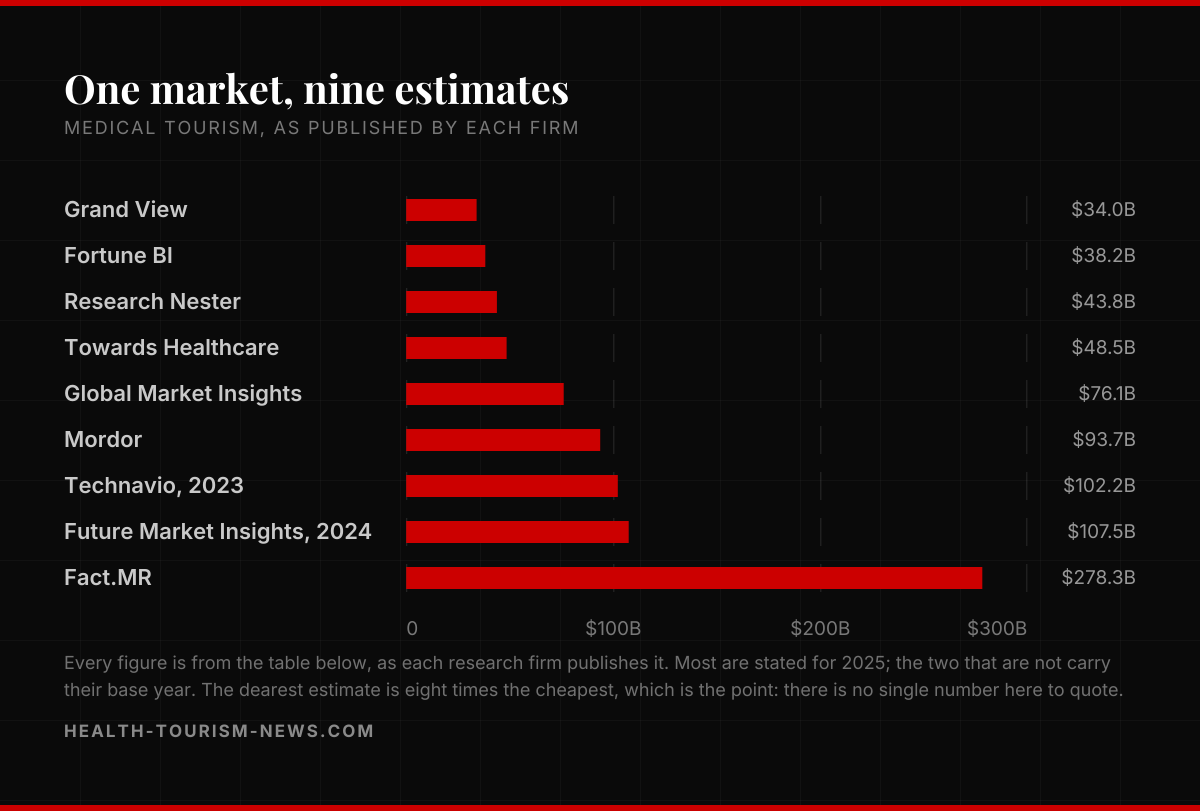
The clearest way to see that is to set the published estimates side by side. The table below collects what the main research firms say the medical tourism sub-sector is worth. Most are stated for 2025; two use earlier base years, flagged in the table.
| Source | Market size | Base year | CAGR | Forecast |
|---|---|---|---|---|
| Grand View Research | $34.0B | 2025 | 14.1% | $126.2B by 2035 |
| Fortune Business Insights | $38.2B | 2025 | 23.3% | $250.0B by 2034 |
| Research Nester | $43.8B | 2025 | 21.9% | $316.7B by 2035 |
| Towards Healthcare | $48.5B | 2025 | 16.1% | $216.3B by 2035 |
| Global Market Insights | $76.1B | 2025 | 8.4% | $174.1B by 2035 |
| Mordor Intelligence | $93.7B | 2025 | 18.4% | $258.3B by 2031 |
| Technavio | $102.2B | 2023 | not stated | +$132.8B by 2029 |
| Future Market Insights | $312.5B | 2026 | 12.3% | $1,000.2B by 2036 |
| Fact.MR | $278.3B | 2025 | 12.3% | $1,000.2B by 2036 |
Every figure is the firm's own published headline estimate, read from its own page on 1 September 2026 and linked in the Sources block below. All are estimates rather than measurements: nobody counts this industry, they model it. Base years differ, and the column says which. Technavio states no single forward rate. Two entries have moved since we first tabulated them, which is itself instructive: Towards Healthcare now projects $216.3 billion by 2035 where it previously carried $186.3 billion by 2034, and Future Market Insights has rebased from a 2024-to-2035 window onto 2026-to-2036. We have followed both to their current published figures.
One detail is worth pausing on. Fact.MR and Future Market Insights now both put the market at $1,000.2 billion in 2036, growing at 12.3 per cent. Two firms selling separate reports arriving at the same figure to the decimal, for the same year, at the same rate, is not two independent measurements agreeing. It is a reminder that these numbers circulate.
The numbers describe the same industry, yet the highest is roughly eight times the lowest, and the growth rates contradict each other as sharply as the totals do. This is not a rounding problem. Methodologies differ, the definition of what counts as medical tourism differs, base years differ, and a good many of these figures are forecasts presented with more confidence than forecasting deserves. The sensible response is not to choose a number but to notice the range. When a market is quoted to you at a single precise value, the first question worth asking is who measured it and what they counted.
You will have noticed that the table says medical tourism, not health tourism, and that is deliberate. Health tourism as a whole is not measured as a single credible figure, and the reason takes us straight back to where this guide began. The term is too loosely held for anyone to count it. Where a firm does publish a "health tourism market" number, it almost always turns out to be the medical slice wearing a different hat: read the scope and you find the same list of cosmetic, dental, cardiac and fertility procedures, simply relabelled, with the spa weeks and the retreats quietly left out of the sum.
And the handful that claim to size the whole are no steadier. One published estimate puts the global health tourism market at twenty-seven million dollars. Not billion. Million. That is around a thousandth of what other firms put on the same industry, attached to a growth rate higher than any serious medical forecast, and it sits on sale like any other report. I have kept it out of the table above, since dropping a figure like that in among genuine estimates would be its own small dishonesty. I raise it because it makes the point better than I can: when the thing being counted has no agreed definition, the count is free to be almost anything. The definitional vacuum from the start of this guide is not a theory. That is what it looks like the moment someone tries to put a price on it.
The wellness end is better documented, because it has the one thing the medical end lacks: a body whose figures are widely accepted. The Global Wellness Institute measured the global wellness economy at 6.8 trillion dollars in 2024, and wellness tourism within it at 894 billion, growing 6.4 per cent a year since 2019 against 1.9 per cent for tourism as a whole. By revenue, then, the wellness side dwarfs the medical side many times over, even though a single cardiac patient generates more value than a great many spa guests combined. The two ends of the spectrum are not only clinically different. They are different sizes of business entirely.
What can be said with reasonable confidence is directional. Cross-border patient flows recovered past their pre-pandemic levels and kept climbing. Medical inflation in the wealthier systems, longer public waiting lists, and a growing middle class across Asia, the Middle East and Latin America are all genuine pressures pushing volumes up. Europe remains a substantial share of the medical market, supported by the cross-border rules covered further down and by short intra-regional journeys. Beyond that, treat precise totals with the suspicion they have earned.
The Risks of Health Tourism
Health tourism carries real risks, and they cluster into four that recur regardless of destination or procedure. They bite hardest at the medical end of the spectrum, but a version of each applies wherever clinical work is involved.
The first is the difficulty of judging quality. Healthcare is the business of trust, and trust is hard to extend across a border. A patient, even a well-read one, is rarely equipped to assess a foreign provider, because most patients cannot assess their domestic one either. They are passive recipients of a service they do not fully understand, and where quality information exists, they have no reliable way to know whether it is true. This is the gap into which the worst of the industry's marketing pours: the "best hospital, best doctors" promises that mean nothing on inspection and prey on people who are frightened and short of options.
The second is infection. Travel exposes a patient to organisms their body has not met, and hospital-acquired infection, including with antibiotic-resistant bacteria, varies considerably between facilities and between countries. Infection-control standards are not uniform, and they are hard to verify from a distance before committing.
The third is continuity of care, and it is the one patients underestimate most. A procedure can go well and still leave a problem, because care does not end when the patient flies home. Who manages the follow-up? Will a home-country doctor willingly take on a case treated abroad in a way they would not have chosen, with implants or protocols they do not recognise? Will the prescribed medication even be available, or licensed, back home? The handover that domestic care takes for granted is, in health tourism, frequently nobody's clear responsibility.
The fourth is cost, beyond the headline price. Estimates are quoted for the planned procedure. They rarely account for what happens when more care is needed than expected, and in some places treatment may stall until the extra cost is settled. Worse, patients regularly return home to find their own insurer will not cover the complications of a trip it never sanctioned. The saving that justified the journey can evaporate the moment something does not go to plan.
None of this argues against health tourism. It argues for going in with open eyes. The safeguards are unglamorous and effective: choose a provider on the strength of its actual track record rather than its advertising, get the treatment plan and the full cost in writing before committing, make sure your doctor at home holds the documentation and will take the case back, insure specifically for planned treatment abroad and its complications, and leave enough recovery time before flying. For a complex procedure in an unfamiliar place a competent facilitator earns their fee, provided you understand how they are paid and whether their advice is genuinely independent of whoever is paying them.
Choosing a Health Tourism Provider
Provider selection is the decision that determines the outcome, more than the country, the price or the brochure. Most of what matters has already appeared above, so this section is about two ideas that mislead patients and professionals alike: accreditation and reputation.
Accreditation is widely misunderstood, in both directions. It is not the magic seal that marketing implies. The notion that a patient sees a logo, recognises the awarding body, and books on the strength of it is largely a fiction. Most patients neither know nor care which institution accredited a hospital, and many do not understand what accreditation is. As a signal aimed straight at patients, it is weak. Its real value is indirect, and more interesting. A serious accreditation is not a payment in exchange for a badge. It is a set of standards, processes and obligations an institution has to meet, and the act of meeting them tends to make the institution better. The benefit, in other words, is not being accredited. It is having pursued accreditation, and carrying the improvements that pursuit forced. Those improvements show in the care, and good care travels by word of mouth. Treated as a quality-building exercise, accreditation is worth a great deal. Treated as a marketing sticker, it is worth very little.
Worth naming in the same breath, and firmly on the marketing-sticker side, are industry awards. The "best international hospital" trophies that circulate in this field are, with few exceptions, theatre. They are not the product of any verifiable process, they are frequently tied to who has sponsored or attended an event, and patients sensibly ignore them. Professionals should too. A provider that leans on its awards is telling you something, and it is not what it intends.
Which leaves reputation, the most powerful force in health tourism and the hardest to fake at scale. Word of mouth, from former patients and from trusted professionals who have watched a provider's work over time, remains the single most reliable guide to quality in this market. It is slow, unglamorous, and cannot be bought outright, which is precisely why it is worth more than anything that can.
Health Tourism Law and Regulation
No single body regulates health tourism worldwide, which is consistent with everything else in this field. Rules are set nation by nation, with a few regional frameworks that matter more than the rest. For anyone working in or travelling within Europe, one of those is worth understanding properly.
The European Union's Directive 2011/24/EU, on patients' rights in cross-border healthcare, gives EU citizens the right to seek planned care in another member state and reclaim the cost from their home system, at the rate the home system would have paid at home. It is not a blank cheque. Reimbursement is capped at home-country tariffs, so a patient choosing a dearer destination covers the difference, and certain higher-cost or inpatient treatments need prior authorisation. The directive also obliged each member state to run a national contact point for cross-border information and set up reference networks for rare and complex conditions. Implementation varies between states, but the principle is real, and it makes intra-European health travel a more orderly business than the cross-border picture almost anywhere else.
Outside Europe, the larger destination countries have built their own national rules for international patients: licensing for facilitators, minimum standards for international patient departments, and government bodies charged with both promoting and policing the trade. These vary widely in how seriously they are enforced.
The quietest regulatory force of all is the one mentioned earlier among the drivers: what a patient's home law forbids. A great deal of cross-border movement exists precisely because a procedure is lawful in one place and not another, from particular reproductive arrangements to certain experimental treatments and, in a small number of jurisdictions, assisted dying. This is the part of health tourism where law does not merely regulate the trade but creates it, and it raises ethical questions that sit well beyond the scope of a market. They deserve more honest attention than the industry, generally keener to talk about growth, tends to give them.
Health Tourism: Common Questions
Sources
Every market estimate on this page was read from the publisher's own page on 1 September 2026. All nine are firm estimates, not measurements. Three block automated requests and are marked, because saying so is better than implying a clean fetch.
- Grand View Research, "Medical Tourism Market Size & Share Report", 2026. States USD 34.0 billion for 2025 at 14.1 per cent to USD 126.2 billion by 2035. Returns 403 to automated requests; figures confirmed from its own indexed text. grandviewresearch.com/industry-analysis/medical-tourism-market
- Fortune Business Insights, "Medical Tourism Market", 2026. States USD 38.2 billion for 2025 at 23.3 per cent to USD 250.0 billion by 2034. Returns 403 to automated requests. fortunebusinessinsights.com/industry-reports/medical-tourism-market-100681
- Research Nester, "Medical Tourism Market", 2026. States USD 43.8 billion for 2025 at 21.9 per cent to USD 316.7 billion by 2035. researchnester.com/reports/medical-tourism-market/4508
- Towards Healthcare, "Medical Tourism Market Sizing", 2026. States USD 48.53 billion for 2025 and USD 216.3 billion by 2035. It previously carried USD 186.27 billion by 2034, and on 1 September 2026 its page title still advertised that older figure while its body gave the newer one; we followed the body. Re-checked 2 September 2026: the publisher has since aligned its title, and the superseded figure no longer appears anywhere on the page. Rate-limits automated requests intermittently. towardshealthcare.com/insights/medical-tourism-market-sizing
- Global Market Insights, "Medical Tourism Market", 2026. States USD 76.1 billion for 2025 at 8.4 per cent to USD 174.1 billion by 2035. gminsights.com/industry-analysis/medical-tourism-market
- Mordor Intelligence, "Medical Tourism Market", 2026. States USD 93.72 billion for 2025 at 18.41 per cent to USD 258.32 billion by 2031, from its own proprietary estimation framework. mordorintelligence.com/industry-reports/medical-tourism-market
- Technavio, "Medical Tourism Market", 2026. States USD 102.2 billion for 2023 and an increment of USD 132.8 billion to 2029, with no single forward rate. technavio.com/report/medical-tourism-market-industry-analysis
- Future Market Insights, "Medical Tourism Market", 2026. Now leads with USD 312.5 billion for 2026 at 12.3 per cent to USD 1,000.2 billion by 2036, having rebased from an earlier 2024-to-2035 window that gave USD 107.5 billion and USD 375.2 billion. Both superseded figures are still printed further down the publisher’s own page, describing the retired window. We follow the window the publisher now leads with, so a reader who clicks through and scrolls will find the older pair there; that is the publisher’s rebasing, not a figure we have misread. Re-checked 2 September 2026. futuremarketinsights.com/reports/medical-tourism-market
- Fact.MR, "Medical Tourism Market", 2026. States USD 278.3 billion for 2025 at 12.3 per cent to USD 1,000.2 billion by 2036, the same endpoint and rate as Future Market Insights. factmr.com/report/medical-tourism-market