What Wellness Tourism Is
Wellness tourism is travel undertaken to maintain or improve your health and wellbeing, rather than to treat anything that has gone wrong with it. The Global Wellness Institute, which has done more than anyone to measure the field, defines it as travel associated with the pursuit of maintaining or enhancing one's personal wellbeing, and that is as good a starting point as any. A yoga fortnight in Bali, a thermal cure in the old German spa towns, a week of supervised fasting in the mountains, a sleep programme in a clinic built for the purpose: all of it counts, and what unites it is the direction of travel. The person is not broken. They are trying to stay well, or to get better at being well, and they have decided to leave home to do it.
That is the part most people get wrong about wellness tourism, and they get it wrong by underrating it. Say the words and a certain picture arrives unbidden: cucumber water, scented candles, a robe, a price that buys very little of substance. It is easy to dismiss the whole field as the frivolous end of an indulgent industry, and a good many serious people in health travel do exactly that, usually without looking closely. I think that is a mistake, and an expensive one, because it misses what wellness tourism actually is and how much of it is real.
Start with age, because it settles the frivolity question quickly. This is the oldest form of health travel there is. People were travelling to thermal springs to take the waters when surgery was a death sentence and a hospital was the last place you wanted to be. The Romans built much of their social life around bathing. The German-speaking world turned the medically supervised cure, the Kur, into an institution its health system funded for over a century, and I happen to write this from a city whose name was made by its hot springs. Long before anyone coined the phrase "medical tourism", before there were aeroplanes to carry patients or clinics worth flying to, there was wellness tourism, and it rested then, as the best of it rests now, on the simple and largely correct idea that warm mineral water, rest, movement and a change of air do a body good.
Where this sits in the wider field is the mirror image of where I have placed medical tourism. If you have read the health tourism guide, you already know I treat the whole field as a spectrum, with medical tourism at one pole and wellness tourism at the other, and I will not redraw the whole thing here. The short version is that they are opposites. Medical tourism is reactive, clinical, often invasive, and undertaken out of necessity by people with something wrong. Wellness tourism is proactive, largely non-clinical, non-invasive, and chosen by people with nothing especially wrong who would like to keep it that way, or to do a little better. One repairs. The other maintains and enhances. That single difference, repair against upkeep, drives almost everything else about how the two behave.
None of which makes the field simple, or means that every "wellness" label stands for the same thing, or for anything at all. It is, if anything, the loosest term in a field full of loose terms. "Wellness" has been attached to everything from a genuine course of balneotherapy to a scented candle, and that breadth is a real problem for anyone trying to understand the sector rather than sell into it. So this guide tries to do two things at once, and to keep them in balance. It takes wellness tourism seriously, because it deserves to be and usually is not. And it stays honest about where the evidence is strong, where it is still arriving, and where the marketing has run ahead of anything anyone can show. Those two are not in tension. The way to respect a field like this is to look at it clearly, and the surest way to keep it frivolous is to refuse to.
Why People Travel for Wellness
The reasons people travel for wellness are not the reasons they travel for medical care, and the difference is instructive. Nobody crosses a border for a thermal cure because the waiting list at home is too long or because they cannot afford to stay ill. They go because they want something rather than because they need it, and want is a more complicated motive than need. Strip away the brochure language and a handful of honest reasons remain.
The largest, by some distance, is the state of modern life itself. People are tired in a way a weekend does not fix. Stress, overwork, poor sleep and the low background hum of being permanently reachable have produced a real and widespread appetite for getting away from all of it, on purpose, with recovery as the actual aim rather than a happy side effect. The pandemic did not create this, but it sharpened it. A great many people used a forced pause to notice how depleted they were, and the demand for deliberate rest has not fallen back since. This is the burned-out professional more than anyone, and it is the engine under the whole sector.
One honest qualification belongs here, though. When that tiredness has tipped into something more serious, burnout that has become a genuine ailment rather than a hard few months, a trip on its own will not mend it. Conditions of that kind ask for more than a change of scene: a change of habits, often a change of perspective, sometimes proper clinical help, and all of it kept up long after the flight home. A good programme can open the door to that work, and give a person the quiet to see they need it, which is no small thing. But at that point the journey is one part of a recovery rather than the whole of it, and what is doing the healing is no longer purely wellness tourism.
Close behind is prevention, the wish to get ahead of trouble rather than wait for it. This is the person who has watched a parent's health go, or had a birthday with a nought in it, or simply decided that looking after the body now is cheaper than repairing it later. They are not ill. They are trying not to become so, and a focused week away from their ordinary habits is a way to take that seriously for once.
Then there is a reason the industry understands better than it usually explains: you can do things away from home that you cannot do at home. The whole power of a residential programme is that it lifts you out of the environment that keeps you stuck. The fridge you raid, the desk you never leave, the phone on the bedside table, the thousand small defaults of an ordinary life are all suspended, and for a week or two a different set of habits becomes not merely possible but easy. Whether the change survives the journey home is the real question, and I come to it later, but the appeal is genuine and the mechanism is sound. Change is simply easier somewhere else.
Some travel for something more specific. A fitness goal pursued properly for once, a yoga or meditation practice taken deeper than a weekly class allows, a sleep problem addressed in a place built around it, a weight or a habit tackled with full attention. These are the closest wellness travel comes to the focused, goal-led shape of a medical trip, and they tend to be the programmes with the most substance behind them.
And some travel for reasons that are harder to put on a spreadsheet: to think, to grieve, to mark a change, to reconnect with something the ordinary week leaves no room for. There is also, and it would be dishonest not to say so, a fair amount of wellness travel that is really about identity, the trip as a statement of the kind of person one is or means to become. I do not say that with a sneer. People have always spent on the things that tell them who they are, and a meditation retreat is a more benign version of that impulse than most.
One last thing worth knowing, because it reshapes the picture. Most wellness travel is not a dedicated wellness trip at all. By the Global Wellness Institute's own measure, the bulk of it is what they call secondary: not a journey taken for wellness, but wellness folded into a journey taken for something else, the spa afternoon on a business trip, the healthier hotel chosen over the indifferent one, the morning swim and the better menu on an ordinary holiday. The dedicated retreat is the visible tip of the sector. The larger part is simply people choosing, more and more, to look after themselves a little better wherever they happen to be going. Hold on to that, because it tells you wellness tourism is less a niche people opt into than a habit slowly spreading across travel as a whole.
Types of Wellness Tourism
Wellness tourism is not one product, and the word covers things with very little in common beyond intent. A useful way to hold the range is to group it by what each form actually does, and roughly how settled the ground beneath it is, running from the oldest and most established to the newest and most contested. The detailed question of what the evidence supports I take up in the next section. Here I want to lay the forms out, and be honest about the character of each.
Oldest, and most grounded, is the water. Thermal and mineral-spring bathing, and the spa tradition built on it, is where wellness tourism began and remains its most serious wing. This is the European Kur in its proper sense, balneotherapy and hydrotherapy under some degree of medical supervision, and it is also the onsen culture of Japan and the bathhouse revival now spreading through cities. It is the part of the field with the deepest history and, not by coincidence, the firmest evidence, particularly for musculoskeletal complaints and for stress. When people want to show that wellness travel is more than indulgence, this is usually where they point, and they are right to.
Next, and almost as straightforward, is movement. Fitness retreats, active holidays, training camps, hiking and cycling weeks, and the more physical end of yoga belong here. There is nothing mysterious about why these work, when they do: they are exercise, done with attention and without the usual excuses, in a place arranged to make it easy. The honest appeal is not some special property of the destination but the removal of everything at home that stops you moving. A week that gets a sedentary person genuinely active is worth having, whatever you call it.
The fastest-growing wing addresses the mind, and it is the one the modern appetite for wellness is really built on. Mindfulness and meditation retreats, dedicated mental-health and burnout programmes, digital-detox stays that take the phone away, and the newer sleep-focused offerings all sit here. This is wellness tourism answering the tiredness and stress I described earlier, and for stress and the milder reaches of anxiety and low mood the evidence is genuinely encouraging, which I come to. It is also, for the reasons in the last section, the wing most often asked to carry more than it can, where a retreat is hoped to mend something that needs a good deal more than a retreat.
Then come the traditions, the classical healing systems people travel into rather than merely sample. Ayurveda above all, with its multi-week panchakarma programmes in India and Sri Lanka, but also traditional Chinese medicine and other long-established systems. These are not inventions of the wellness industry. They are old, coherent, and practised by people trained in real lineages, and they deserve more respect than a sceptic gives them and more scrutiny than an enthusiast does. The evidence is genuinely mixed, the quality of practitioner varies enormously, and there are real safety questions around some preparations. They are serious things, done well or badly, and the gap between the two matters more here than almost anywhere.
Then there are the nutritional and fasting programmes, among the most popular forms of all, ranging from gentle dietary resets to extended, closely managed fasts. What any particular regime does or does not achieve is a question for nutrition specialists rather than for me, and I am content to leave it with them. The point that belongs in a guide like this is the practical one: these programmes run from the mild to the genuinely demanding, and the demanding end, prolonged fasting above all, is the part that calls for real medical supervision rather than a casual booking.
And at the far edge sit the experiential and the ceremonial: spiritual retreats, pilgrimage in its modern wellness form, and the plant-medicine and psychedelic programmes built around ayahuasca, psilocybin and the like. This is the most contested ground in the whole field, and the most uneven. Some of it is ancient and culturally serious. Some of it is unregulated, legally grey, and genuinely hazardous, mixing powerful psychoactive substances with strangers in places with no medical cover. There is also, confusingly, a thread of serious clinical research running alongside it, into psilocybin for depression in particular, which a retreat in the jungle has almost nothing to do with. Anyone drawn to this end owes themselves far more homework than the rest of the field asks, and I treat its risks separately later on.
That is the spread, from the bathhouse to the ceremony. What none of these descriptions has yet done is say plainly which of them stands up to examination and which leans on hope. That is the next question, and the one this guide has been circling from the start.
What the Evidence Says
So: what actually works? It is the question the whole field tends to avoid, and the fair answer is more encouraging than a sceptic expects and more qualified than a brochure admits. There is a pattern worth stating up front, because it holds across almost everything below. The evidence is strongest for the oldest and simplest interventions and thinnest for the newest and most heavily marketed, and even where it is good, the honest finding is usually a real but modest benefit rather than a transformation. Hold that shape in mind and most of wellness tourism falls into place.
What the evidence actually supports
Strongest at the top
Download this chart PNG, free to republish with attribution
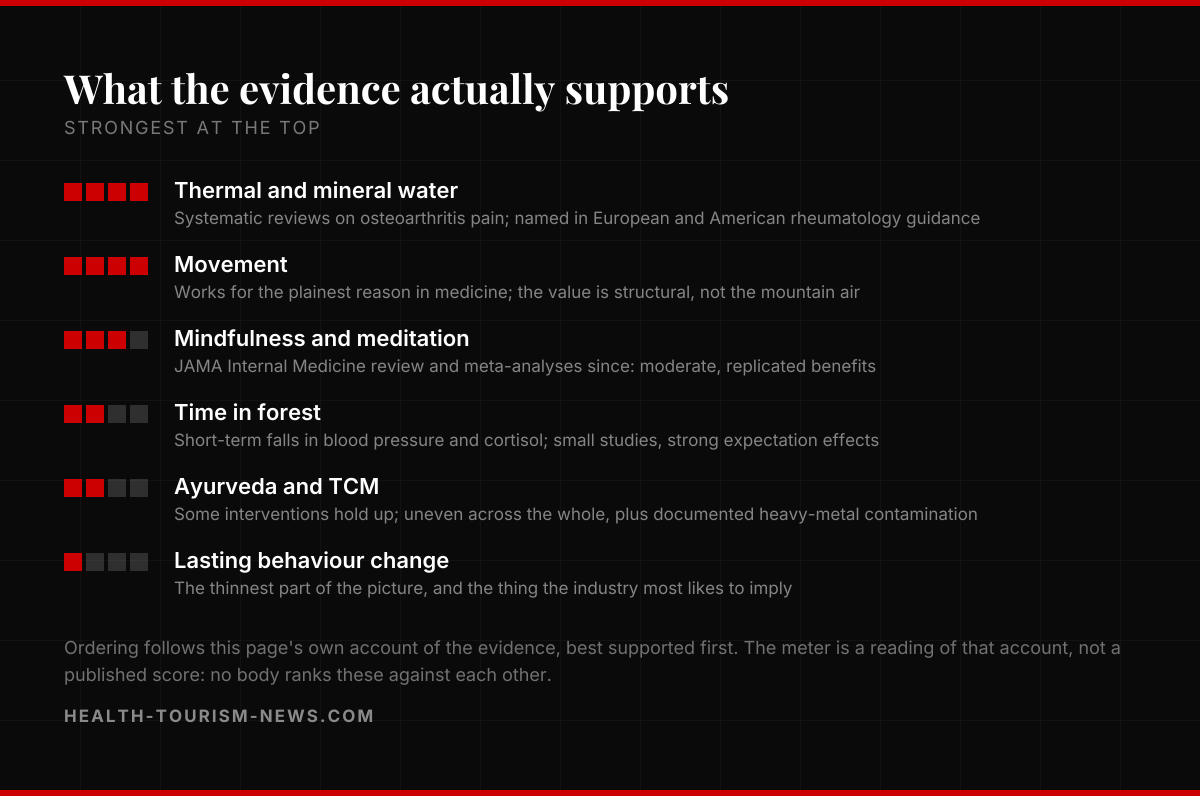
Start where the evidence is best, which is also where the field began. Thermal and mineral-water treatment, the old balneotherapy of the European cure, has a genuine research base behind it. Systematic reviews of bathing in thermal mineral water find consistent improvements in pain and quality of life for people with osteoarthritis of the knee, hip and spine, and the effect is taken seriously enough that both the European and the American rheumatology bodies mention thermal treatment in their guidance for managing the condition. The usual and fair caveat applies: many of the underlying studies are small or methodologically weak, and the reviewers say so plainly. But the direction is steady across decades of work, and the mechanism is no mystery. Warm water eases stiff joints, takes the load off them, and the heat and minerals do measurable things to circulation and inflammation. Of everything in this guide, this is the part that has most earned the right to be called treatment.
Next, and almost too obvious to argue, is movement. A fitness retreat, an active week, the more physical reaches of yoga: these work, when they work, for the plainest reason in medicine, which is that exercise is good for you and most of us do too little of it. There is no special property in the mountain air. The value is structural, the way a residential week strips out the desk, the car and the excuses and leaves you with little to do but move. The honest claim is small and solid. Take a sedentary person, put them somewhere built around activity, and they will move more than they do at home, and be the better for it while they keep it up.
The mind is where the modern appetite for wellness really sits, and the evidence there is genuinely encouraging without being miraculous. For mindfulness and meditation the research is now substantial. A landmark review in the Journal of the American Medical Association's internal medicine title, and a good many meta-analyses since, find moderate, replicated benefits for anxiety, depression and stress, on a par with what you might hope for from a decent self-help intervention. Two honest qualifications belong with that. The effects, while real, are moderate rather than dramatic, and they tend to shrink when meditation is measured not against doing nothing but against another active practice, which suggests some of the benefit is the structure and the attention rather than anything unique to meditation itself. And the quality of the studies varies a great deal. None of which is a debunking. For stress and the milder reaches of low mood, this is a real and useful thing, backed by more evidence than most of what is sold alongside it.
The same broadly holds for nature, which the Japanese formalised as forest bathing and the research has taken more seriously than the name suggests. Several reviews find that time spent in forest does measurably lower blood pressure and the stress hormone cortisol, at least in the short term. The studies are mostly small, often Japanese, and not always well controlled, and one review caught the telling detail that people's stress markers fell merely in anticipation of the forest, before they had set foot in it, which says something about how much of the effect is expectation. Even so, that a quiet walk among trees calms the body is both plausible and reasonably well supported, and it costs nothing to believe.
Here the thread I left hanging earlier has to be picked up, because it qualifies all of this. Almost every benefit above is easy to produce on the retreat and hard to keep once the retreat ends. The immersive week is wonderful at starting a change and largely silent on sustaining it, and the honest truth is that the evidence for lasting behaviour change, the thing the industry most likes to imply, is the thinnest part of the whole picture. A fortnight of good sleep, clean eating and daily movement proves only that you can do those things in a place designed for them. Whether you still do them in the place that wore you down in the first place is the question that matters, and the better programmes know it, which is why they build follow-up and home practice into what they sell. Treat any promise of permanent transformation with the caution it has earned.
The classical traditions ask for both more respect and more care than either side tends to give them. Ayurveda and traditional Chinese medicine are old, coherent systems, and some of their specific interventions hold up in trials, certain herbal preparations among them. But the evidence across the whole is uneven, the quality of practitioner varies enormously, and there is a real safety issue the romance around these traditions tends to skate over. Some Ayurvedic preparations, the herbo-metallic ones in particular, have been found to contain dangerous levels of lead, mercury and arsenic, and there are documented cases of heavy-metal poisoning traced to them across several countries, with the metal content varying wildly even between batches of the same product. The traditional belief that processing renders those metals safe is not borne out by the poisoning records. So take the traditions seriously, by all means, but choose a properly trained practitioner, be wary of what you are given to swallow, and treat the herbo-metallic remedies with particular caution.
Last, and most surprising, is the ceremonial and plant-medicine end, where the evidence is doing something genuinely interesting. There is now serious clinical research into psychedelics, psilocybin above all, and for depression the trial results are striking, with large effects and some sign that a single supervised session can help for months. Ayahuasca has early but real trial support for treatment-resistant depression too. This is not fringe science any more. But the gap between that research and a ceremony in the jungle is the whole point, and it is a chasm. The trials that produce those results screen their participants carefully, exclude the people for whom the drugs are dangerous, and run the session with medical supervision and structured psychological support. A retreat with strangers in a place with no medical cover offers none of that, while using substances powerful enough to raise blood pressure sharply and to drag traumatic memories to the surface, which can heal under the right conditions and harm badly under the wrong ones. The promise is real. The setting in which most wellness travellers will meet it is not the setting that produced the promise, and that distinction matters more here than anywhere else in this guide.
Step back from all of it and the picture is neither the believer's nor the cynic's. A good deal of wellness tourism rests on real evidence, more of it than its detractors think. Much of what works delivers a real but modest good rather than a transformation, which is no small thing in a world short of both rest and movement. Some of it is sold far beyond anything the evidence will bear. And the traveller's task is only to tell those apart, which is easier than the marketing makes it look, because the tell is consistent. The further a claim travels from rest, movement, water, attention and a change of surroundings, and the closer it gets to curing and transforming, the harder you should look before you pay. That is not a reason to be cynical about wellness travel. It is how you get the real good out of it.
The Wellness Tourism Market
Here is the figure that ought to change how the field is seen: the Global Wellness Institute measured wellness tourism at $894 billion in 2024, and projects it past a trillion dollars a year in 2026. The number wants a caveat from the very start, because wellness is a loosely drawn word and a great deal gets folded under it, but even read conservatively it makes the part of health travel most often waved away as frivolous, by money and by sheer number of trips, far the largest part of the whole field. It is bigger than medical tourism several times over. The pole everyone dismisses is the bigger business by a wide margin, and it is worth understanding why, and what the trillion does and does not mean.
Begin with an unusual point in its favour. On the umbrella page I made a good deal of the fact that medical tourism cannot be pinned to a credible single number, with serious estimates spread eightfold, from the mid-thirty billions to well over two hundred. Wellness tourism is the rare corner of this field where the numbers roughly agree. Measuring the present market, the major research houses land within a fairly narrow band of one another.
| Source | Wellness tourism market | Basis |
|---|---|---|
| Global Wellness Institute | $894 billion | 2024, measured |
| Grand View Research | ~$990 billion | 2025, firm estimate |
| Straits Research | ~$1.03 trillion | 2025, firm estimate |
| Precedence Research | ~$1.03 trillion | 2025, firm estimate |
| Future Market Insights | ~$1.21 trillion | 2025, firm estimate |
Recent wellness tourism estimates, each verified against the publisher's own page on 31 August 2026 and linked in the source column. Read the GWI row differently from the rest: it is a measured figure for a completed year, while the others are firms' own 2025 valuations. The spread is narrow by the standards of this industry, largely because the Global Wellness Institute is the field's principal measurer and most others track close to its definition. Note that GWI itself forecast the trade would pass a trillion dollars in 2024 and then measured $894 billion, which is the difference between a forecast and a count.
That agreement is reassuring and a little misleading at once, because a trillion dollars is not a trillion spent on dedicated wellness trips. The figure is generous by construction. It counts what the Institute calls secondary wellness travel, the spa afternoon taken on a business trip, the healthier hotel chosen over the cheaper one, the better menu and the morning swim on an ordinary holiday, right alongside the person who flies somewhere expressly for a retreat. Most wellness travel is of that secondary kind, and most of it is domestic rather than international. So read the trillion correctly. It is not the size of a global retreat industry. It is a measure of how widely the wish to look after oneself has spread across travel as a whole, which is a real and significant thing, but a different one.
The forecasts, as ever, deserve less trust than the present figures. Projected growth across the five firms in the table above runs from 7.8 to 10.4 per cent a year, and the Institute itself cut its own forward estimate for wellness tourism from over sixteen per cent a year to around nine between two of its reports. Nobody knows how fast this grows. They know only that it grows, and has grown faster than tourism in general: on the Institute's own numbers, 6.4 per cent a year between 2019 and 2024 against 1.9 per cent for tourism as a whole, lifting wellness from 14.2 to 17.6 per cent of all tourism spending.
Set against the rest of the field, the scale is striking. Medical tourism, the serious clinical end that commands all the attention, sits somewhere between thirty-four billion dollars and two hundred and seventy-eight on the estimates I gathered for that guide. Wellness tourism is approaching a trillion, and on the commercial estimates has already passed it. The quiet, discretionary, much-mocked business of helping well people stay well is, in plain commercial terms, the giant of health travel, and the surgical end is the smaller sibling.
Why everyone now chases it is no mystery, and the reasons are worth being honest about. Wellness travellers spend more, markedly more: the Institute puts the average international wellness tourist's outlay at around forty per cent above that of the ordinary international tourist, and the domestic premium is larger again. Wellness trips make up under a tenth of all tourism trips but close to a fifth of all tourism spending. And there is a colder reason beneath the warm language, which the brochures will never state and I may as well. The wellness end carries that premium spend without the risk that haunts the medical end. A spa cannot be sued for a fatal complication. A meditation retreat carries no malpractice exposure, no revision surgery, no patient flown home worse than they arrived. For a hotel group, a destination or a health ministry, wellness offers a good deal of the money of medical tourism and almost none of the danger, and that pairing, high spend and low liability, is why every resort now has a spa, every destination a wellness strategy, and every tourism board a slide about it. It is the most attractive proposition in health travel, and the safest.
None of which is cause for cynicism, only for reading the number with your eyes open. The trillion is real, and it tells you something true, that looking after oneself has quietly become a mainstream feature of how the world travels. It also flatters, by counting every healthy breakfast on an ordinary holiday as a slice of the wellness economy. Both things are true at once, and holding them together is most of what it takes to understand this market.
Wellness Tourism Destinations
Wellness destinations are scattered across the world in a way medical ones are not, and the reason is built into the thing itself. Medical tourism clusters, because the patient is chasing a fairly small number of places that can do a particular procedure cheaply or well, and I argued on that page that the list is short and barely changes. Wellness has no such gravity. The asset that makes somewhere a genuine wellness destination, a hot spring, a healing tradition, a landscape, a culture built around rest or the body, is spread all over the map, and so the destinations are too. There is no honest top ten, whatever the lists tell you. There are many places, each good for a particular thing.
Which is the first and most useful thing to understand about choosing one: you choose by what you want, not by ranking. The question is never which is the best wellness destination in the world, a question with no answer, but which place has a real, rooted strength in the specific thing you are after. Go to the home of the tradition you actually want, and ignore the rest of the list.
The distinction that matters more than any ranking is between the rooted and the manufactured, and it is worth learning to spot, though it is not, for wellness, the moral fault line it can be at the medical end. Some wellness destinations have earned the name over centuries. The thing they offer grew out of the place and the culture, and the depth shows. Others are manufactured: a fine resort with a beach and a spa menu, dropping a wellness concept onto ground with no particular tradition behind it, and calling the result a destination. The manufactured kind is not a scandal. A great deal of it is professionally run and genuinely pleasant, and if a well-made spa week in a beautiful hotel is what you want, you will not be cheated. But you should know which you are buying, because the rooted place offers something the manufactured one cannot fake, and the manufactured one often charges as though it could.
The rooted traditions are not hard to name, and the most serious of them is the one nearest home for a European reader. The thermal cure, the Kur of the German-speaking world and the spa towns of Central Europe, is the evidence-backed, medically supervised end of wellness travel I keep returning to, and it is real in a way little else in the field is. Beyond it sit a handful of other genuine traditions, each the true home of a particular kind of wellness.
| Tradition | Genuinely rooted in | What you go for |
|---|---|---|
| The thermal cure (Kur) | Germany, Austria, Hungary, Czechia, Italy, France | Medically supervised thermal and mineral-water treatment, the evidence-backed end |
| Onsen and forest culture | Japan | Hot-spring bathing and forest bathing, in a culture built around both |
| Ayurveda and yoga | India, Sri Lanka | Classical Ayurveda and panchakarma, and yoga practised at its source |
| Traditional medicine and spa | Thailand | Thai traditional medicine, and a deep, mature spa and retreat infrastructure |
The most deeply rooted wellness traditions and their true homes. The point of the table is not a ranking but a match: go to the place where the thing you want actually grew up.
Alongside these sit the places that are neither ancient tradition nor pure manufacture, and they deserve an honest word, because they are where a great many people actually go. Bali, Portugal, Costa Rica and their like have built genuine modern retreat scenes, yoga, mindfulness, nature immersion, on the strength of good climate, real beauty and, in Bali's case, a living spiritual culture that the industry both draws on and, at times, dresses up. These are not fakes, and they are not the thousand-year traditions either. They are good places to do a particular kind of modern wellness, often very well, and the honest way to see them is exactly that, rather than through the soft language of ancient wisdom the marketing tends to reach for.
So the whole of choosing a destination comes down to the match, the same lesson as the medical page in a gentler key. There the test was hard, because a place with no real advantage had no business taking patients at all. Here it is friendlier. Most places with a genuine asset, a spring, a tradition, a landscape, can offer a traveller something real, and even the manufactured ones are rarely harmful. The task is only to know what you want, to go where that thing is genuinely rooted rather than merely advertised, and to pay rooted prices for rooted things and manufactured prices for manufactured ones. Do that, and the spread of wellness destinations stops being confusing and becomes what it actually is: a wide choice in which almost everywhere is good for something, and the trick is knowing for what.
Choosing a Wellness Provider
The thing to understand before you book anything is that wellness travel has even less gatekeeping than the medical end, which had little enough. There is no meaningful licence to run a retreat, no body that vets who may call themselves a wellness practitioner, and almost no quality floor beneath the word. Anyone can hang out a sign. That sounds alarming, and at the intensive end it genuinely matters, but for most wellness travel the stakes are mercifully low: the worst outcome of a mediocre spa week is a disappointing spa week and a lighter wallet. So choosing well is mostly about getting your money's worth and steering clear of the few real hazards, rather than the life-and-death vetting the medical page demanded. A handful of questions does most of the work.
Ask who is actually leading the programme, and what they are trained in. "Wellness" attracts the genuinely expert and the entirely self-appointed in roughly equal measure, and the difference matters most for anything with a physiological edge to it. A yoga teacher with a real lineage and years of practice is a different proposition from someone who did a fortnight's course, and a fasting or intensive nutritional programme run by people with no clinical training is a different proposition again. Look for verifiable qualifications in the specific thing on offer, not a general air of wisdom.
Ask for the actual itinerary, not the promise. The reliable tell of a serious programme is that it can tell you, concretely, what you will do each day, who will run it and what it includes. The unreliable one answers in the language of transformation, of healing and journeys and holistic renewal, and goes vague the moment you ask for specifics. Vagueness is not depth. A provider that cannot describe its own programme plainly usually has less programme than it implies.
For anything intensive, ask about medical screening, and be wary if there is none. This is the question that matters, and I mean it narrowly. Extended fasting, hard physical programmes and anything involving plant medicine carry real physiological risk for the wrong person, and a serious provider of those things screens its participants and has medical support to hand. One that takes all comers without asking a single health question is telling you it is not equipped for the thing it is selling. For a gentle spa or a meditation week this hardly arises. For the intensive end it is the difference that counts.
Then the smaller, sensible things. Ask the group size, because individual attention falls away fast in a crowd. Ask exactly what the price includes and excludes, since wellness pricing is famously elastic. Look for independent accounts from real past guests rather than the testimonials on the provider's own page, which are curated by definition. Treat awards with the suspicion they deserve everywhere in this field; the wellness circuit runs its own prizes and they mean as little as the medical ones. And if the benefit you are after is meant to outlast the trip, ask what the programme does to help you keep it going once you are home, because the ones that have thought about that are the ones taking the lasting-change problem seriously.
None of this is onerous, and none of it needs expertise. It is mostly a matter of preferring the concrete to the mystical, the qualified to the self-appointed, and the provider that asks about your health to the one that asks only for your booking.
The Risks Worth Knowing
Set against the medical end, wellness travel is low-risk, and it would be dishonest to dress it up as otherwise. Most of it carries no more hazard than an ordinary holiday, and the worst that befalls most wellness travellers is that they paid for more than they got. But the risk is not evenly spread. It concentrates at a few specific ends of the field, and those few are worth naming plainly, because that is exactly where the generous, low-stakes picture stops being true.
The first is the intensive programme. Prolonged fasting and severe dietary restriction, along with the hardest physical regimes, are not harmless simply because they are sold in the language of health. For someone with diabetes, a heart condition, an eating disorder in their history, or any of a number of other circumstances, a demanding fast or a punishing fitness week can be genuinely dangerous, and the cheerful absence of clinical oversight at many such programmes makes it more so. The rule is simple. The more a programme restricts what you eat or demands of your body, the more it needs to know about your health before it begins, and the more cautious you should be if it does not ask.
The second is plant medicine, the other thread from the evidence section. I said there that the clinical research into psilocybin and ayahuasca is real and the gap between that research and a jungle ceremony is a chasm, and this is where that gap turns into actual danger. A retreat using powerful psychoactive substances, often in a country with no regulation worth the name and no medical cover on site, is a genuinely high-risk undertaking dressed in the soft clothes of wellness. These substances can raise blood pressure sharply, interact badly with medication, and bring buried trauma violently to the surface in people with no support to meet it. There is also the plain legal exposure: the substances are illegal in many places, and a traveller can face real consequences at home or at the destination. None of this denies the promise the research points to. It is to say that the retreat is the riskiest way to pursue it, and anyone drawn to it owes themselves far more care, and far more honest medical advice, than the field tends to encourage.
The third risk is quieter and, in its way, the most important, because it can catch the well-meaning and the seriously unwell alike. It is the temptation to let wellness travel stand in for medical care it cannot replace. This is the thread from early in the guide, where I said a retreat can open the door to recovery from something serious but cannot be the whole of it. The danger is sharper than that. A person with a real illness, of body or mind, who chooses a wellness programme over actual treatment on the strength of a provider's claims, can lose time that matters. Wellness travel sits alongside medicine. It is not a substitute for it, and any provider who implies otherwise, who suggests their programme can treat a disease that belongs in a clinic, has crossed from wellness into something closer to quackery, and should be left well alone.
The last is the mildest, and the one most travellers will actually meet: the gap between what is promised and what is delivered. Most of the wellness field overpromises a little, in the ordinary way of marketing, and a fair amount of it overpromises a great deal. The harm here is usually only to the wallet and the expectations, which is why it sits last. But hold the evidence section in mind as the antidote. The further a programme's claims travel from the things that genuinely work, rest, movement, water, attention, a change of place, and the closer they get to curing and transforming, the more of your scepticism they have earned. Keep that measure, screen for the few real hazards, and wellness travel is among the safer things a person can do for themselves. Lose it, and it is among the easier ways to be parted from a good deal of money, and occasionally from rather more.
Wellness Tourism FAQ
Sources
- Global Wellness Institute. "What is Wellness Tourism?" Read 31 August 2026. States wellness tourism expenditures reaching $894 billion in 2024. globalwellnessinstitute.org/what-is-wellness/what-is-wellness-tourism
- Global Wellness Institute. "Statistics and Facts", drawing on the Global Wellness Economy Monitor 2025. Read 31 August 2026. States the wellness economy grew 7.9 per cent from 2023 to 2024 and reached $6.8 trillion in 2024. globalwellnessinstitute.org/press-room/statistics-and-facts
- Global Wellness Institute. "Wellness Tourism Will Cross the $1 Trillion Mark in 2024", 28 November 2023. Source of the 7.8 per cent of trips and 18.7 per cent of tourism expenditure figures, and of the trillion-dollar projection that the 2024 count came in below. globalwellnessinstitute.org/global-wellness-institute-blog/2023/11/28
- Grand View Research. "Wellness Tourism Market Size & Share Report, 2026-2035", 2026. States USD 990.4 billion for 2025. The page returns 403 to automated requests; the figure was confirmed from its own indexed text on 31 August 2026. grandviewresearch.com/industry-analysis/wellness-tourism-market
- Straits Research. "Wellness Tourism Market", 2026. States USD 1,029.65 billion for 2025. Read 31 August 2026. straitsresearch.com/report/wellness-tourism-market
- Precedence Research. "Wellness Tourism Market", 2026. States USD 1,032.38 billion for 2025. Read 31 August 2026. precedenceresearch.com/wellness-tourism-market
- Future Market Insights. "Wellness Tourism Market", 2026. States USD 1,213.8 billion for 2025. Read 31 August 2026. futuremarketinsights.com/reports/wellness-tourism-market
- Meditation evidence. Goyal M, Singh S, Sibinga EMS, et al. "Meditation Programs for Psychological Stress and Well-being: A Systematic Review and Meta-analysis." JAMA Internal Medicine 174(3):357-368, March 2014. pmc.ncbi.nlm.nih.gov/articles/PMC4142584
- Traditional-medicine safety. Saper RB, Phillips RS, Sehgal A, et al. "Lead, Mercury, and Arsenic in US- and Indian-Manufactured Ayurvedic Medicines Sold via the Internet." JAMA 300(14):1652, 8 October 2008. Found detectable lead, mercury or arsenic in one fifth of the products tested. pmc.ncbi.nlm.nih.gov/articles/PMC2755247