What Dental Tourism Is
Dental tourism is travel abroad for dental treatment, and it is the form of medical travel almost everyone meets first. It is also the most common kind there is. When the American health authorities looked at why their citizens go abroad for care, dental work came top of the list, ahead of every kind of surgery, and the reason is not complicated. Teeth are expensive everywhere, dental insurance is thin everywhere, and the savings abroad are large and, unusually for this field, reliable. More people cross borders for their teeth than for almost anything else medicine offers.
It is worth being clear at the outset about how this sits inside the wider field, because dental tourism is a part of medical tourism, not a thing apart from it. If you have read the medical tourism guide, the machinery will be familiar: the same five reasons people travel, the same questions about who profits from the arrangement, the same risks around judging quality from afar and managing trouble once you are home. I will not repeat all of that here. This page is about what dental travel does differently, and it does enough differently to earn its own treatment.
What it owns, more than any other corner of the field, is reach. Dental tourism is the democratic one. Most medical travel is for people with a serious problem and, often, serious money: the heart operation, the cancer treatment, the joint replacement that runs to five figures. Dental travel is for everyone. A single implant or a couple of crowns is within reach of an ordinary person on an ordinary wage, and the savings on even a small job can cover the flights and the hotel with money to spare. That accessibility is the whole character of the sub-sector. It is the entry point, the form of medical travel people try first, often years before they would consider going abroad for anything more serious, and for a great many it is the only kind they will ever need.
The cost case is also, genuinely, stronger here than almost anywhere else in medical travel, and I say that as someone generally wary of how savings get sold. On the medical tourism page I spent some time pulling apart the headline percentages, because a saving measured against an American hospital's list price is measured against a number almost nobody actually pays. Dental is different. The home price you are comparing against is, for most people, a real price, the actual out-of-pocket cost at a private dentist, because dental insurance is poor in almost every country and even the insured pay most of it themselves. So when a clinic abroad quotes you a third of the home figure, that third is usually honest in a way the surgical equivalents often are not. The saving is real, and it is the engine of the whole thing.
And yet the very things that make dental travel so accessible, that it is cheap, routine and feels low-stakes next to surgery, are exactly what make it the form people walk into least carefully. Nobody books a heart operation abroad without anxiety. People book a smile makeover the way they book a holiday, and that is where the trouble starts. The risks in dental travel are real, but they are quiet ones, and they hide inside the routineness: the work that cannot be undone, the treatment you did not need, the second and third trips the brochure did not mention. This guide takes dental tourism seriously, as the largest and most useful part of medical travel, and it stays honest about the particular ways the easy ones go wrong. That balance, the genuine value and the underestimated risk, is the whole of it.
Why People Travel for Dental Care
The reasons people travel for dental work are mostly the five I set out on the medical tourism page, with the weighting shifted. Cost dominates, more completely than in almost any other part of medical travel. But two of the others, access and appearance, do enough of the work in dental specifically that they are worth taking on their own terms.
Cost first, because it is the heart of it. Dental work is dear in the rich countries for reasons that have little to do with the work itself: high clinic overheads, high labour costs, expensive laboratory fees, and dental systems that have quietly shifted most of the bill onto the patient. That last point matters most and gets noticed least. In most countries dental care sits half outside the public health system, and dental insurance, where it exists at all, covers a fraction of any serious work. The British health service offers a few hundred pounds towards complex treatment and no more. American public cover offers nothing for it. So unlike the heart operation or the hip, which someone's insurance or health service may well pay for at home, the dental patient is usually paying out of their own pocket from the first pound, and a person paying their own way is a person who shops around. That is why the same procedure at a third or a quarter of the price abroad moves so many people to get on a plane. The saving is theirs to keep.
Access is the second driver, and in some places it has overtaken cost entirely. This is clearest in Britain, where public dentistry has been failing for years in a way that has become its own small national scandal. By the government's own figures, something like fourteen million adults in England, more than one in four, cannot get an appointment with a health-service dentist. Whole regions have become what the press now calls dental deserts, with practices closed to new patients for years at a stretch. The result has been reported in Parliament and the papers alike: people pulling their own teeth at home, queues forming when a rare appointment is released, and, said plainly by members of Parliament describing their own constituents, pensioners flying abroad for basic dental treatment they cannot get at home. When a person cannot see a dentist in their own country at any reasonable price or within any reasonable time, the flight to Budapest or Istanbul stops being a luxury and becomes the only option on the table. For a growing number, dental travel is not about saving money. It is about getting treated at all.
Appearance is the third, and it is the newest and fastest-growing, and the one that carries the most trouble in its wake. A large and rising share of dental travel is not about health at all but about looks: whiter, straighter, more uniform teeth, the smile makeover sold hard across social media to people who were never in any pain. This is the part of dental tourism that shades into cosmetic tourism, and I take up the broader business of appearance medicine on that page. But it belongs here too, because the demand for a perfect smile, cheaply and quickly, is what drives the volume end of dental travel, and it is where the worst of the harm has gathered. People who genuinely need a tooth replaced are one kind of dental traveller. People talked into reshaping a healthy mouth they were unhappy with are another, and the second group, as I come to when I reach the risks, are the ones the industry has served worst.
Those are the three that move people: a bill they must pay themselves and can cut sharply, a home system that in places can no longer see them, and the pull of a better smile. The first is rational and largely sound. The second is a symptom of something broken at home, much as I argued the whole of medical tourism is. The third is where desire and salesmanship meet, and where a person most needs to keep their head.
What Dental Work Abroad Costs
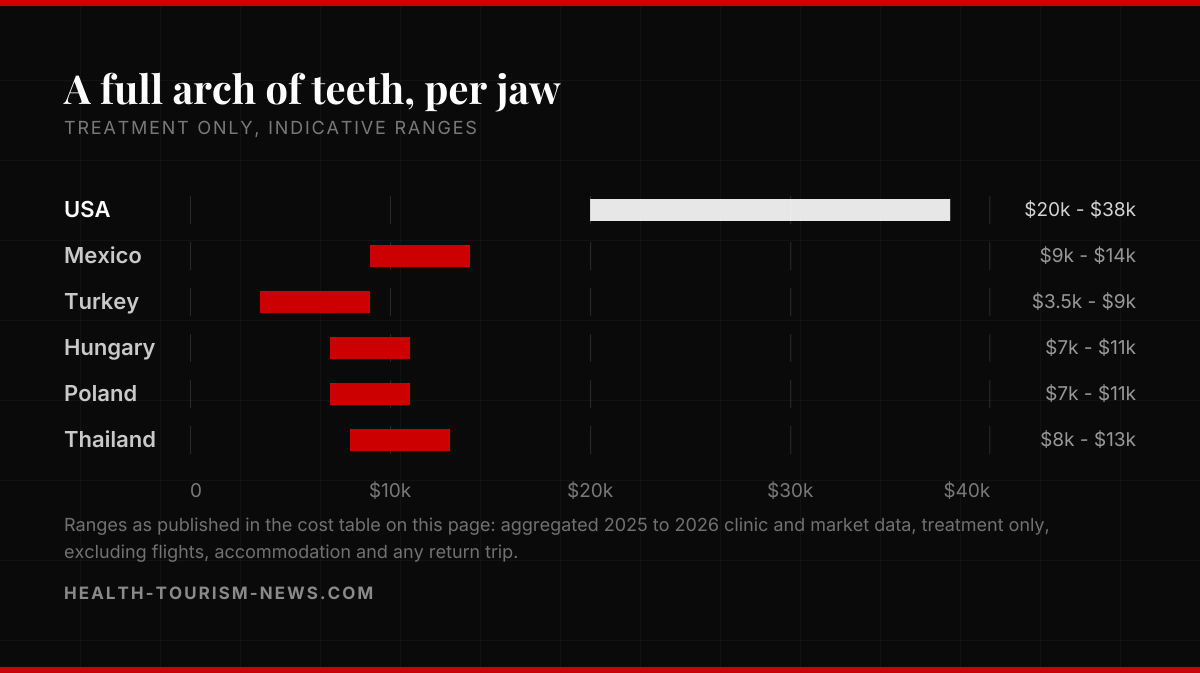
The numbers are the reason anyone reads a page like this, so here they are, with the usual warning that they are indicative ranges and not quotes. Dental pricing moves by clinic, by city, by the seniority of the dentist, by the brand of the components and by the complexity of your particular mouth, and no table can stand in for an itemised quote built from your own X-rays. What a table can do is show the shape of the thing, and the shape is stark.
A full arch of teeth, per jaw
Treatment only, indicative ranges
Download this chart PNG, free to republish with attribution
| Procedure | Where | Price panel | Home-market anchor | Difference |
|---|---|---|---|---|
| Single implant, restored | Poland | $535 - $1,340 | $3,355 UK median | -72% |
| Türkiye | $940 - $1,140 | $3,355 UK median | -69% | |
| Hungary | $950 - $1,460 | $3,355 UK median | -64% | |
| Croatia | $1,050 - $1,715 | $3,355 UK median | -59% | |
| Thailand | $1,050 - $3,150 | $3,355 UK median | -37% | |
| Mexico | $1,200 - $1,730 | $3,500 - $5,500 US complete | -67% | |
| All-on-4, per arch | Türkiye | from $2,150 | $16,100 - $33,500 UK | published floor |
| Poland | $5,700 - $8,900 | $16,100 - $33,500 UK | -71% | |
| Hungary | $6,965 - $11,400 | $16,100 - $33,500 UK | -63% | |
| Croatia | $7,550 - $8,750 | $16,100 - $33,500 UK | -67% | |
| Mexico | $8,110 - $13,500 | $25,000 - $35,000 US, large chains | -64% | |
| Thailand | $9,900 - $13,200 | $16,100 - $33,500 UK | -53% | |
| Porcelain veneer, per tooth | Türkiye | $215 - $430 | $823 UK median | -61% |
| South Korea | $720 - $1,500 | $823 UK median | +35% |
Every row is drawn from the Health Tourism News treatment guide linked in its destination cell, where the provider panel, the dates the lists were read and the conversion rates are set out in full. Panels are lists published by named providers, held on file, verified July 2026 and re-verified quarterly. The difference column compares panel midpoints against the home-market anchor midpoint, so it describes typical against typical. Anchors are what a patient actually pays, never a list price. Treatment only: flights, accommodation and the second trip are excluded. Crowns and root canals have been removed from this table because we hold no price panel for them; a shorter sourced table is worth more than a longer unsourced one.
Look at the table and the first thing to say is that, yes, the saving is genuine, and on the larger jobs it is enormous. A full arch of teeth that runs past thirty thousand dollars at home can be had, to a comparable clinical standard at a good clinic, for a quarter or a third of that. On a single small procedure the headline gap is just as wide in percentage terms. That is the real and honest core of dental tourism, and I will not pretend otherwise.
But the headline number flatters in two directions, and both deserve naming. It flatters the small jobs, because the moment you add the flights, the hotel and the time off work, a single implant that looked seventy per cent cheaper is a good deal less cheap, and for one small thing the trip may barely pay. And it understates the big ones, because the table shows treatment only, and the full-arch traveller saves not a few hundred but ten or twenty thousand dollars, enough to dwarf any travel cost. So the rule that falls out of the table is this: dental travel pays best for big, multi-unit work and pays least for a single small repair. The more teeth involved, the stronger the case.
Two things hide inside the prices that no table can show, and both are where the saving can turn out to be false. The first is what the implant actually is. An implant is not an implant: a fixture from one of the established global manufacturers and an unbranded one from a factory you have never heard of can sit in the same price column and the same jaw, and the gap in the quote is often precisely that difference. It matters beyond snobbery, because the recognised systems are the ones a dentist at home can identify, service and repair years later, while the obscure one may leave you with work nobody back home can touch. Ask which brand, get it in writing, and be wary of a price that looks too good against the others in its row. The second is what the quote includes. The cheapest figure is sometimes the implant alone, with the abutment and the crown added later, so that the bargain quietly assembles itself into something closer to the rest of the field by the time you have a tooth you can chew on. Compare like for like, or you are not comparing at all.
One honest footnote on the geography, because the league table has shifted. Hungary, and Budapest above all, was the original bargain of European dental travel, and for thirty years it earned the name. It is no longer the cheapest. Years of demand and a generation inside the European Union have pushed Hungarian prices up to the point where Turkey now plainly undercuts it, and the patient chasing the lowest number has largely moved on. That does not make Hungary a worse place to have your teeth done. It makes it a reminder that "cheapest" is a moving target in this business, and not the only one worth aiming at.
The Risks That Matter
Dental travel is lower-risk than surgical travel, and I have said so more than once, because it is true and because the opposite claim frightens people for no good reason. The four risks I set out on the medical tourism page all apply here, judging quality from afar, the danger of infection, the problem of who cares for you afterwards, and the question of who pays when something needs putting right, and I will not walk through them again in the same terms. What I want to do instead is name the handful of hazards specific to teeth, because they are not the ones people expect, and they hide, as I keep saying, inside how routine the whole thing feels.
The first is the simplest and the most underestimated: time. A good deal of dental work cannot honestly be done in a single trip. An implant is not a tooth screwed into a jaw in an afternoon; it is a fixture placed in the bone, then left for months while the bone grows around it and holds it fast, and only then crowned. That healing, three to six months of it for most people, is not optional, and it means the honest version of implant treatment abroad is two trips, sometimes three, with the flights and the hotels and the time off work doubled accordingly. Some clinics will offer to compress it, to place and crown in a single visit, and for the right case in the right mouth that can be sound. But where it is offered to save you a second flight rather than because your bone is ready, it is the convenience of the seller dressed as a kindness to the buyer, and it is the wrong reason to rush a thing that does not want rushing. Plan for the trips the treatment actually needs, and be suspicious of a timeline that happens to match your holiday.
The second is the one that does the most damage, and it is a problem of incentive. A dentist who is paid per crown has a reason to fit crowns, and the further you travel into the cheap, high-volume end of cosmetic dentistry, the stronger that reason runs and the weaker the things that would normally check it. This is not a dark secret. A BBC documentary put it to the test directly: a dentist sent photographs of her own perfectly healthy teeth to well over a hundred clinics abroad and fifty at home, asking for veneers. More than half the overseas clinics wrote back recommending she have twenty or more teeth crowned. Not one of the clinics at home recommended any treatment at all, because there was nothing to treat. That is the whole problem in a single experiment. When the person advising you on whether you need work is also the person who profits from the work, and no one who knows you is in the room, you are being sold to, not cared for, and a healthy mouth is no defence.
Which leads to the gravest of them, the one that cannot be taken back. The over-selling matters so much in dentistry because so much of what gets over-sold is irreversible. Here is the distinction everyone should understand and almost no one is told, between a veneer and a crown. A veneer is a thin shell bonded to the front of a tooth, taking a fraction of a millimetre of enamel, and in its gentlest forms it can sometimes be undone. A crown requires the tooth to be ground down to a small peg, sixty or seventy per cent of it filed away, to seat a cap over the stump. On a tooth that is broken or decayed, that is good and necessary dentistry. On a healthy tooth, done for the sake of appearance, it is the permanent destruction of something that was working, and it can never be reversed, because once the tooth is a peg there is no longer enough of it to hold a veneer or anything else. The patient is committed for life to a cycle of replacement, and if the work was poor the road runs through infection, root canals, and teeth lost altogether.
The step that cannot be taken back
A veneer and a crown are not alternatives
Veneer
A thin shell bonded to the front
- Removes
- A fraction of a millimetre of enamel
- Afterwards
- In its gentlest forms, sometimes reversible
Crown
A cap over the whole tooth
- Removes
- Sixty or seventy per cent of the tooth, filed to a peg
- Afterwards
- Cannot be undone
This is the phenomenon that acquired a nickname, "Turkey teeth", and the name needs a word of fairness. It stuck to Turkey because Turkey is the largest and most visible dental destination in the world, the place the volume and the social-media smiles, and therefore the horror stories, most often come from. But the thing itself is not Turkish and not confined to Turkey. It is what happens wherever cheap cosmetic dentistry is sold at volume to people who want a quick, dramatic result, and it can be found, and avoided, in every dental corridor on the map. A good clinic in Istanbul will treat your teeth more conservatively than a bad one anywhere; the country on the sign is not the variable that matters. So take the warning for what it is, a warning about a practice and an incentive, not about a place. The lesson is not "avoid Turkey". It is "be enormously careful before you let anyone file down a healthy tooth, wherever in the world they propose to do it".
The last risk is the one that turns a bad outcome into a lasting one: what happens when it fails, and you are home. A crown fractures, an implant does not take, an infection sets in, and the clinic that did the work is a plane ride and a language away. The warranty that looked reassuring on the website is hard to enforce from another country, and harder when "lifetime" turns out, in the paperwork, to mean ten years. Worse, your own dentist at home may be unable or unwilling to help, partly because correcting another clinic's work is genuinely difficult, and partly because the materials and systems used may be ones they cannot identify or source. A British Dental Association survey found that almost all UK dentists had by now seen patients who were treated abroad, and that the large majority of those patients needed remedial work once home, often costing more than the original saving. Public health systems will generally not clean up the consequences of private cosmetic work done overseas, and the law of the destination usually offers the foreign patient little. So the person who saved a few thousand on a smile can spend a great deal more, and suffer for a good while, putting it right.
None of this is a reason to stay home. It is a reason to treat dental travel as the real medical decision it is, rather than the shopping trip it is dressed up as. Almost every one of these hazards is avoided by the same unglamorous discipline: get an honest assessment of what you actually need, ideally from someone who is not selling it to you; refuse irreversible work you did not come for and do not understand; plan for the time the treatment genuinely takes; and know, before you go, who will look after you if it goes wrong. Do that, and dental travel is what it should be, the most useful bargain in medicine. Skip it, and it is the easiest way in the whole field to turn a saving into a catastrophe.
Dental Tourism Destinations
Where to go for dental work is a different question from where to go for surgery, and the difference comes straight out of the risks section. Because so much serious dental work needs two trips rather than one, the distance you must travel matters more here than almost anywhere else in medical travel. A heart operation is done once: you fly far, you recover, you come home. An implant may pull you back across the world for the crown months later, and a corridor that is a short hop becomes worth a great deal when you may have to fly it twice. So dental destinations sort themselves, more than anything, by proximity, and the honest map is regional rather than global. The question is rarely "which is the best country in the world", which has no answer, but "which is the best country from where I live".
| Corridor | Serves mainly | Known for | The trade-off |
|---|---|---|---|
| Hungary | UK, Germany, Austria, Ireland | Implants, full-mouth, restorative; the original European dental capital | Deeply experienced and EU-regulated, but no longer the cheapest |
| Turkey | UK, Europe, the Gulf | Veneers, crowns, cosmetic, full-arch; the global volume leader | The lowest prices and the most packages, but outside EU regulation and the source of most cautionary tales |
| Poland | UK, Germany, Scandinavia | Implants, crowns, restorative | EU-regulated and a short flight, a little cheaper than Hungary, but thinner on complex-case volume |
| Spain | UK, Northern Europe, expats | Implants, full-arch, cosmetic | The smallest savings, but EU-regulated, a short flight and a genuine holiday |
| Mexico | USA, Canada | Implants, crowns, full-arch | A walk across the border for North Americans; quality varies sharply by clinic and town |
| Thailand | Australia, Asia, some UK and US | Cosmetic, implants, orthodontics | Mature and tourism-friendly, but a long way to fly twice |
The main dental corridors, sorted by who they serve rather than ranked against one another. The right one is mostly a function of where you live and what you need, not a global league table.
For Europeans the choice comes down mostly to three. Hungary has the deepest claim, and earns it: Budapest has been the centre of European dental travel for over thirty years, its clinics are practised at treating foreigners, and as a member of the European Union it offers the cross-border regulatory backstop and the consistent professional standards that come with that. Its one drawback is that success has raised its prices, and it is no longer the bargain it was. Turkey is where the bargain went. It is the largest dental destination on earth, with the lowest prices and the most polished all-inclusive packages, and for a well-chosen clinic it can be excellent value. But it sits outside the European framework, trading that regulatory cover for the lower number, and as the risks section made plain it is also where the volume, and therefore the cautionary tales, are concentrated. Poland is the quieter middle path, EU-regulated and a short flight, a little cheaper than Hungary, strong on routine implant and restorative work if lighter on the most complex full-arch cases. Spain sits apart from all three: it saves the least, often only a third off home prices rather than the two-thirds further east, but it offers full European regulation, a flight under three hours and a destination that is a real holiday rather than a treatment trip, which for many is worth the smaller discount.
Beyond Europe the map is simpler and follows the same proximity logic. For North Americans, Mexico is the natural corridor, near enough that border-town clinics in places like Los Algodones see patients who walk across and home the same day, though the range of quality from clinic to clinic and town to town is wider than anywhere, and selection matters more in proportion. For Australians and much of Asia, Thailand is the established choice, a dental pioneer of two decades with a deep tourism infrastructure wrapped around it. The newer European entrants, Croatia, Romania, Albania and others, are real and growing, several of them EU-regulated and genuinely cheaper than the established names, and the only honest caution is that their dental-tourism infrastructure and the depth of patient feedback are thinner, so the burden of checking a specific clinic falls more heavily on you.
The through-line is the same one the whole field keeps returning to. A destination is worth choosing when it has a genuine claim on the thing you need, the experience, the standards, the price, the proximity that actually serves your case, and not because a package looked attractive. The corridors above are established because each, in its way, has earned a real claim. Match yours to where you live and what your mouth needs, and the question of the "best" country mostly answers itself.
Choosing a Dental Provider
Everything in the risks section points to a single piece of advice, and if you take only one thing from this page, take this: get an honest assessment of what you need from someone who is not going to do the work. On the medical page I argued that the surgeon matters more than the hospital, and that holds for teeth too, the individual dentist's skill and volume in your specific procedure is what determines your outcome. But dentistry adds a problem surgery mostly does not, the over-selling I described, and the only real protection against it is a second opinion from a dentist with no stake in the answer. See someone at home first. Get your own X-rays and a baseline view of what is actually wrong, if anything. Then, when a clinic abroad proposes a plan, you have something honest to measure it against, and the gap between "you need one implant" and "you need twenty crowns" becomes visible before it becomes permanent. This one habit prevents most of the disasters on this page.
The rest is practical, and most of it is about getting things in writing before you fly. Insist on an itemised treatment plan and quote built from your own X-rays, not a number pulled from a photograph on social media; any clinic willing to plan irreversible work off an Instagram picture, without imaging, has told you what kind of clinic it is. Confirm the specific implant brand and components in writing, and prefer the recognised systems a dentist at home can service later. Ask the treating dentist directly about their training and how many of your procedure they do, and be wary if you can only ever reach a booking coordinator and never the person who will hold the drill. Read the warranty before you commit, and read it properly: what it covers, for how long, and whether "lifetime" means what you think. A guarantee you cannot enforce from another country is worth less than it looks, so ask how complications are actually handled once you are home.
Then plan the whole thing honestly. Budget for the trips the treatment really needs, not the one you hope for. Buy travel insurance that covers dental complications. And arrange your aftercare before you go rather than after, ideally by lining up a dentist at home who will see you on your return and giving them the full record of what was done, which materials, which components, which brand, so that if anything goes wrong they can act rather than shrug.
The warning signs, gathered in one place, are easy to remember. Be cautious of anyone who recommends crowning healthy teeth, who plans major work without scans, who keeps you away from the dentist and routes you through salespeople, whose pricing shifts or sits suspiciously below everyone else's, or who promises a film-star smile in a single visit. None of those is proof of a bad clinic on its own. Together they are the profile of the kind of place this page exists to keep you away from. The good clinics, and there are many, will not mind a single one of these questions. The ones that bristle at them are answering you.
Dental Tourism FAQ
Sources
- Price panels for every row of the cost table: the Health Tourism News guides to dental implants in Poland, Türkiye, Hungary, Croatia, Thailand and Mexico, and to veneers in Türkiye and South Korea. Each sets out its provider panel, the dates the lists were read and the conversion rates used. Verified July 2026, re-verified quarterly.
- Implant survival. The 93 to 96 per cent ten-year survival range comes from the systematic reviews cited in each guide's own Sources panel, for example dental implants in Türkiye, not from any destination's outcome data. No country publishes national dental implant outcomes, which is why this page compares price and verifiability rather than results. Verified July 2026.