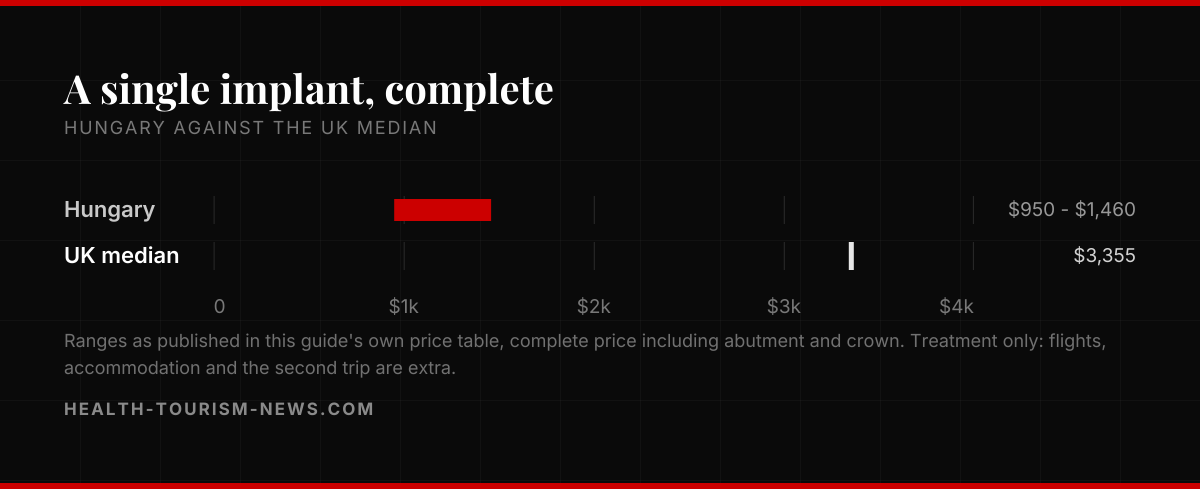
A single dental implant in Hungary is advertised from about €325, and the finished tooth costs $950 to $1,460 once the abutment and crown join the bill, against a UK median of $3,355. Hungary has sold dental work to foreigners for longer than almost anywhere in Europe, and the maturity shows in the machinery rather than the marketing. It runs a national register a patient can search, it has a chain of border towns built on Austrians driving over for the day, and its price lists were undercutting Vienna before Croatia had a private clinic worth the name. What the country asks a British patient to grasp is narrower than the brochures let on, and it starts with a currency that is not the euro and a chamber rule that changed in 2023. This guide sets out the published prices, what the EU framework does and does not buy, and the checks that still work.
Health Tourism News is a trade publication and sells no treatment. Prices below are the list prices clinics publish, converted and attributed, and their limits are flagged where they matter.
How much are dental implants in Hungary?
The advertised figure is the surgical post, and in Hungary the posts span a wide range. The budget end of the Budapest market lists a standard implant from about €325 implant-only in the middle of 2026, though the best-known flagship clinics start nearer €680, and premium Straumann fixtures at those clinics run €1,100 to €1,240. The custom abutment adds around €184, and the crown €276 to €316 depending on the material, so a mainstream restored tooth, the part that actually chews, lands between roughly $950 and $1,460, with premium-fixture cases higher again. The medical-travel platforms sampling Hungarian clinics put the complete single tooth at $950 to $1,400 over the same period, which is corroboration rather than coincidence. The UK median near $3,355 from 2026 cost surveys sets the frame, and the finished tooth in Hungary costs between a third and a half of the British one. Turkey is cheaper still. That gap is worth knowing before the European premium is paid without examination.
| Offer | Price | Notes |
|---|---|---|
| Single implant, implant only | $370 - $1,415 €325 - €1,240 | budget floor to premium Straumann |
| Single implant, restored, mainstream | $950 - $1,460 €835 - €1,280 | implant, abutment and crown |
| All-on-4, per arch, published lists | $6,965 - $11,400 £5,199 - £8,500 | low end leaves the final bridge unstated |
| All-on-4, platform sample average | $6,505 June 2026 | Hungarian clinics |
| UK single implant, median | $3,355 £2,500 | 2026 UK cost survey |
| UK All-on-4, per arch | $16,100 - $33,500 £12,000 - £25,000 | per jaw, 2026 |
Budapest clinics’ published prices, held on file. Full methodology under Sources.
Whether a home insurer will cover a complication traceable to treatment bought abroad is not settled, and is worth asking before booking rather than after.
All-on-4 prices and the final-bridge question
The full-arch quotes in Hungary split the same way they do everywhere, and the difference is the bridge you keep. The published lists start an arch at about £5,199 for a fixed bridge on four implants, with the edentulous upper jaw on six implants nearer £6,499, and a June 2026 sample of Hungarian clinics put the average All-on-4 around $6,505 across a wide field. Above those sit fuller packages reaching £8,500 an arch and beyond. The cheap floors share one habit worth naming: they quote the implants and the temporary, then go quiet on the final bridge and its material. The noun sorts the offers, not the headline. Which bridge, acrylic or zirconia, fitted on which visit. The clinical record adds one footnote here as everywhere. The pooled reviews put the implants themselves near 99.8 per cent survival past two years, while 23.2 per cent of patients fracture the definitive prosthesis, so the warranty on the bridge matters more than the warranty on the titanium.
Is Hungary good for dental work?
Clinical numbers travel with the procedure, not the passport. Ten-year implant survival sits at about 93 to 96 per cent in the long-term reviews, roughly one patient in five develops peri-implantitis over the years that follow, and no registry publishes Hungary-specific outcomes to argue with either figure. What Hungary can claim honestly is depth of practice. Its dental schools are old and well regarded, its degree is one of the qualifications the European Union recognises automatically across member states, and its clinics have been treating foreign mouths at volume since the 1980s and 1990s. Volume is not the same as safety, and the aftermath statistics make no exception for experience. A British Dental Association survey reported through the British Dental Journal found 86 per cent of UK dentists had treated complications from work done abroad, with implants among the treatments most often involved. Hungary’s long record cuts both ways: a mature market has learned the logistics, and it has also had time to accumulate the clinics that coast on a country’s reputation rather than their own.
What the EU framework actually buys
Hungary joined the European Union in 2004, and clinics lead with the membership. For a British patient the badge needs the same careful reading it needs anywhere. It buys harmonised training standards, device rules on the implants themselves, and a qualification recognised across the bloc. It does not buy the euro, and it does not buy a safety net. Hungary kept the forint, so the tidy euro figure on a Budapest price list is a conversion of a forint cost, and the number that reaches a British card depends on the day’s rate as much as the clinic’s. A refund route that once let Britons reclaim EU treatment costs closed with Brexit, the surviving S2 scheme covers state healthcare and expressly not private clinics, and the UK global health card pays for emergencies rather than the treatment you flew out to buy. A British implant patient in Hungary is a private customer, and the contract is the protection, not the flag.
How to check a Hungarian dentist
Here Hungary is stronger than several of its rivals, and the guide owes readers the plain version. Every dentist practising in Hungary must hold state registration, and the national health directorate keeps a public register a patient can search by name, optionally with the registration number. A patient can therefore confirm that the person holding the drill is licensed to hold it, which is more than Croatia offers and worth using. One thing changed in 2023 that the brochures have not caught up with. Chamber membership, once compulsory, became optional for doctors and dentists on 2 March 2023, so a clinic’s chamber credential is now a choice rather than a requirement, and its absence no longer tells a patient much. What means something is the state operational register, not the chamber badge. Ask for the dentist’s full name, confirm the registration, and ask whether a prosthodontist or an oral surgeon handles each stage, because the facility is licensed separately from the person working inside it.
Two trips, and the drive from Vienna
The implant calendar runs the same on the Danube as anywhere else. The first visit of two to three days places the fixtures, five for a full arch, the bone then heals through osseointegration for three to six months at home, and the second visit of five to seven days fits the final teeth. Immediate-load full-arch work compresses the first stage into a single trip with a temporary bridge fitted within a day of surgery, and the permanent bridge still waits for the second visit. Hungary’s structural advantage was built for its founding market rather than for Britons. The border towns near Sopron and Mosonmagyaróvár grew their clinics on Austrians who drive an hour from Vienna, for whom the gap between visits is an errand rather than a journey. British patients fly, London to Budapest in around two and a half hours, with returns from about £40 on the cheapest routes and several times that in summer. Most clinics still sweeten the first move with a free examination and a scan. The free check-up prices the introduction, not the treatment.
The second trip slips because life happens, and because the full cost was never on the table.
Two-trip treatment is rarely paid in advance. That is presented as flexibility for the patient. It is also commercially useful, because a good number of patients would not take the first trip if they saw the total at the start. By the time they do see it, they have a fixture in their jaw and a reason to finish.
Stopping midway is worse than never starting. An unrestored implant is not a neutral pause.
The clinics worth using stay in contact across the gap. They check the patient is healing, they ask about problems, and they know if someone is drifting. Four months of silence from a clinic is information. Ask before you book what contact there will be between the trips, and treat “none” as an answer.
If something goes wrong at home
A Hungarian dentist answers to the state registration system and, if they hold it, to the chamber, and neither returns money to a patient. Compensation means Hungarian civil courts, in Hungarian, on Hungarian timescales, and no English-language complaints pathway for foreign patients exists at the primary sources. That 2023 change to optional chamber membership matters here too, because the professional-conduct route a patient might once have assumed runs through a body the dentist need no longer belong to. On the British side the advice holds regardless of the destination. The NHS owes no duty to repair elective work done abroad, and UK dentists are wary of adopting another surgeon’s fixtures. The General Dental Council tells patients to check who is treating them and under what registration, and to brief their own dentist before travelling, which doubles as the aftercare plan. The protections that actually work are the ones signed before the deposit: the named and registered dentist, the implant brand with lot numbers, the bridge specification, and warranty terms that say who pays for a redo and where it happens.
What this means for patients
Hungary sells the mature middle of the market, and it sells it more cleanly than most once the labels are read. A restored tooth at $950 to $1,460 is a genuine saving on the UK, a little under Croatia, and dearer than Turkey, attached to a training system the EU recognises and a register a patient can actually search. Weak points are the ones the country stays quiet about: a euro price that is really a forint price, a chamber signal that stopped meaning what it used to in 2023, and the same complications arithmetic that follows implants home from every border. Patients who compare the finished tooth rather than the post, get the final bridge named in the quote, confirm the registration and carry the paperwork home are buying what the price lists describe. Hungary has been doing this longer than the countries now copying it, and the plumbing is the part that shows.