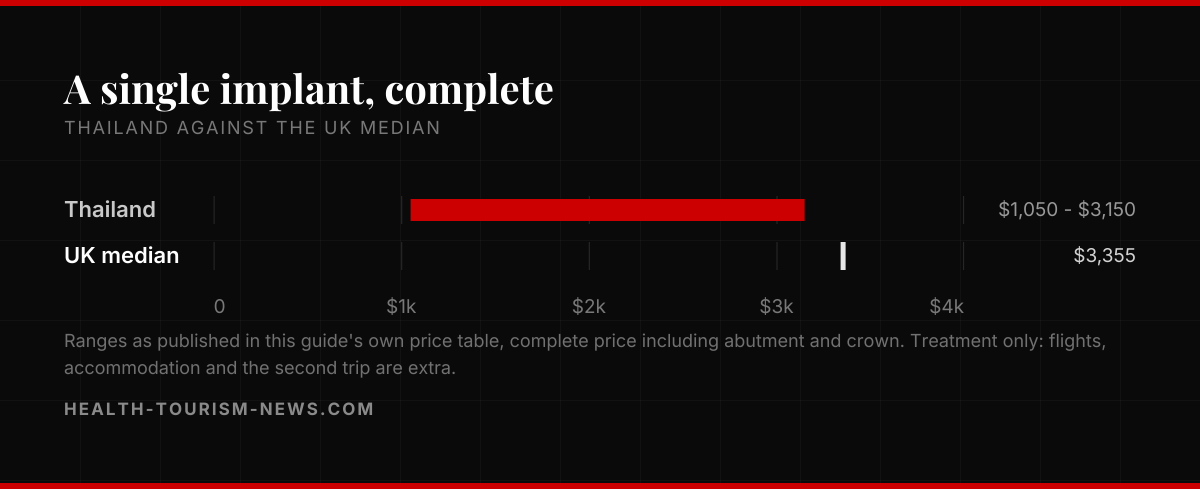
A dental implant in Thailand costs $1,050 to $1,950 complete with an economy fixture and $1,950 to $3,150 with a premium Swiss or Swedish one, against a UK median of $3,355. Read those numbers twice before booking, because the arithmetic of an eleven-hour flight changes what they mean. Thailand’s real market is not the Briton saving on a single tooth; it is the full-mouth patient, the Australian who is nine hours from Bangkok, and anyone whose treatment plan is large enough to absorb two long-haul returns. This guide sets out the published prices, the hospital badges and what they cover, the licence register that actually works, and the timetable no marketing shortens.
Health Tourism News is a trade publication and sells no treatment. Prices below are attributed to their publishers, and their limitations are stated where they matter.
How much are dental implants in Thailand?
Thai clinics price by implant brand, and most print the whole tooth in one figure. Complete single implants with Korean systems ran 35,000 to 65,000 baht, $1,050 to $1,950, across ten providers publishing prices in mid-2026, names on file. Premium Swiss and Swedish systems ran 65,000 to 105,000 baht, or $1,950 to $3,150. One exception matters: two providers, one of them the hospital-branded operation on the panel, headline the implant body alone and charge the crown separately at 25,000 to 30,000 baht more, so their cheaper-looking figures are not the price of a tooth. Set against the UK median of $3,355 from a 1,125-practice comparison, an economy Thai tooth costs roughly a third to a half of the British one, and a premium tooth runs from three fifths to nearly the full British price. That saving is real and smaller than the brochures say, and the flight has not been bought yet.
| Offer | Price | Notes |
|---|---|---|
| Single implant, complete, economy brands | $1,050 - $1,950 THB 35,000 - 65,000 | crown included |
| Single implant, complete, premium brands | $1,950 - $3,150 THB 65,000 - 105,000 | Swiss and Swedish systems |
| Implant body only, headline figures | $870 - $1,770 THB 29,000 - 59,000 | crown adds $750 - $900; not a tooth price |
| All-on-4, per arch, premium brand | $9,900 - $13,200 THB 330,000 - 440,000 | mainstream published band |
| All-on-4, per arch, budget Korean | $6,300 THB 210,000 | one provider |
| UK single implant, median | $3,355 £2,500 | 1,125-practice comparison |
| UK All-on-4, per arch | $16,100 - $33,500 £12,000 - £25,000 | per jaw, 2026 |
Ten Thai providers’ published rate cards, held on file. Full methodology under Sources.
Whether a home insurer will cover a complication traceable to treatment bought abroad is not settled, and is worth asking before booking rather than after.
Full-mouth prices and the off-page extras
Full-arch work is what the long flight is for, and the Thai lists price it openly. All-on-4 with a mainstream premium brand runs $9,900 to $13,200 per arch, a budget Korean version appears at $6,300, and zirconia-heavy configurations reach $16,500. All-on-6 spans $8,400 to $19,800 by brand, names on file, and fixed bridges on four to six implants with a full set of crowns run about $10,450 to $18,750. The published floors marked “from” sit below all of that and behave like floors. What the cards mostly omit is the ground work: only two of the ten providers publish bone graft or sinus lift prices at all, at $150 to $1,500 per procedure, and the rest bill them case by case after the scan. A grafting-heavy mouth can add four figures to a quote that looked complete, which makes the pre-travel scan review and an all-in figure in writing before the deposit the two documents worth insisting on. The hardware itself holds up in the pooled reviews, with implant survival at 99.8 per cent past two years and the definitive prosthesis fracturing in 23.2 per cent of patients, so the bridge warranty matters more than the titanium’s.
Is Thailand safe for dental work?
The procedure’s numbers do not change at customs. Ten-year implant survival runs about 93 to 96 per cent in the pooled reviews, about one patient in five develops peri-implantitis over the following years, and Thailand publishes no country-specific implant outcomes to sharpen either figure. The infrastructure argument is genuine. Thailand has run a state medical-hub policy since 2004, its national hospital-accreditation body is statutory and its standards internationally benchmarked, and the Foreign Office’s own advice states that private hospitals in Thailand are of a high standard, adding that they can be expensive and that public clinics do not always meet UK standards outside Bangkok. The counterweight comes from Australia, Thailand’s biggest critic and customer at once. The Australian Dental Association warns that overseas elective treatment carries risks of long-term problems that are difficult to resolve at home, and its president’s 2024 examples, crowns that do not fit and decay left behind, describe the aftermath its members treat. Neither side of that argument names Thailand as unusual. The record supports choosing carefully, not staying home.
Hospital or clinic?
Thailand sells hospital-grade dentistry, and the phrase needs unpacking. Accreditation, whether the Thai national scheme or the international one on the famous Bangkok hospitals, certifies the organisation: its infection control, its medication systems, its governance. It does not certify the dentist who places your implants, it expires and must be renewed, and this guide could not confirm any panel clinic’s current international accreditation against the accreditor’s own directory. The market has a second wrinkle: the big accredited hospital groups publish no implant price lists at all, quoting privately above the clinic market, so the transparency this page relies on lives almost entirely in standalone clinics. The honest reading is that a hospital badge buys systems, not hands, and the verification that matters most sits with the individual dentist regardless of the building.
How to check a Thai dentist
Here Thailand beats every destination this series has covered. The Dental Council, the profession’s statutory regulator since 1994, runs a public register on its English-language site: enter the dentist’s first and last name and it returns whether that person holds a current licence to practise. Only licensed, living dentists appear, so a name that returns nothing is either misspelled or unlicensed, and a clinic that cannot supply a name the register recognises has answered the question. Two refinements complete the check. The register shows licence status rather than specialty, so ask separately for the surgeon’s board credential, oral and maxillofacial surgery or periodontics for the placement and prosthodontics for the restoration, and ask who does which part. And treat the word implantologist as decoration, because it is a protected title nowhere, Thailand included. The register check takes minutes. The specialty question takes one email.
Verifying a clinician abroad is harder than any checklist admits.
Start with the register, because unlicensed is not an option under any circumstances. Then search properly. What I look for is a role in a specialty board or a medical society: a committee seat, an office held, a named position. Those are conferred by peers, they are hard to buy, and they are visible from outside the country.
Awards and prizes are the opposite. A large share of them are pay to play. I would disregard them, and a clinic that displays several is telling you how it competes.
One more, which sits apart from skill. Look at how the clinician presents themselves and ask whether you would feel comfortable in a room with them. That predicts nothing about surgical ability. It predicts whether you will raise a concern early or sit on it, and patients who sit on concerns do worse.
The long-haul timetable
Distance is Thailand’s honest tax. Implant treatment needs two visits, a first of three to seven days for placement and a second of two to three days for the final teeth, with osseointegration filling three to six months between them, and the clinics’ own rate cards label the work two trips. Immediate-load full-arch protocols compress the first stage into one longer visit of seven to fourteen days and send the patient home on a temporary bridge; the permanent set still belongs to the second trip. For a Briton the flights run $445 to $710 return by season at eleven to thirteen hours each way, twice, which is why the comparison content aimed at UK patients keeps concluding that Turkey does the same work four hours away for less, particularly on full arches. For the Australian who is nine hours from Bangkok, and for anyone combining a full-mouth restoration with the holiday the savings fund, the maths lands differently. The trip works when the treatment is large enough to carry it.
If something goes wrong at home
The warranty flies worse than the patient. Thai clinic guarantees, where published, run to two years and are honoured in Thailand, which means a failed crown costs a return flight before it costs nothing. At home, the practical questions are the ones the Australian association tells its members’ patients to ask in advance: which implant system, is it stocked locally, and will the records travel in English with the fixtures’ serial numbers. A mainstream brand can be serviced almost anywhere; an unbranded fixture can mean removal and replacement at domestic prices. Legal recourse in Thailand exists through the regulator’s discipline, a consumer board and the civil courts, and for a foreigner it runs in Thai, on Thai timescales, for damages set well below UK or Australian norms. The General Dental Council’s advice to brief your own dentist before travelling is the aftercare plan that costs nothing, and the paperwork signed before the deposit is the rest.
What this means for patients
Thailand’s offer is infrastructure, transparency where the clinics are concerned, and the best licence register in the business, priced at a genuine but not maximal discount and gated by the longest flights in this series. A complete economy tooth at $1,050 to $1,950, roughly a third to a half of the British one, rewards the full-mouth patient whose plan is large enough to amortise the travel, and punishes the one chasing a single cheap crown across an eleven-hour flight. Patients who compare complete prices, make the register check that takes minutes, get the graft budget in writing after the scan and plan both trips from the start are buying what the rate cards describe. The beach is a recovery room, not a discount.