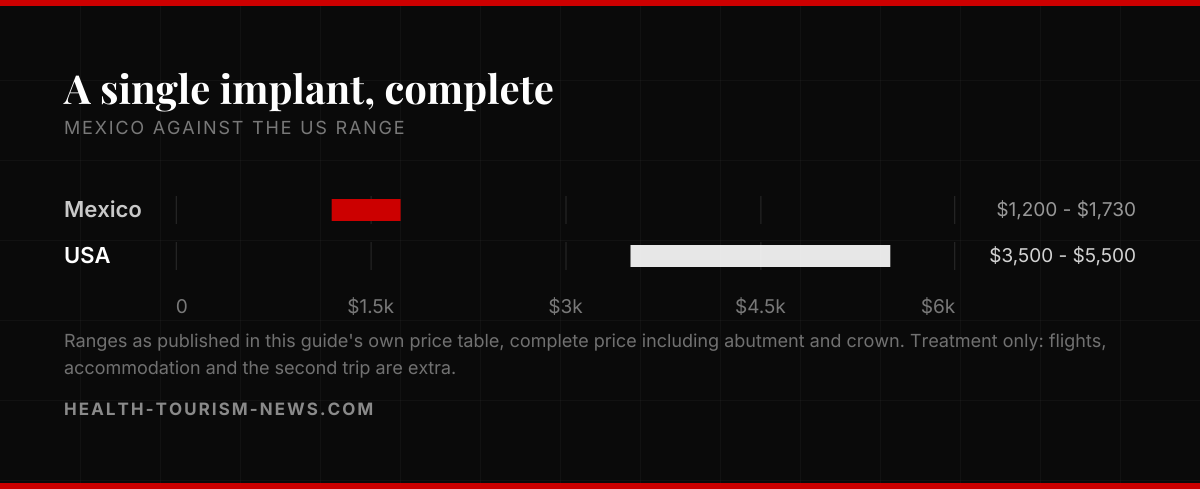
A single dental implant in a Mexican border town is advertised from $750, and the figure is real without being the price of a tooth. Add the abutment and the crown that turn a titanium post into something to chew with and the complete tooth runs about $1,200 to $1,600 in the border towns, against $3,500 to $5,500 for the same finished tooth in the United States. The saving is genuine at every step, and so is the pattern in the small print. The CareQuest Institute counts 69 million American adults without dental insurance, and its 2026 survey found 9.6 million who have crossed a border for dental care at some point in their lives. This guide sets out the published prices, the arithmetic the advertisements leave out, and the checks that separate a licensed surgeon from a weekend certificate.
Health Tourism News is a trade publication and sells no treatment. Prices below are attributed to their publishers, and their limitations are stated where they matter.
How much do dental implants cost in Mexico?
The advertised number and the finished tooth are different products. Across ten Mexican providers publishing prices in mid-2026, names on file, a standard titanium implant ran $750 to $890 in the border towns. That figure buys the surgical post alone. The abutment and the crown add $450 to $720 on the same price lists, so the complete tooth lands between $1,200 and $1,610 in the border towns, with premium Swiss and Swedish systems from $950 to $1,350 before restoration. A Mexico City clinic that quotes the complete pathway in one line prints $1,730. None of this is hidden. It sits in separate rows of the same table, and a patient comparing headline figures against a US quote is comparing a part against a whole.
The US anchor makes the honest gap plain enough without inflation. Consumer guides put a complete single implant at $3,000 to $6,000, with most patients between $3,500 and $5,500. The complete tooth at $1,200 to $1,730 is roughly a third of the American price, a saving that survives the small print. What does not survive is the sub-$900 tooth of the advertisements.
| Offer | Price | Notes |
|---|---|---|
| Single implant, implant only | $750 - $890 | border-town lists; the post, no tooth on it |
| Single implant, complete | $1,200 - $1,610 | implant, abutment and crown; border towns |
| Single implant, complete, Mexico City | $1,730 | one provider, fixed pathway price |
| All-on-4, per arch | $8,110 - $9,900 | border towns, brand-tiered |
| All-on-4, per arch, Cancun | $10,000 - $13,500 | resort packages, travel services bundled |
| US complete single implant | $3,500 - $5,500 | consumer-guide range |
| US All-on-4, per arch | $25,000 - $35,000 | as reported by comparison guides; the largest chain publishes no flat prices |
Ten Mexican providers’ published prices, held on file. Full methodology under Sources.
Whether a home insurer will cover a complication traceable to treatment bought abroad is not settled, and is worth asking before booking rather than after.
All-on-4 prices and the per-arch arithmetic
Full-arch work is where the sums grow and the labels blur. Border-town All-on-4 runs $8,110 to $9,900 per arch depending on the implant brand, with Cancun and Mexico City lists at $10,000 to $13,500. All-on-6 runs $10,000 to $13,310 on the same lists, names on file, and All-on-8 reaches $14,300. Two checks belong on every quote. The first is whether the figure covers one arch or two, because a full mouth is roughly double the per-arch price, and one provider’s list carries a $19,200 both-jaws figure two rows under an $8,900 arch. The second is what the price includes, since bone grafts are quoted per unit, per cubic centimetre or per site at $200 to $600, and a sinus lift runs $300 to $1,500 on the same lists. Offers well below the market floor exist, one at roughly half of it, and they tend to describe a surgical phase rather than a finished set of teeth.
The clinical record on the method itself is reassuring on the hardware and blunter about the prosthesis. A pooled review found the implants surviving in 99.8 per cent of cases past two years, while 23.2 per cent of patients fractured the definitive prosthesis at some point. Teeth on four implants work; the acrylic and zirconia on top wear like anything else load-bearing.
Is it safe to get dental implants in Mexico?
No registry publishes Mexico-specific implant outcomes, so the honest answer starts with the international numbers and adds the local facts. Long-term studies put ten-year implant survival at about 93 to 96 per cent, and one twenty-year analysis found 92 per cent among patients it could still follow, falling to 78 per cent when dropouts were counted against it. About one patient in five develops peri-implantitis, the gum inflammation that threatens the fixture, over the years that follow. Those figures travel with the procedure, not the country.
The country-specific risk is regulatory. The Centers for Disease Control states that dental care is the most common form of medical tourism among US residents, and its Yellow Book lists the documented hazards of poor infection control: hepatitis B and C, HIV, bloodstream and surgical-site infections. A 2018 study in Globalization and Health found most Los Algodones dentists were not members of the local professional association despite guidelines requiring it, and described a market whose price competition can reward corner-cutting. The State Department’s advisory for Baja California sits at level three, citing crime and kidnapping in areas tourists rarely enter, and its only instruction for Los Algodones is that its own employees reach the town through the Andrade border crossing from the US side. The record supports care in choosing, not alarm at the map.
Which city is best for dental work in Mexico?
Three corridors serve three kinds of patient. Los Algodones, a town of about 6,000 people with roughly 500 dentists in the peer-reviewed count and more than a thousand in the New Yorker’s 2025 reporting, is a walk-across market a short drive west of Yuma, Arizona. Parking on the US side costs about $10 a day, the border gate closes at ten, and the clientele is heavily retired and returning. It is the cheapest corridor and the most crowded. Tijuana serves San Diego through the San Ysidro crossing, with clinic-issued medical passes that put patients in a fast lane, about $77 for a 48-hour pass, and its bigger labs court patients wanting premium brands. Cancun is the fly-in option, some 20 to 30 per cent dearer per arch, and its packages bundle hotels, transfers and sedation into a resort fortnight. Flights from the American Midwest run about $340 to $430 return. Mexico City prices for residents rather than tourists and quotes the complete tooth in one figure. The best city is the one whose logistics a patient can actually repeat, because implant work means coming back.
How to check a dentist in Mexico
Mexican dentists are licensed federally. Every practising dentist holds a cedula profesional issued through the education ministry, and the ministry runs a free public register that can be searched by full name or licence number, in Spanish, listing the profession, the issuing university and the year, a check that takes minutes. That is the floor, and it is worth standing on. The ceiling matters more for surgery. A general dental licence says nothing about implant training, and a 2023 review in the Mexican dental association’s journal found that only 17 institutions in the country are authorised to teach an implant specialty, that no official standard governs implant placement at all, and that short diploma courses carry no legal weight for practice. The verifiable surgical specialties are periodontics and maxillofacial surgery, which carry a second specialty licence a patient can ask to see. Board certification through the association’s certification council sits on top of the licence system and remains voluntary. A clinic’s own registration is a lighter document than it sounds: a dental office files a notice of operation with the health regulator rather than earning an inspected licence, and no public register of clinics exists to check. Two licence numbers, the implant brand in writing and the association certificate are the documents that carry weight.
The two-trip timetable
Implant treatment is a calendar, not an appointment. A first visit runs five to seven days for radiographs, extractions and placement, and full-arch patients fly home on a temporary bridge fitted within about 48 hours. Then the jaw takes over and heals on its own schedule. Osseointegration, the fusing of jawbone to titanium, needs three to six months and cannot be hurried by any pricing tier. The second visit of five to ten days fits the permanent teeth once those three to six months have passed. Same-week immediate loading is legitimate when the bone passes torque and stability testing, and the umbrella reviews find no meaningful survival difference when it does, but what is fitted in a week is the temporary. Clinics marketing teeth in a day are describing the bridge a patient leaves with, not the teeth they will keep. Snowbirds wintering near the border can fold the interval into a season, and a patient flying from Chicago should price two trips from the start.
If something goes wrong at home
The fear on the forums is that no American dentist will touch foreign work. American dentistry’s own rules say otherwise. In its ethics guidance, the American Dental Association tells members to treat a returning patient “in the same manner” as any transferred one, and it warns that refusal can raise patient-abandonment concerns, with emergencies carrying their own duty of care. What remains is a narrower and more expensive gap. A dentist at home has no records, no radiographs, no warranty on another surgeon’s fixture and possibly no componentry for an unfamiliar implant system, so repair often means replacement at American prices. Insurance rarely bridges it. Most US dental plans stop at the border, though some PPO schemes reimburse 50 to 80 per cent of out-of-network work against an itemised receipt with standard procedure codes, which is worth requesting in English before leaving the chair. Medicare does not cover routine dental care abroad.
Recourse in Mexico exists and is voluntary in the way that matters. Mexico’s national medical arbitration commission hears complaints without charge and nothing in its framework excludes foreigners; dental claims are reportedly its most numerous category, arbitration binds only when the clinic agrees, and many disputes end at conciliation instead. A separate consumer agency runs a complaint channel from abroad for the commercial side. Practical protection is contractual: the written warranty, one to three years on most tourism lists and honoured in Mexico rather than at home, and the quoted price signed before the deposit. American judgments are close to unenforceable across the border, and American courts are, for nearly all purposes, out of reach.
The first call a patient makes is to their own doctor, not the clinic abroad.
That is the pattern I saw repeatedly. Local care is faster, closer and, if they are insured, cheaper. The clinic gets contacted second, if there is a direct line to contact. Some engage. Many go quiet or play for time and suggest the patient seek immediate care at home, which is where they already are.
Being offered a return trip sounds like a remedy and often is not one. Can the patient afford another flight? Are they fit to take one? A warranty that requires travel is worth least to the patient who most needs it.
Formal mechanisms matter, and they do not look after anyone. What resolves these cases is a provider who honours a guarantee by facilitating and funding the return, or insurance that covers the fallout. Both are chosen at booking, not after.
What this means for patients
The finished tooth for a third of the American price is a real offer, and roughly half a million Americans took some version of it in 2019, the most recent year the CareQuest survey counted. The price to compare is the complete one, implant, abutment and crown, at $1,200 to $1,730 against $3,500 to $5,500 at home. The checks are a register search that takes minutes, a second specialty licence for the surgery itself, and the written warranty honoured in Mexico rather than at home. A calendar of two trips follows from a jaw that heals on its own schedule. Patients who buy the finished tooth, verify the two licences and price the return flight are taking the deal the numbers describe. Patients who buy the advertisement are buying a titanium post.