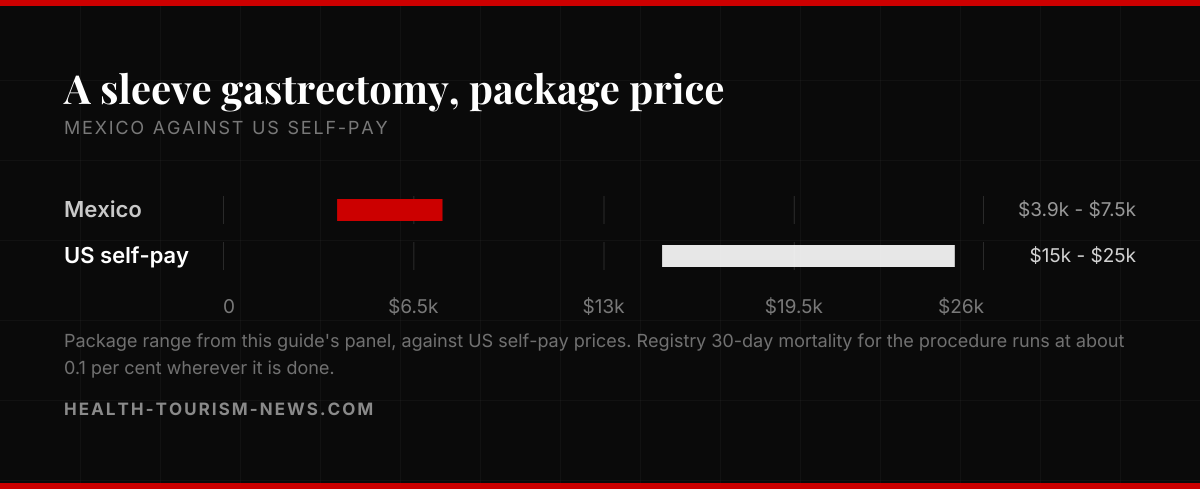
A gastric sleeve in Mexico costs $4,150 to $5,000 as a typical all-inclusive package, with the wider market running from about $3,900 to $7,500, against $15,000 to $25,000 as a self-pay procedure in the United States. That saving is the reason the border city of Tijuana became the busiest bariatric-tourism hub in the Americas, a short drive from San Diego. It is also not the whole story, because this is major surgery with a measurable death rate, and the harm on record in Mexico has a pattern worth reading before booking. This guide sets out the published prices, the registry numbers behind the safety question, and the checks that separate a licensed hospital from a border mill.
Health Tourism News is a trade publication and sells no treatment. Prices below are the figures providers and platforms publish, attributed, and their limits are flagged where they matter.
How much does a gastric sleeve cost in Mexico?
The published all-inclusive packages in 2026 ran from about $3,900 to $7,500, with the typical Tijuana offer at $4,150 to $5,000 and promotional floors near $3,900. The figure covers the operation and anaesthesia, one to three hospital nights, pre-operative labs, medications, transfers and usually a hotel night or two, priced in US dollars for an overwhelmingly American market even though the domestic currency is the peso. As a self-pay procedure in the United States the same operation commonly runs $15,000 to $25,000, so the gap that draws patients south is a factor of three to five.
| Offer | Price | Notes |
|---|---|---|
| Gastric sleeve, promotional floor | from $3,900 | lowest advertised, fewest inclusions |
| Gastric sleeve, typical package | $4,150 - $5,000 | one to three hospital nights, transfers, hotel |
| Gastric sleeve, higher-tier package | $5,500 - $7,500 | more inpatient nights, fuller aftercare contact |
| US self-pay, same operation | $15,000 - $25,000 | hospital and surgeon fees |
Tijuana and Mexican providers’ published package prices, held on file. Full methodology under Sources.
Lowest price and safest choice are rarely the same package. Inclusions that matter most for a bariatric operation, the hospital nights and the aftercare, are the ones trimmed to reach a headline price, so the promotional floor and the typical package are not the same product at a different price. They are different products.
Whether a home insurer will cover a complication traceable to treatment bought abroad is not settled, and is worth asking before booking rather than after.
Is a gastric sleeve in Mexico safe?
The operation and the market are two different safety questions, and conflating them is where patients come unstuck. As a procedure, the sleeve is well established and low-risk in competent hands, with registry mortality near 0.1 per cent and staple-line leaks reported at 0.17 per cent in one large registry and about 1.5 per cent in a systematic review of more than 40,000 patients. Those numbers hold in a properly equipped hospital anywhere. The market question is Mexico-specific and pointed. In 2019 US health authorities traced an outbreak of multidrug-resistant infection among American patients to weight-loss surgery performed at clinics in Tijuana, a cluster serious enough to warrant a formal warning. Academic surgical centres on the US side of the border report a steady flow of patients returning with complications of bariatric tourism, the staple-line leak prominent among them. A consistent pattern runs through the harm: it concentrates in the high-volume, low-cost clinics that compete on the headline price, not in the licensed hospitals with board-certified surgeons. Buying safety in this market means refusing the cheapest version of it.
What is the death rate for a gastric sleeve in Mexico?
No registry publishes a Mexico-specific figure, so the honest answer borrows from the international data. Thirty-day mortality after sleeve gastrectomy runs at roughly 0.1 per cent in collaborative registry studies, and England’s hospital data put it near 0.07 per cent across more than 41,000 primary bariatric operations. Those are low numbers, and they describe the operation rather than any particular clinic. The death rate is a property of a system, the surgeon, the hospital, the intensive-care backup and the follow-up, and the border deaths that reach the press share the opposite of that system: rushed assessment, minimal inpatient time and a patient travelling home before a complication can declare itself. That registry rate is achievable in Tijuana in the right hospital. It is not a promise the market makes on a patient’s behalf.
Who qualifies for a gastric sleeve?
Mexican clinics advertise surgery from a body mass index of 30, and some lower. US and international surgical bodies set the bar higher, considering surgery from a BMI of 35, or from 30 where a weight-related condition such as type 2 diabetes is present. The gap is not a technicality. A patient a home surgeon would ask to lose weight first, or to try medical therapy, can be booked directly by a clinic paid to operate, and the weaker the candidacy the more the aftercare and the assessment matter. Weight stability and a genuine pre-operative work-up are part of a safe sleeve, not obstacles to it.
How to check a Mexican hospital and surgeon
Verification in Mexico runs through two names worth learning. The facilities are licensed by COFEPRIS, the federal health-risk regulator, and a bariatric operation belongs in a COFEPRIS-licensed hospital with intensive care on site rather than a same-day surgical suite. Surgeons hold specialty certification, and a bariatric surgeon should carry general-surgery board certification through the Mexican Council of General Surgery, with bariatric subspecialty certification or membership of the Mexican college for obesity surgery layered on top. Ask for the surgeon’s name and certification, the named hospital and its licence, and the surgeon’s annual sleeve volume and leak rate in writing. A clinic that answers those plainly is the standard to hold out for; one that routes every enquiry through a coordinator and will not name the operating surgeon is the pattern the complications track. None of these checks measures a single outcome, but together they separate the licensed hospital from the border mill more reliably than any before-and-after gallery.
Recovery, and the crossing home
Tijuana markets its proximity as a safety feature, and there is something to it: a patient who can drive back across the border reaches home care faster than one flying home from across an ocean. Early days still matter most. Serious complications, a leak above all, tend to show in the first week, which is the argument for more hospital nights before discharge rather than the earliest possible checkout. Patients flying rather than driving should weigh aviation guidance, which sets around ten days after abdominal surgery, against the discharge schedule, because clot risk rises on longer flights. The convenience that makes Tijuana attractive is real, and it is not a substitute for the supervised days that catch the problems.
Aftercare for life, and who provides it
A sleeve is not an event but a lifelong regime, and the regime is the part hardest to sustain after surgery far from home. Lifelong vitamin supplementation and annual blood monitoring are standard, and after self-funded surgery abroad they fall to the patient to arrange and pay for. US insurers frequently exclude complications of elective surgery obtained overseas, so a leak or a revision treated at home can carry a bill the saving never accounted for. An honest budget for a Mexican sleeve adds the private aftercare and the possibility of a complication treated at US rates to the package price. Patients who plan and fund that follow-up keep the weight loss the operation makes possible; patients who treat the surgery as the finish line are the ones the long-term data lets down.
If something goes wrong at home
Recourse against a Mexican clinic exists in principle and is hard from a distance in practice, running through the Mexican civil and regulatory system in Spanish. The formal quality signal is the COFEPRIS licence and the surgeon’s certification, which is why they are worth confirming before rather than after. On the US side, emergency departments treat urgent complications without question, but routine revision and aftercare of elective surgery bought abroad are the patient’s own responsibility, and insurers may decline the complications too. Documents that travel home decide what the next surgeon can do: the operative note, the discharge summary and the surgeon’s contact for the questions a home team will have. Prevention, in the checks above, is worth more than any remedy once a patient has flown or driven home.
What this means for patients
Arithmetic favours Mexico by a wide margin, and the margin is exactly why the market rewards care. The sleeve at $4,150 to $5,000 against $15,000 to $25,000 leaves room to choose the licensed hospital over the cheapest floor, to pay for the extra hospital nights, and to fund the lifelong aftercare that decides the result. The procedure’s own death rate is low, near 0.1 per cent in the registries, and harm on record in Tijuana has clustered in clinics that cut the price by cutting the safeguards. Patients who verify the hospital and the surgeon, refuse the promotional floor, and budget the aftercare and the risk of a complication treated at home are buying a well-established operation at a genuine discount. The saving is real for patients who spend part of it on safety.