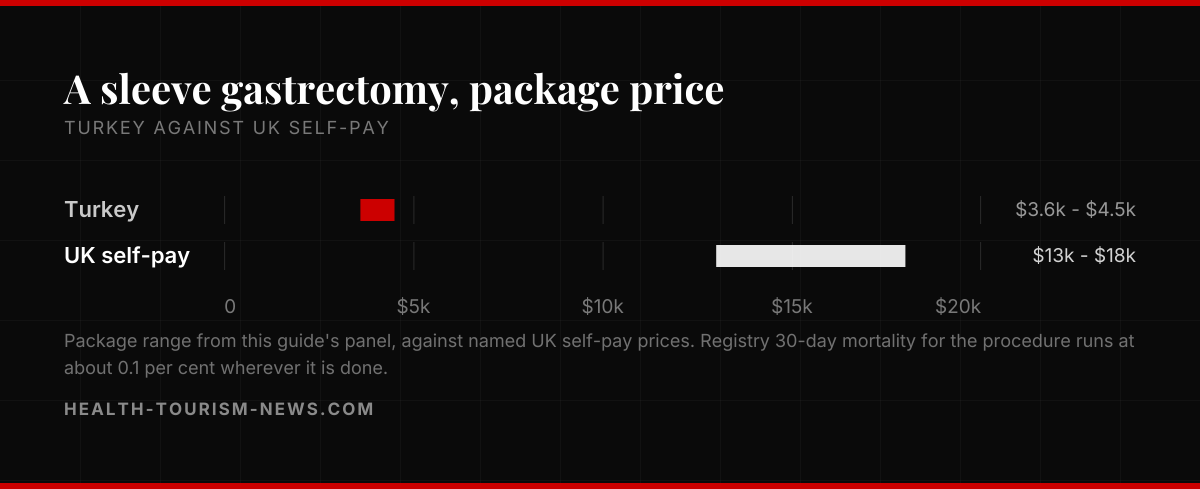
A gastric sleeve, or sleeve gastrectomy, costs between $3,600 and $4,500 in Turkey as an all-inclusive package on published 2026 lists. Named UK hospital groups publish self-pay fees of $13,000 to $18,000 for the same operation. The saving is real, and so are the stakes: this is major bariatric surgery with a measurable death rate, sold on a schedule that puts patients on a plane inside a week. This guide sets out the published prices, the registry numbers behind the safety question and the checks that belong in writing before the deposit.
Health Tourism News is a trade publication and sells no treatment. Prices below are attributed to their publishers, and their limitations are stated where they matter.
How much does a gastric sleeve cost in Turkey?
Published all-inclusive packages ran from $3,600 to $4,500 in mid-2026, with $3,850 the median. The figures come from the list prices of nine Turkish providers in Istanbul, Antalya and Izmir, held on file. Promotional and basic-tier offers push the floor towards $2,900, and the bundle behind those figures covers the laparoscopic sleeve gastrectomy, one to four nights in hospital, pre-operative tests, transfers and a period of remote dietitian support. Aggregator listings run wider, from about $3,200 to $5,900. One aggregator quotes premium hospitals from roughly $6,100, though other aggregators list premium hospitals nearer $4,000, so a marketplace price depends heavily on the hospital behind it.
The UK baseline is published by the sellers themselves. Self-pay fees at named UK hospital groups ran from £9,680 to £13,425 ($13,000 to $18,000) on published and third-party-reported 2025-26 lists, names on file. One major group’s published sleeve gastrectomy price rose from £9,494 in archived listings to £10,495 in 2026, at least one group publishes entry prices near £8,800, and a wider UK market range of £8,000 to £12,000 circulates from comparison services on 2025 data. Set against those fees, the Turkish median package is roughly a fifth to a third of the UK price before flights.
| Offer | Price | Notes |
|---|---|---|
| Turkey panel, all-inclusive package | $3,600 - $4,500 £2,700 - £3,370 | nine providers, lists on file |
| Panel median | $3,850 £2,850 | promotional offers excluded |
| Promotional and basic-tier floor | from about $2,900 | struck-through promos, surgery-only tiers |
| Platform listings | $3,200 - $5,900 | robotic surgery quoted higher |
| UK named self-pay | $13,000 - $18,000 £9,680 - £13,425 | published and third-party-reported |
Nine Turkish providers’ published prices, held on file. Full methodology under Sources.
Whether a home insurer will cover a complication traceable to treatment bought abroad is not settled, and is worth asking before booking rather than after.
What a gastric sleeve Turkey package includes, and what it leaves out
The bundle is broadly consistent across published offers: the laparoscopic operation and anaesthesia, one to four nights in a private hospital room, most commonly two or three, pre-operative blood tests and scans, airport and clinic transfers and an interpreter. Most packages add a starter supply of vitamins and protein and a year or more of remote dietitian contact. Hospital time varies more than anything else in the bundle. Published packages range from one night with hotel recovery to four nights of inpatient care, and the difference matters for an operation whose most serious early complication is checked for in hospital. Flights sit outside the package on nearly every offer, though one provider bundles them in and another includes travel insurance.
Two absences deserve attention in writing before the deposit. No package reviewed for this guide publishes a revision policy, the terms under which a failed or complicated sleeve gastrectomy is reoperated, and none prices an extended stay if a complication delays the flight home. The pre-operative liver-reduction diet, typically one to four weeks of a strict low-calorie regime, happens at home at the patient’s own cost.
The full cost of the trip
Return flights from London to Istanbul started at about £85 ($115) on Skyscanner data in July 2026, and most patients travel with a companion, whose fare and time join the bill. Hotel nights sit inside most packages, so the realistic all-in figure for a median package lands around $4,300 to $4,600 with two economy fares and incidental spending.
The honest budget adds the aftercare line. NHS emergency care covers a returning patient whatever went wrong, but routine follow-up of self-funded bariatric surgery is a different matter. One integrated care board policy, current to a 2028 review date, states that such care is not routinely commissioned and that GP practices are not expected to provide or arrange it. Annual blood monitoring and dietitian support for life then fall to the patient privately, an open-ended cost no package mentions.
What is the death rate for gastric sleeve surgery in Turkey?
No registry publishes a Turkey-specific death rate, so the honest answer starts with the international numbers. A global multicentre study of 3,983 sleeve gastrectomy patients recorded 30-day mortality of 0.1 per cent, and England’s hospital data across 41,241 bariatric operations put in-hospital mortality at 0.07 per cent. Both figures describe registered, audited surgical programmes, and both are low.
The UK record sits beside them. A BBC investigation reported in March 2023 that seven UK patients had died after weight loss surgery in Turkey since 2019. A Foreign Office minister told Parliament in March 2024, recorded in Hansard, that 28 British nationals had died in Turkey after elective medical procedures of all kinds since 2019. Neither number converts into a rate, because nobody counts how many Britons have the operation each year, and the two counts measure different things. Coroner findings and surgeon reports point at the package model rather than the country: assessment compressed into a remote consultation, discharge within days, a fit-to-fly letter inside a week and no follow-up on return. One inquest reported in 2025 concerned a Norfolk woman who died weeks after her sleeve in Izmir, after multiple perforations. The coroner found the operation had not been done properly.
Is a gastric sleeve in Turkey safe?
Registry data put the staple-line leak, the complication patients fear most, at 0.17 per cent within 30 days across 692,554 sleeve gastrectomy operations in one six-year study. A systematic review across 40,653 patients put the overall rate at 1.5 per cent, ranging from 0.7 to 2.7 per cent by technique. Timing is the point for a medical traveller. Leaks and other serious complications can surface days or weeks after discharge, inside the window when a package patient has already flown home, and the deaths in recent UK inquest reporting followed complications that developed after the first days of recovery.
The British Obesity and Metabolic Surgery Society strongly advises UK residents to be cautious about bariatric surgery abroad, and lists unknown surgical quality and poor or non-existent follow-up among its stated concerns. Its guidance also notes that weight loss surgery needs at least two years of structured support and lifelong annual reviews, which is the part no seven-day package can contain.
None of this is an argument that Turkish bariatric surgery is unsafe as a category. Turkey has high-volume centres, university hospitals and surgeons carrying international accreditations, and the surgical literature associates high-volume centres with lower complication rates. Done well, the operation also works. A systematic review across 2,713 patients reported excess-weight loss of about 58 per cent maintained at five years, with improvement or remission of type 2 diabetes in 78 per cent. Risk concentrates at the cheapest end of the package model, where assessment, inpatient time and follow-up are the costs that got cut.
Who qualifies for a gastric sleeve?
NICE guidance published in January 2025 asks NHS referrers to consider surgery at a body mass index of 40 or more, or from 35 with a significant weight-related condition. Thresholds drop by 2.5 for people from several ethnic backgrounds at higher cardiometabolic risk. Global surgical bodies moved lower in 2022, recommending surgery from a BMI of 35 with or without complications and considering it from 30 with metabolic disease. Turkish packages advertise to a BMI of 30 and sometimes lower, which aligns with the international floor but skips the NHS demands on prior weight management and long-term follow-up.
A newer comparison is pharmaceutical. Reporting through 2024 and 2025 tracked weight-loss injections pulling demand away from bariatric surgery in the United States, with surgical volumes falling by roughly a third from 2022 while GLP-1 prescriptions more than doubled. Wegovy and Mounjaro are reversible and stoppable, and a sleeve gastrectomy is permanent, which is a fair first question to settle with a specialist before any deposit crosses a border.
How to find the best gastric sleeve hospital and surgeon in Turkey
Bariatric surgery in Turkey is the work of general surgeons, and while no protected title of bariatric surgeon exists, a Ministry of Health regulation updated in November 2025 requires an obesity-surgery practice certificate, earned through logged case numbers and Ministry training. The regulation also confines the operation to authorised obesity units with set staffing and intensive-care rules, so the certificate and the unit are both things you can check. Verification runs through the state’s own records. The Ministry of Health operates a Doctor Information Bank on the e-Devlet portal covering a physician’s specialty and diplomas, and clinics can be asked to pull a surgeon’s record up on the spot. The Turkish Medical Association register, through the provincial chamber, is checkable the same way. The registers confirm legitimacy rather than skill, and no Turkish source publishes surgeon-level volumes or complication rates, so case numbers remain a question for the clinic, in writing before the deposit.
Where the operation happens matters as much as who performs it. A sleeve gastrectomy is major inpatient surgery under general anaesthesia and belongs in a licensed hospital, not an outpatient clinic with a transfer arrangement, and reputable centres describe on-site intensive care and 24-hour emergency cover. Turkey’s health-tourism authorisation layer, covered in this publication’s dental guide, applies here too: the Ministry of Health publishes lists of authorised facilities, and the register check takes minutes. The voluntary badges add a further signal and deserve a fair reading. The biggest badge in this field reviews a centre’s equipment, care pathways, staffing and data collection through an outside audit. It is voluntary, its outcome data are self-reported by the programmes, and it regulates nobody. Treat it as evidence of process investment rather than proof of results.
How long do you stay in Turkey, and when can you fly home?
Published packages schedule five to seven days in Turkey, with one to four nights of that in hospital. The UK Civil Aviation Authority’s passenger guidance allows flying about 24 hours after laparoscopic surgery, but that figure addresses trapped surgical gas and nothing else. The same guidance sets ten days after abdominal surgery, the honest anchor for an operation on the stomach, and clot risk rises with long-haul travel after any operation. Serious sleeve complications can present after the standard package has ended. This is why good clinics run a leak test before discharge. A fit-to-fly letter inside a week is a sales timetable rather than a clinical milestone, and the surgeon’s discharge checks, not the calendar, are what make it defensible.
It is worth being precise about where the pressure comes from, because the usual telling has it backwards. The flight date does not drive the clinical decision so much as expose who is willing to be driven by it. A clinic that sees an inflexible return booking and says so before taking the deposit, that asks the date to be moved or declines the case, is showing you exactly the judgement you are paying for. The pressure underneath is financial on both sides: extra nights cost the provider margin on a fixed-price package, and cost the patient money they may not have budgeted. So a clinic that accepts a tight ticket without remark has not solved that problem, it has decided who absorbs it. Ask what an extra three nights would cost and who pays, and treat a clinic that pushes back on your dates as the better sign.
Aftercare for life, and who provides it
NICE guidance specifies a minimum of two years of follow-up within the surgical service, with annual shared-care monitoring after discharge, and UK society guidance makes the reviews lifelong, with vitamins and minerals to match for life. UK society guidance sets the annual blood panel: full blood count, ferritin, B12 and folate, calcium and vitamin D among them. The framework assumes an NHS surgical team that a self-funded patient in Turkey never entered, and the funding position above leaves those who return to arrange the same checks on their own. A named aftercare plan at home, costed and in writing before the deposit, is the piece of the package the patient has to build alone.
If something goes wrong at home
The NHS treats emergencies from surgery abroad without question, and UK guidance tells doctors to care for returning patients rather than turn them away. Routine aftercare and revision surgery are where the funding line falls. Standard travel insurance excludes elective surgery and its complications, and cover bought for a surgery trip is a separate product rather than an add-on. In Turkey, complaints run through the Ministry of Health patient line SABIM on 184 and, ultimately, the Turkish courts. Foreign patients hold the same rights as citizens there, and face the same practical barriers pursuing a claim from abroad. Prevention, in the form of the checks above, remains worth more than any remedy afterwards.
What this means for patients
The arithmetic still favours Turkey after honest accounting, and honest accounting is the condition. A median package at $3,850 against $13,000 to $18,000 at named UK groups leaves room for a companion’s flights, for a named aftercare plan at home and for refusing any schedule that discharges faster than the surgeon can justify. Registry numbers for this operation are good. Risk lives in the package timetable, and the pattern in the deaths is consistent: rushed assessment, early discharge, a quick flight and nobody watching afterwards. The saving is real for patients who price the aftercare and the checks as part of the operation, because nobody else will.