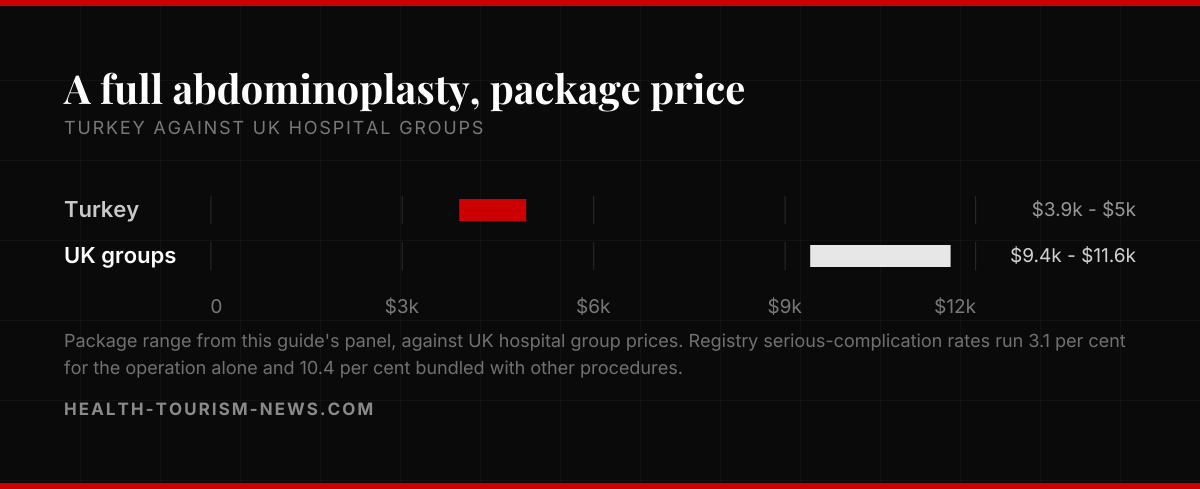
A tummy tuck in Turkey costs $3,900 to $4,950 as a published package, with $4,500 the panel median, against hospital-group averages of $9,400 to $11,600 in the UK. The saving is familiar; the risks on this page have a calendar attached. Registry data put serious complications at 3.1 per cent for abdominoplasty alone and 10.4 per cent when packages bundle it with liposuction and body contouring. Most clots after this operation strike within two weeks, either side of the standard flight home. This guide sets out the published prices, the bundling arithmetic and the checks that belong in writing before the deposit.
Health Tourism News is a trade publication and sells no treatment. Prices below are attributed to their publishers, and their limitations are stated where they matter.
How much is a tummy tuck in Turkey?
Published full-abdominoplasty packages ran from $3,900 to $4,950 in mid-2026, with $4,500 the median across seven providers publishing sterling or euro prices, names on file. Band tops reached $6,700 for extended and fleur-de-lis variants. Mini tummy tucks, the shorter operation below the navel, ran $3,100 to $4,050. Two providers publish genuinely fixed prices, one of them stating that the price does not move on arrival, which is worth more than a lower floor that does. Platform listings for abdominoplasty ran about $3,800 to $6,000.
The UK anchor comes from a dated comparison of named hospital groups: averages from £7,000 to £8,631 ($9,400 to $11,600), a national band of £6,500 to £9,500. One national chain’s own price list starts standard abdominoplasty from £9,995 ($13,400), names on file. Set against those, the Turkish median package is roughly a third to a half of the UK price before flights, a narrower gap than dental work but a five-figure sum on the bigger procedures.
| Offer | Price | Notes |
|---|---|---|
| Full abdominoplasty, Turkey panel | $3,900 - $4,950 £2,899 - £3,705 | seven providers, lists on file |
| Panel median | $4,500 £3,365 | floors and fixed prices; band tops to $6,700 |
| Mini tummy tuck | $3,100 - $4,050 £2,300 - £3,000 | below-navel only, little or no muscle repair |
| Tummy tuck with lipo 360 | ~$4,500 - $7,100 | clinic and platform lists, dollar-published |
| UK hospital-group averages | $9,400 - $11,600 £7,000 - £8,631 | named groups, January 2026 comparison |
Seven Turkish providers’ published prices, held on file. Full methodology under Sources.
Whether a home insurer will cover a complication traceable to treatment bought abroad is not settled, and is worth asking before booking rather than after.
Mummy makeovers and the bundling arithmetic
Combination is where this market makes its money and its headlines. A mummy makeover bundles the tummy tuck with breast surgery and liposuction in one anaesthetic, at $5,650 to $12,750 on published Turkish lists against $13,400 to $20,150 quoted in the UK. The discount is real and so is the arithmetic against it. A 2015 registry analysis of 25,478 abdominoplasties put major complications at 3.1 per cent for the operation alone. The rate rose step by step with each addition: 4.6 per cent with liposuction and a breast procedure, the classic makeover shape, and 10.4 per cent when liposuction and further body contouring joined it. The same registry found the clot share of those complications at about a fifth. Separate work reports the pulmonary embolism risk of cosmetic abdominoplasty at several times that of its functional equivalent.
The sales pattern reported by returning patients runs the other way: a quote for a tummy tuck that grows into a makeover after arrival. Adding procedures in the consultation room adds risk that was never in the booking, and the honest way to buy a combination is to price it, and its complication ladder, before travelling. One operation per anaesthetic is the conservative default the registry data support.
Is it safe to have a tummy tuck in Turkey?
Abdominoplasty carries the highest serious-complication rate of the common aesthetic operations: 4 per cent in the registry against 1.4 per cent for other cosmetic surgery, driven by haematoma, infection and clots. Seroma, a pocket of fluid under the skin, is the most common complication of all and sits outside those figures; published rates run from under 1 per cent to about 31 per cent depending on series and technique, and most cases settle with needle drainage, sometimes repeated. None of those numbers is Turkey-specific, because no one publishes Turkey-specific outcomes. What exists instead is the aftermath record. The Foreign Office states that seven British nationals died in Turkey in 2025 following medical procedures. A surgical-association complications database logged about 200 returning cosmetic-tourism cases in its first two years, and its reporting attributes some 76 to 80 per cent of them to surgery in Turkey.
The counterweight is also real. Plastic surgery in Turkey is a protected specialty, with voluntary board certification through a society integrated into the European board system, and that society published joint patient guidance with its British counterpart in 2023. The pattern in the record is the one this series keeps finding: the risk concentrates in bundled procedures, compressed timetables and absent aftercare rather than in the country on the letterhead.
Who is a candidate
The registry data put body mass index of 30 or more among the risk multipliers, and UK surgeons commonly require patients under that line before operating; packages marketed to plus-size patients price what many home surgeons would first ask a patient to change. Smoking is the other standing condition, with cessation four to six weeks before surgery and at least two to six after the standard demand, because nicotine starves healing skin. The mini-versus-full question belongs in the assessment too. A mini tuck removes skin below the navel only, while a full abdominoplasty repositions the navel and usually repairs separated stomach muscles, the diastasis that pregnancy leaves. Patients report the muscle repair as the hard part of recovery. A remote consultation that cannot say which operation you need is quoting a price, not a plan.
Drains, seromas and flying home
Recovery has hardware. Drains stay until output falls, commonly about a week, and compression garments run six weeks, sometimes eight, both usually inside the package. The calendar problem sits after that. Nearly half of symptomatic clots after surgery arrive in the first week, and most within two. A large UK cohort found risk stayed elevated for around twelve weeks after inpatient surgery, and 87 per cent of pulmonary embolisms after abdominoplasty in one study struck after discharge, around day ten. Published packages issue fit-to-fly letters around day six to eight. Surgeons’ guidance for long-haul flying after this class of surgery commonly says four to six weeks, and a patient flying home inside the second week is flying inside the peak window, garments and stockings notwithstanding. A seroma that swells three weeks after landing needs someone at home willing to drain it. Both facts belong in the plan before the deposit. Neither appears in the brochure.
How to choose the best place for a tummy tuck in Turkey
Unlike some fields on these pages, this one has a protected title to check. Plastic, reconstructive and aesthetic surgery is a protected specialty in Turkey, so the question is whether the named surgeon holds it. The Ministry of Health’s Doctor Information Bank on the e-Devlet portal records a physician’s specialty, and clinics can pull the record up on request. The society register and European board affiliations are checkable signals above that floor. The facility questions are the standing ones: a licensed hospital rather than an office suite, intensive care on site, and the clinic’s name on the Ministry’s authorised health-tourism lists, a register check that takes minutes. The five questions for the card below are the contract questions; reluctance on any of them is the clearest red flag this market offers.
If something goes wrong at home
The NHS treats emergencies from surgery abroad, and infected wounds and sepsis are emergencies; revision surgery and cosmetic correction are not, and are not funded. A seroma at home lands in the gap between the two, drained privately or by a sympathetic GP practice, and worth asking about before travel rather than after. Standard travel insurance excludes elective surgery and its complications, and the recourse pathway in Turkey, the patient line on 184 and ultimately the Turkish courts, carries the practical barriers this series has described before. Prevention remains cheaper than remedy, and on this operation prevention is mostly scheduling: one procedure, a ready body, and a flight booked for the far side of the risk window.
What this means for patients
A tummy tuck at the panel median of $4,500 against $9,400 to $11,600 at UK hospital groups is a real saving on a real operation. The record says the danger sits in the additions: the makeover bundle that multiplies the complication rate, the arrival-day upsell, the fit-to-fly letter that beats the clot window home. Patients who buy one operation, stay past the first week and put the aftercare plan in writing before the deposit are taking the risk the registry describes. Patients who buy the bundle on a discount are taking a different one, and nobody prices it for them.