A full set of veneers in Turkey costs between $2,900 and $6,050 at published 2025-26 package prices, about £2,150 to £4,500 at current rates, against $6,050 to $13,400 for a full smile of eight to ten teeth in the United Kingdom. The savings are real, and so is the catch: much of what is sold abroad as veneers is crown work, a different procedure with different risks. This guide sets out the published prices, the clinical data and the checks that cost nothing before anyone pays a deposit.
Health Tourism News is a trade publication and sells no treatment. Prices below are attributed to their publishers, and their limitations are stated where they matter.
How much do veneers cost in Turkey?
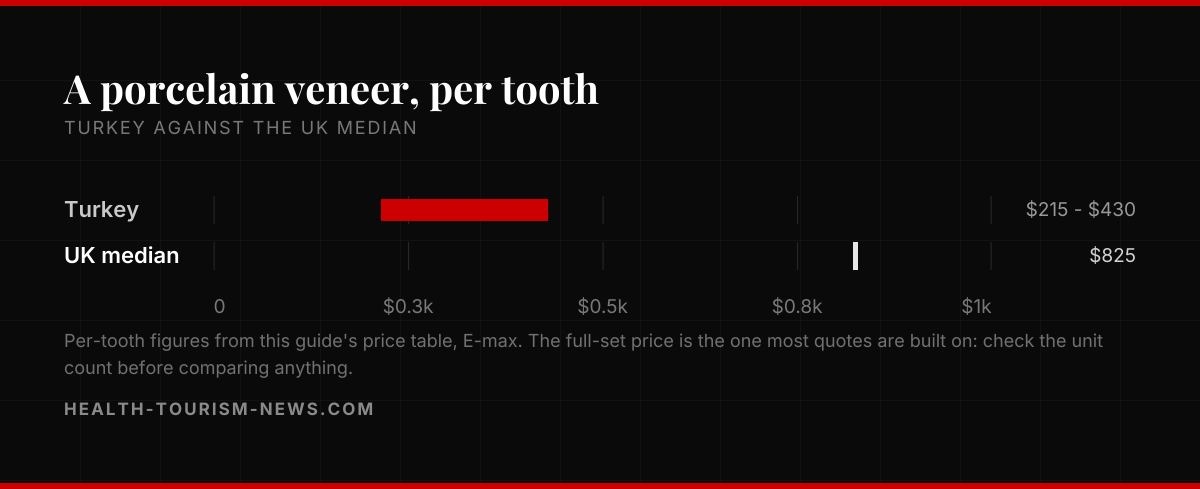
Clinic list prices in mid-2026 put a single E-max (lithium disilicate) veneer at $215 to $430, a zirconia unit at $200 to $485, a porcelain laminate at $175 to $375 and a composite veneer at $95 to $270. The figures come from price lists published by nine Turkish providers in Istanbul and Antalya between June 2025 and July 2026, and the panel medians sit well below the tops of those ranges: $270 for E-max, $230 for zirconia and $135 for composite. Platform quotes spread wider than clinic lists; one major booking platform lists E-max at $450 to $750 per tooth while others publish figures close to the clinic panel, so a quote is best compared against the treating clinic’s own published prices.
TreatCompare, a UK price-comparison service drawing on 1,622 practices, puts the UK median at £614 ($825) per veneer, with most fees between £250 and £975 ($335 to $1,310). The current London lists put a single porcelain veneer at £850 to £995 ($1,140 to $1,335), names on file. On the same data a full smile of eight to ten teeth costs £4,500 to £10,000 ($6,050 to $13,400) in the UK, and TreatCompare’s separate crown sample of 1,758 practices puts the median UK crown at £720 ($965). Set against the Turkish panel medians, the like-for-like saving runs at roughly 60 to 75 per cent before travel.
| Material | Turkey panel, per tooth | Panel median | UK, typical private fee |
|---|---|---|---|
| E-max (lithium disilicate) | $215 - $430 £160 - £320 | $270 | $670 - $1,340 £500 - £1,000 |
| Zirconia (zirconium) | $200 - $485 £150 - £360 | $230 | $670 - $1,340 £500 - £1,000 |
| Porcelain laminate | $175 - $375 £130 - £280 | $240 | $670 - $1,340 £500 - £1,000 |
| Composite | $95 - $270 £70 - £200 | $135 | $270 - $670 £200 - £500 |
Nine Turkish providers’ published prices, held on file. Full methodology under Sources.
Package prices follow the same pattern. Published full-set offers in 2025-26 ran from $2,900 to $6,050 (£2,150 to £4,500) for 20 units across the panel, and $4,700 is the median for a 20-unit case. Sixteen-unit offers ran $2,700 to $5,350, and an eight-tooth treatment, the standard smile zone, was published from $1,400 at the panel floor to about $3,500 at the top. Premium 20-unit E-max packages reach $6,000 to $9,000 on hospital-grade lists and international booking platforms. The typical bundle includes five to seven days of hotel and transfers, though not all do: at least one large provider prices hotel and flights separately.
| Package size | Panel range, published lists | Typical stay |
|---|---|---|
| 8 units | from $1,400 £1,030 | 5 - 7 days |
| 16 units | $2,700 - $5,350 £2,000 - £4,000 | 5 - 7 days |
| 20 units | $2,900 - $6,050 £2,150 - £4,500 | 5 - 7 days |
| 20 E-max units, premium | $6,000 - $9,000 | 5 - 7 days |
Same panel and booking platforms; twenty-unit offers are frequently crown work.
Whether a home insurer will cover a complication traceable to treatment bought abroad is not settled, and is worth asking before booking rather than after.
What a veneers Turkey package includes, and what it leaves out
The standard bundle is consistent across most published offers: five to seven nights in a four- or five-star hotel, airport and clinic transfers, the consultation and panoramic X-ray, temporary teeth, an English-speaking coordinator and a warranty of 5 to 15 years. Flights stay outside the package on nearly every offer reviewed for this guide, and a minority of providers exclude the hotel as well. So does any treatment at home: a warranty is honoured by the issuing clinic, and none of the published offers state who pays for flights back to Turkey if it is invoked. Remedial work done in the UK is covered by nobody.
Two questions belong in writing before any deposit on the package itself. One is where the warranty is honoured and who pays the travel when it is used. The other is what happens to the price if the treatment plan changes after the in-person examination, since published packages are quotes against ideal cases rather than binding prices.
The quoted price is an orientation, not a commitment. That is the first thing to understand about a fixed-price veneer package. In the years I spent coordinating international patients, the quote changed almost every time. Not because anyone was lying, but because a treatment plan built from photographs and a panoramic X-ray meets the patient’s mouth for the first time on arrival, and the mouth wins. The number moves in both directions.
Price guarantees exist. They also carry exits, and the exits are written by the people offering the guarantee.
What separates a good operator is that they say this before you fly. They cap the variation by treatment type, they tell you which findings would move the price, and they ask for better records up front: clear images, properly documented, not out of date. The clinics that skip that conversation are not being optimistic. They are moving it to a point where you are already in the chair.
Most patients accept the change. The full impact of accepting only becomes clear afterwards.
The full cost of the trip
Return flights from London to Istanbul started at about £85 ($115) on Skyscanner data in July 2026, with typical economy fares well under £300 ($400) when booked a month or more ahead. Hotel and transfers sit inside most packages, so the realistic all-in figure for a 20-unit zirconia case is around $5,000 to $5,250 including flights and incidental spending. Against a UK course of 20 crowns at the £720 median, roughly $19,300, the headline saving holds at about $14,000.
The honest budget adds one more line. In a 2022 survey of 1,000 UK dentists by the British Dental Association, 65 per cent of dentists who treated complications from work done abroad put the remedial cost at £500 ($670) or more, 51 per cent above £1,000 ($1,340) and 20 per cent above £5,000 ($6,700). A UK repair bill is not a certainty, and it is not a rarity either. Budgeting for the possibility is the difference between a price and a best case.
Are Turkey teeth veneers or crowns?
Much of what is sold as veneers is crown work, and the difference is the single most important fact in this market. A veneer is a thin shell bonded to the front face of the tooth; preparation removes roughly 3 to 30 per cent of the tooth’s structure. A crown requires circumferential reduction of the whole tooth. A gravimetric study in the Journal of Prosthetic Dentistry measured crown preparation at 63 to 72 per cent of the tooth’s coronal structure by weight. Enamel does not grow back. A tooth cut for a crown will need crowns for the rest of its life.
The sellers’ own listings show the pattern: 20-unit packages marketed as veneers are specified as zirconia crowns in the platforms’ fine print. Material choice is a usable signal here. E-max is the translucent material generally used on visible front teeth; zirconia is the stronger, more opaque material suited to molars. A quote that puts zirconia across the whole front of the mouth is usually describing crowns, whatever the headline says.
The BBC tested the sales process for a 2022 documentary fronted by a dentist, Trishala Lakhani. Of 120 Turkish clinics that responded to an enquiry from a person with healthy teeth, 70 proposed veneer or crown treatment. All 34 UK clinics that replied said no treatment was needed. Over-treatment, not geography, is the risk the numbers point to, and it is the reason the veneer-or-crown question belongs in writing for every single tooth.
Is it safe to get veneers in Turkey?
Performed as genuine veneers, the procedure has a strong record wherever it is done. A 2021 systematic review in the Journal of Clinical Medicine, covering 25 studies and roughly 6,500 veneers, reported 95.5 per cent survival at ten years, with fracture and debonding the most common failures and root canal treatment needed in about 1 per cent of cases. A separate 2020 review reported survival of up to 94 per cent at ten to twelve years, with long-term figures of about 83 to 96 per cent at twenty. Those numbers describe conservative veneers on suitable teeth, and they are good numbers.
Crown work on healthy teeth carries a different profile. A prospective study in the International Endodontic Journal found pulp necrosis, the death of the nerve, in about 9 per cent of teeth after full-crown preparation, with 5 per cent for intact teeth and 13 per cent for teeth already compromised. A 2023 meta-analysis in BMC Oral Health reported pulp necrosis in about 5 per cent of teeth after indirect restorations such as crowns. If those rates held across a 20-tooth case, one or two teeth would need root canal treatment in the years that follow, which matches the pattern in patient accounts: teeth that flare up one at a time, each needing its own repair.
The scale of the aftermath is documented in the UK. In the British Dental Association survey, 94 per cent of dentists had examined patients who had travelled for dental work and 86 per cent of dentists had treated complications, with crowns the treatment most likely to need remedial work. Individual cases reach the press regularly; The Mirror reported in June 2023 on a 22-year-old who paid £3,000 ($4,000) for a full set and returned with infection and a repair estimate of £20,000 ($26,800) at UK rates.
None of this is an argument that Turkish dentistry is unsafe. Turkey trains specialists through university dental hospitals in Istanbul, Antalya and beyond, materials at reputable clinics are the same European brands used in London, and the good outcomes on record share a pattern: conservative treatment plans, named dentists, staged appointments with healing time. The failure cases share the opposite pattern: many teeth cut in a single visit, crowns sold as veneers and prices too low to allow for laboratory quality. The risk follows the business model, not the country.
How to check a clinic and dentist
Turkey has regulated health tourism since a Ministry of Health regulation published in the Official Gazette in July 2017 made an International Health Tourism Authorisation Certificate mandatory for facilities and agencies serving foreign patients. The Ministry publishes lists of authorised hospitals, medical centres and private practices through its Health Tourism Department, and HealthTurkiye, the state portal run by USHAS, lists certified providers alongside licensed agents. Checking a clinic means matching its exact legal name against the Ministry lists or the HealthTurkiye portal. The register check takes minutes. The certificate shows that a clinic is set up to take foreign patients, with multilingual consent forms in place; it is not a measure of clinical skill or outcomes, and the Ministry of Health does not publish an outcomes register.
Dentists hold a Ministry licence and register with the Turkish Dental Association, the statutory body founded in 1985 with about 40,000 members. No public English-language register of individual dentists exists, so verification runs through the clinic. Ask for the treating dentist’s full name and diploma number, and check registration with the Turkish Dental Association through the clinic or the local dental chamber. Specialist prosthodontists complete a further three years of university training after a national examination. A general dentist may lawfully place veneers; a named specialist is simply a credential that can be checked.
Accreditation deserves a fair reading. Joint Commission International accredits hospital-level quality and safety systems, and more than 40 Turkish organisations have held it. Standalone dental clinics generally sit outside its programmes, so the absence of a JCI badge at a dental clinic is normal rather than a warning sign. Any badge of this kind certifies systems rather than the individual dentist, and none of them replaces the register check.
Five questions belong in writing before any deposit: the treating dentist’s name, the veneer-or-crown decision for each tooth, the material and brand, the warranty and aftercare terms with who pays for travel if either is invoked, and an itemised price that states what happens if the plan changes on examination. Written answers to all five are what a good clinic gives in the normal course of business; reluctance on any of them is the clearest red flag this market offers.
How long do veneers in Turkey take?
One trip of five to seven days covers porcelain, E-max and zirconia veneers: preparation and impressions in the first days, laboratory work in the middle, fitting and bonding at the end, with temporary teeth in between. Composite veneers take one to two days. Implants, by contrast, need two trips separated by three to six months, which is one reason veneers dominate the single-journey market. Patient accounts of good outcomes tend to describe the slower end of the schedule; The Impatient Tourist, a travel blog that documented a 17-unit treatment in Antalya, reported nine days across three appointments with deliberate healing gaps, and no failures several years on.
If something goes wrong at home
The General Dental Council regulates dentists in the UK only, and its guidance on treatment abroad is blunt: “We can’t guarantee another organisation like us exists in other countries…” The NHS treats what is clinically urgent, including pain, infection and a broken restoration, but it does not fund cosmetic re-treatment or routine aftercare of private work done abroad. Standard travel insurance excludes planned treatment, and underwriters generally exclude complications of elective procedures as well. UK dentists who repair work done abroad take responsibility for what they touch, which is why indemnity guidance tells them to assess fully, document consent and refer on when a case is beyond their scope, and why some decline remedial work altogether.
Recourse in Turkey exists on paper and is hard from a distance in practice. Complaints go through the Ministry of Health patient line SABIM on 184, through hospital patient-rights units, or through the Turkish courts, where foreign patients hold the same rights as citizens. A dedicated international-patient call centre backs the SABIM line around the clock in six languages. Proceedings run in Turkish and require a local lawyer, translated records and time; legal commentators consistently flag those barriers for patients who have flown home. Turkey sits outside the EU cross-border healthcare framework, so no EU-level complaint or refund route applies. Prevention, in the form of the checks above, is worth more than any remedy afterwards.
What this means for patients
The arithmetic still favours Turkey after honest accounting, and honest accounting is the condition. A 20-unit case priced at $4,700 against $19,300 at UK rates leaves room for flights, for a remedial visit at UK rates in the years that follow, and for saying no to a plan that turns veneers into crowns. The register check takes minutes, the five questions cost nothing, and the pattern in the failure cases is consistent: speed, volume, crowns sold as veneers and promises that were never put in writing. Teeth prepared for crowns do not come back. The saving on veneers is real for patients who treat the checks as part of the price.