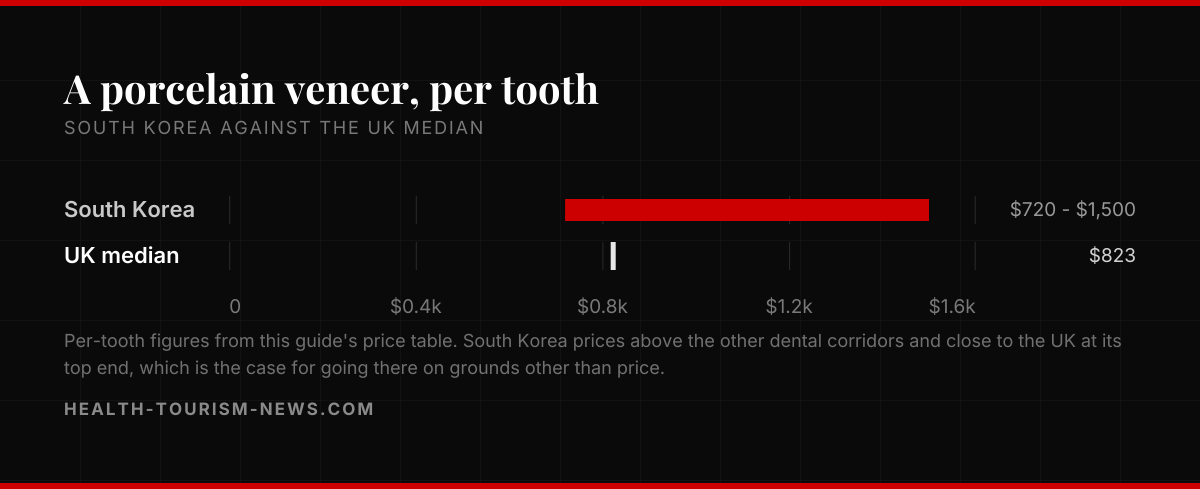
A porcelain veneer in South Korea costs about $720 to $1,500 a tooth, which sits at or above what a private dentist charges in Britain and several times what a clinic charges in Turkey. That single comparison is the whole story. Nobody flies eleven hours to Seoul to save money on a smile, because there is no saving against the UK and none against Turkey. What Korea sells is the opposite of the budget pitch: digital smile design, in-house laboratories, and a cosmetic-dentistry culture built for a country that treats appearance as infrastructure. The question a British or American patient should ask is not whether Korea is cheap, because it is not, but whether the finish and the safeguards are worth a long-haul trip at an at-or-above-home price. This guide sets out the published prices, the clinical facts and the checks that verify a clinic before any deposit.
Health Tourism News is a trade publication and sells no treatment. Prices below are the figures clinics and platforms publish, converted and attributed, and their limits are flagged where they matter.
How much do veneers cost in South Korea?
Seoul porcelain runs roughly ₩1.1m to ₩2.3m a tooth, which at the mid-2026 exchange rate of about 1,530 won to the dollar is $720 to $1,500, with premium and no-prep systems at the top of that range and beyond, and composite veneers at ₩400,000 to ₩800,000, about $260 to $520. A full smile of eight to ten porcelain veneers, the treatment most foreign patients ask about, therefore works out at roughly $5,700 to $15,000 depending on count and tier, with composite bringing the same case well below that. Those are not discount numbers, and Korean clinics do not pretend they are.
| Material | South Korea, per tooth | UK, typical private fee | Turkey, per tooth |
|---|---|---|---|
| Porcelain / laminate | $720 - $1,500 ₩1.1m - ₩2.3m | $670 - $1,340 £500 - £1,000 | $175 - $485 |
| Minimal-prep / no-prep | from ~$1,500 premium labs | $1,000 - $1,600 | not the market |
| Composite | $260 - $520 ₩400k - ₩800k | $270 - $670 £200 - £500 | $95 - $270 |
Seoul clinics’ and platforms’ published prices, held on file. Full methodology under Sources.
A UK veneer runs a median of £614, about $823, on a 2026 sample of British practices, with most fees between roughly £250 and £975. Korean porcelain at $720 to $1,500 sits at the top of that range and above it, so there is no like-for-like saving against Britain, and flights and a longer stay only widen the gap. Against Turkey the difference runs the same way and further: Turkish clinics list veneers from under $100 to about $485 a tooth, a fraction of Seoul’s prices. A patient chasing the lowest price is on the wrong continent.
Patients who choose a costlier destination are usually buying trust in the system.
They will tell you it is quality, or expertise, or reputation, and those matter. But the thing underneath, in my experience of placing patients, is confidence that the country’s machinery works: that the clinician is registered somewhere checkable, that malpractice cover exists, that there is a route if something fails. Korea sells that harder than most, and prices accordingly.
There is a second group who never ask about price at all. They are buying time. A patient who cannot wait, and can afford not to, is running a different calculation from one comparing quotes, and waiting lists at home drive more medical travel than the savings tables suggest.
Neither group is looking for a discount. Which is why this page, showing Korean porcelain at or above the UK median, is not describing a failed bargain. It is describing what people pay when price is not what they came for.
Whether a home insurer will cover a complication traceable to treatment bought abroad is not settled, and is worth asking before booking rather than after.
What the premium price buys
Korea’s dental sector competes on finish rather than fee, and the money goes somewhere specific. Larger Seoul clinics run their own laboratories, so the design, the shade matching and the milling happen under one roof and inside one trip, which is the practical case for the higher price. Digital smile design is standard rather than an upsell, and the aesthetic house style, uniform shape and controlled brightness, is the look the country’s cosmetic culture has spent two decades refining. None of that guarantees a good result, and none of it is unique to Korea, but it is a coherent product. The reason to choose it is a specific outcome and a clinic set up to deliver it, not a number on a price list.
Veneers or crowns?
The distinction that decides everything in this market is the one clinics are least keen to volunteer. A veneer is a thin shell bonded to the front of the tooth, and preparing for one removes roughly 3 to 30 per cent of the tooth’s structure. A crown wraps the whole tooth, and a gravimetric study in the Journal of Prosthetic Dentistry measured full-crown preparation at 63 to 72 per cent of the coronal structure by weight. Enamel does not grow back. A tooth cut for a crown needs a crown for life. Korean clinics tend towards genuine veneers more than the twenty-unit crown packages sold as smiles elsewhere, but tendency is not a guarantee, and the veneer-or-crown decision belongs in writing for every tooth on the plan.
Is it safe to get veneers in South Korea?
Placed as genuine veneers, the procedure has a strong record. A 2021 systematic review in the Journal of Clinical Medicine reported 95.5 per cent survival at ten years, with fracture and debonding the usual failures. A 2020 review put long-term survival at about 83 to 96 per cent. Those figures describe conservative work on suitable teeth, and they travel with the procedure rather than the country. Korea’s specific safeguard is regulatory. Only medical institutions registered with the Ministry of Health and Welfare may legally treat foreign patients, a system introduced in 2009, and since 2016 registration has required malpractice-liability insurance. A patient can therefore confirm both that a clinic is authorised to treat them and that a route to compensation exists. The risk that remains is the universal one, over-treatment, when healthy teeth are reduced for crowns that were never needed, and no register prevents a bad plan.
How to check a South Korean clinic
Verification in Korea is unusually clean, and the guide will say so. Every clinic that lawfully treats foreign patients holds a Ministry of Health and Welfare registration, listed on the official Medical Korea register and evidenced by a certificate the clinic can produce. Unregistered institutions that attract foreign patients face real penalties, so the status is meaningful rather than decorative. Ask to see the registration and match the clinic against the official list, then ask for the treating dentist by name and licence, because Korea’s cosmetic sector carries a documented history of substituted operators during surgery, the practice known locally as ghost surgery. Veneers are placed under local anaesthetic, where that risk is lower than in the general-anaesthetic plastic-surgery cases the scandals centred on, but a named and verifiable dentist is still the answer to give. Confirm the price in the currency you will pay, since the domestic figure is in won and the quoted per-tooth price rarely includes the smile design and the adjustments.
How long veneers take, and the eleven-hour question
Porcelain veneers take five to ten days in Seoul: preparation and a digital design at the start, in-house laboratory work in the middle, and bonding with fine adjustments at the end, with temporaries in between. Composite veneers take one to two days. The long flight changes the calculus that makes shorter-haul destinations easy. London to Seoul runs around eleven hours each way, so a return visit for an adjustment is a serious undertaking rather than a weekend, and the case for getting the plan, the temporaries and the final fit right inside one trip is stronger than it is for Istanbul or Budapest. Patients who build in enough days for laboratory work and a review before flying home are buying the finish they came for.
If something goes wrong at home
Korea sits outside any EU or UK recourse framework, so the safety net a patient relies on is the one built before travel. The mandatory malpractice insurance that comes with foreign-patient registration is the closest thing to a compensation route, and it runs through the Korean system, in Korean, from a distance. On the British side the position is the familiar one. The NHS treats urgent problems such as pain, infection or a failed restoration, but it does not fund cosmetic re-treatment of private work done abroad, and standard travel insurance excludes planned treatment. The General Dental Council tells patients to check who is treating them and to brief their own dentist before travelling, which doubles as the aftercare plan. A UK dentist who repairs the work takes responsibility for what they touch, so the records that travel home, the materials, the plan and the warranty terms, are what make a repair possible.
What this means for patients
South Korea is the premium end of dental tourism, and it should be read that way. A porcelain smile at roughly $5,700 to $15,000 is at or above a British price and a long way above a Turkish one, so the case for the trip rests on the finish, the in-house laboratories and a regulatory system that registers and insures the clinics allowed to treat foreigners. Patients who want the lowest number will not find it in Seoul. Patients who want a specific aesthetic, a verifiable clinic and a compensation route, and who can absorb the flight and the near-home price, are buying a coherent product rather than a bargain. Get the veneer-or-crown decision in writing, check the registration, and treat the eleven-hour return trip as a reason to plan one careful visit rather than two rushed ones.