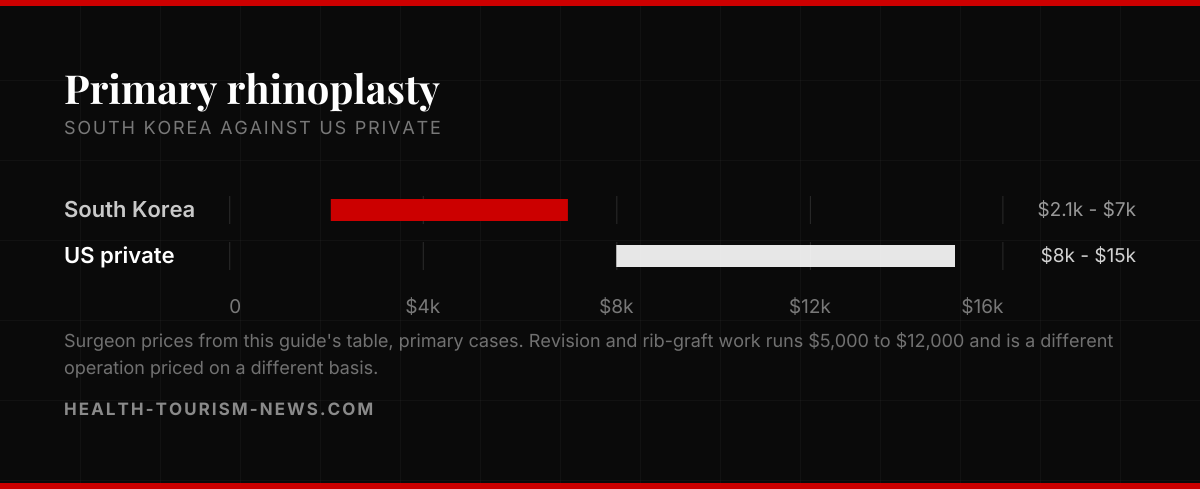
Rhinoplasty in South Korea costs about $2,100 to $3,500 for straightforward primary surgery, more for complex work, and $5,000 to $12,000 for a revision or a rib-cartilage rebuild, against $8,000 to $15,000 in the United States. Seoul runs the busiest cosmetic-surgery market on earth, and the Gangnam district sells noses the way other districts sell handbags. Korea is not the budget option, though. It undercuts America and Britain while charging several times what Turkey or Thailand ask, and it competes on precision and finish rather than on price. It also carries a problem the brochures leave out, serious enough that the country wrote cameras into its operating theatres by law. This guide sets out the published prices, the implant question that defines Asian nose surgery, and the checks that matter before anyone is put under.
Health Tourism News is a trade publication and sells no treatment. Prices below are the figures clinics and platforms publish, converted and attributed, and their limits are flagged where they matter.
How much does rhinoplasty cost in South Korea?
Seoul list prices in mid-2026 put a straightforward primary rhinoplasty at about $2,100 to $3,500, rising to $7,000 or more for complex primary cases at premium clinics, a tip-only refinement at $1,500 to $3,200, and revision work using rib cartilage at $5,000 to $12,000. The platform averages across all types sit near $4,700 to $5,700. Foreign patients may be quoted higher again through agency and facilitator markups, and a 10 per cent VAT refund that once favoured foreign cosmetic patients ended on 1 January 2026. In Korean won the domestic figures run lower than the foreign-patient prices, which is one reason to confirm the currency and the total before treating any number as final.
| Procedure | South Korea | US private | UK private |
|---|---|---|---|
| Primary rhinoplasty | $2,100 - $7,000 | $8,000 - $15,000 | $8,000 - $13,400 £6,000 - £10,000 |
| Tip refinement | $1,500 - $3,200 | $5,000 - $9,000 | from $5,400 |
| Revision or rib-cartilage | $5,000 - $12,000 | $12,000 - $30,000 | $10,700 upward |
Seoul clinics’ and platforms’ reported prices, held on file. Full methodology under Sources.
Against the United States the saving is large, and against the United Kingdom it is real but smaller. Against Turkey and Thailand there is no saving at all, because Korea sits at the premium end of the cosmetic market rather than the cheap one. The patient choosing Seoul is buying a particular kind of surgery and a particular finish, and paying for it. The reason to go is the result, not the receipt.
Whether a home insurer will cover a complication traceable to treatment bought abroad is not settled, and is worth asking before booking rather than after.
What you are paying for, and the implant question
Korean rhinoplasty is not the same operation that dominates Western practice, and the difference decides the risk. Reduction rhinoplasty, the standard Western case, removes tissue from a prominent nose. The typical Asian nose has a low, broad bridge that calls for augmentation, building the bridge up, and the amount of height wanted usually exceeds what a patient’s own septal cartilage can provide. Korean surgeons therefore reach for implants, silicone most often and expanded PTFE next, as the routine technique. Implants are cheaper, quicker and more predictable to shape than a rib graft, which is part of why the prices sit where they do. They also carry risks that autologous cartilage does not, and that is the trade the consultation should name out loud rather than leave in the fine print.
Is rhinoplasty in South Korea safe?
The procedure’s risk is specific and documented. The review of alloplastic materials in rhinoplasty reported implant complication rates ranging from about 4 to 36 per cent across the older published series, the spread reflecting implant type, technique and follow-up length. The 2022 meta-analysis of 27 studies pooled the modern rate far lower, at roughly 2.75 per cent overall, with infection near 1.9 per cent and extrusion under 1 per cent, so the 36 per cent top should be read as a worst-case from early silicone work rather than a typical figure. Infection, extrusion through the skin, displacement and capsular contracture are the recurring failures. Secondary revision was needed in around 10 per cent of cases in one published series, and revision rhinoplasty is harder surgery with lower success than the first operation. Those are the numbers a patient weighing a Seoul implant against a rib graft is actually choosing between. Korea’s institutional safeguard is real and worth using: only clinics registered with the Ministry of Health and Welfare may treat foreign patients, a requirement since 2009, and registration has carried mandatory malpractice-liability insurance since 2016, so both authorisation and a compensation route can be confirmed before booking.
Ghost surgery and the camera in the operating room
South Korea’s cosmetic sector carries a scandal that no other destination has legislated against so directly, and it belongs in any honest guide. Ghost surgery is the practice of substituting the surgeon a patient chose with a different, often junior, operator once the patient is under anaesthetic. Estimates reported by the country’s plastic surgeons ran to roughly 100,000 patients affected between 2008 and 2014, with around five deaths during ghost surgeries recorded between 2014 and 2022, and the response was unusual. Korea passed a law in 2021 requiring closed-circuit cameras in operating theatres, and since 2023 a patient undergoing general anaesthesia has held a legal right to request that the operation is recorded. Later proposals would go further and log every person who enters the room. The reform is the clearest signal available that the problem was real, and it hands the foreign patient a concrete defence: name the operating surgeon in the consent form and exercise the right to the recording. Ghost surgery is now rare in the registered, reputable clinics and concentrated in the high-volume operations that compete hardest on price for foreign patients, which is exactly where the register check earns its keep.
How to check a Seoul clinic and surgeon
Verification in Korea is cleaner than in most destinations, and it runs through the state rather than the marketing. Every clinic that lawfully treats foreign patients holds a Ministry of Health and Welfare registration, listed on the official Medical Korea register and shown by a certificate the clinic can produce, and unregistered institutions that solicit foreign patients face criminal penalties. Match the clinic against the register first. Then take the surgeon in hand: get the operating surgeon, not the consulting one, named in the consent document, and confirm in writing that you may request the operating-room recording under the 2023 right. Ask whether the plan uses an implant or your own cartilage, and if an implant, which material and what the clinic’s own infection and revision figures are. A registered clinic with an insured, named surgeon who answers those questions plainly is the standard to hold out for, and the eleven-hour flight is a reason to settle it by correspondence before departure.
Recovery and the eleven-hour flight home
The rhinoplasty calendar in Seoul runs eight to fourteen days for a foreign patient. Surgery comes early in the visit, an external splint and any sutures come off around day seven, and a review before flying is the step worth insisting on. Bruising and gross swelling settle over the first two to three weeks, but the fine result of a nose keeps changing for a year or more, and implant or graft settling is part of that long tail. Flying is generally permitted once the surgeon is satisfied with early healing, and the practical argument is against the same-week departure some packages imply: an eleven-hour flight home leaves a patient far from the operating surgeon precisely when an early infection or an implant problem would show. Building the trip around a review appointment, rather than the cheapest return date, is the sensible order.
If something goes wrong at home
Korea sits outside any EU or UK recourse framework, so the protections are the ones arranged before surgery. The mandatory malpractice insurance attached to foreign-patient registration is the formal compensation route, and it runs through the Korean system, in Korean, from a distance. On the British side the NHS treats urgent complications such as infection or airway problems but does not fund revision of cosmetic surgery bought privately abroad, and UK surgeons are wary of adopting another surgeon’s rhinoplasty, an operation where the previous work constrains everything that follows. Standard travel insurance excludes planned surgery and usually its complications. The documents that travel home decide what is possible next: the operative note, the implant or graft record with any product details, and the named surgeon who can be asked what was done.
What this means for patients
South Korea is the accomplished, expensive end of cosmetic surgery, and rhinoplasty is its signature. A primary nose at $2,100 to $3,500 undercuts the United States heavily and Britain modestly, and costs multiples of Turkey, so the case for the flight is the surgery and the finish rather than the fee. The distinctive risks are the implant, which trades a rib graft’s difficulty for infection and extrusion rates that a patient should see before consenting, and the substitution problem the country now polices with cameras. Patients who register-check the clinic, name the operating surgeon, settle the implant-or-cartilage question in advance and plan the trip around a review before an eleven-hour flight are using the safeguards Korea has actually built. The nose is a year-long result; the decisions that shape it are made before the anaesthetic.