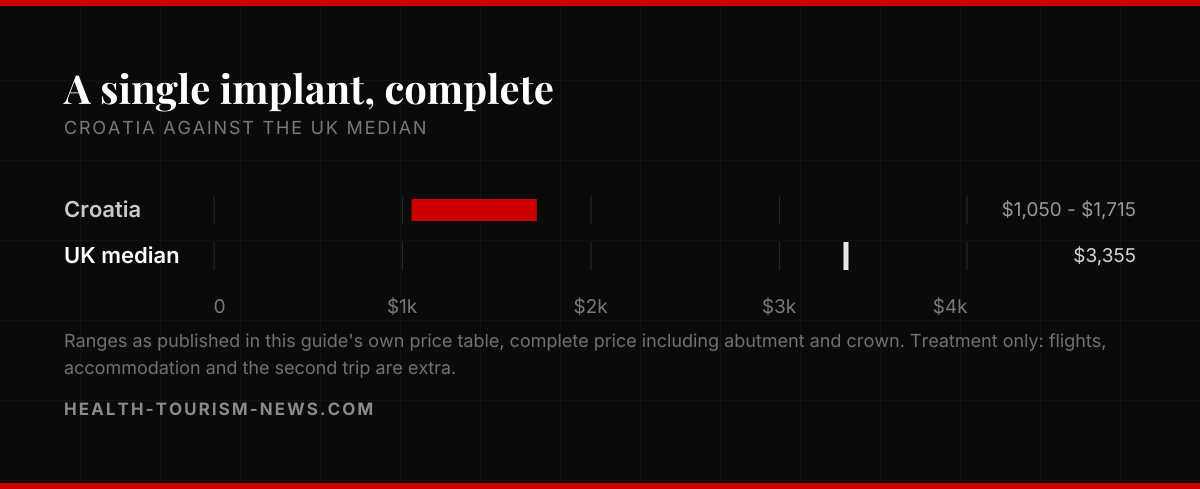
A dental implant in Croatia is advertised from about $775, and the finished tooth costs $1,050 to $1,715 once the abutment and crown join the bill, against a UK median of $3,355. Croatia is not the cheapest country selling implants to Britons, and it does not pretend to be. Its pitch is European Union regulation, a two-hour flight and the Adriatic to recover beside, aimed at patients who read the Turkey headlines and want a safer-sounding address. Parts of that pitch are real and parts need translating, starting with a licence register that no patient can actually search. This guide sets out the published prices, what the EU badge does and does not buy, and the checks that still work.
Health Tourism News is a trade publication and sells no treatment. Prices below are attributed to their publishers, and their limitations are stated where they matter.
How much are dental implants in Croatia?
The advertised figure is the surgical post. Across eight Croatian clinics publishing prices in mid-2026, names on file, a standard implant ran $775 to $935 implant-only, with premium Swedish fixtures at $905 to $1,110. The abutment and the crown add $275 to $790 on the same lists depending on the crown material, so the restored tooth lands between $1,050 and $1,715. Exactly one clinic on the panel prints the implant-only and the finished-tooth price side by side; everywhere else the patient assembles the total from separate rows. Set against the UK median of $3,355 from a comparison of 1,125 practices, the finished tooth in Croatia costs roughly a third to a half of the British one. Turkey undercuts Croatia by a clear margin on the same work, which is worth knowing before the EU premium is paid unexamined.
| Offer | Price | Notes |
|---|---|---|
| Single implant, implant only | $775 - $935 €680 - €820 | the post, no tooth on it |
| Single implant, premium brand, implant only | $905 - $1,110 €790 - €972 | Swedish systems |
| Single implant, restored | $1,050 - $1,715 €920 - €1,500 | implant, abutment and crown |
| All-on-4, per arch, all-inclusive lists | $7,550 - $8,750 €6,616 - €7,664 | final bridge included or itemised |
| All-on-4, full band | $5,150 - $10,950 €4,500 - €9,563 | low ends leave the final bridge unstated |
| UK single implant, median | $3,355 £2,500 | 1,125-practice comparison |
| UK All-on-4, per arch | $16,100 - $33,500 £12,000 - £25,000 | per jaw, 2026 |
Eight Croatian clinics’ published prices, held on file. Full methodology under Sources.
A quote should break down into the same categories the invoice will. Not line by line, but category by category, stated clearly. Anything vaguer is the warning sign, and it is the cheapest check a patient can run before committing to anything.
Where quote and invoice separate, the pattern is predictable. Length of stay, when the package includes it, carries a large margin and moves with the stay. Materials and implant brands, when a patient chooses differently on the day. And complications, which “all inclusive” rarely covers.
That last one is worth sitting with. The packaged price covers the good outcome. The moment the outcome is not good, the package stops describing what you will pay.
Whether a home insurer will cover a complication traceable to treatment bought abroad is not settled, and is worth asking before booking rather than after.
All-on-4 prices and the final-bridge question
Full-arch quotes in Croatia separate into two kinds, and the difference is the bridge you keep. Lists that spell out their contents run $7,550 to $8,750 per arch, and one Split provider prints $8,000 with extractions, grafting, the temporary and the final zirconia bridge all named in the package. Beneath them sit “from” prices as low as $5,150 that never say whether the final bridge is in the figure, and above them a premium Swiss system reaches $10,950. All-on-6 runs $6,650 to $12,850 on the same lists, names on file. The question that sorts the offers is not the headline but the noun: which bridge, acrylic or zirconia, fitted on which visit. The clinical record adds its own footnote. Pooled reviews put the implants themselves at 99.8 per cent survival past two years while 23.2 per cent of patients fracture the definitive prosthesis, so the warranty on the bridge matters more than the warranty on the titanium.
Is Croatia good for dental work?
The clinical numbers travel with the procedure rather than the passport. Ten-year implant survival sits at about 93 to 96 per cent in the long-term reviews, roughly one patient in five develops peri-implantitis over the years that follow, and no registry publishes Croatia-specific outcomes to argue with either figure. What Croatia can honestly claim is training parity on paper: a Croatian dental degree is one of the professions the EU recognises automatically across every member state, which is more than marketing. What it cannot claim is an exemption from the aftermath statistics. A British Dental Association survey reported through the British Dental Journal found 86 per cent of UK dentists had treated complications from work done abroad, with implants among the treatments most at risk, and that figure makes no distinction between destinations with good reputations and bad ones. Croatia’s press record is quiet, with no scandal coverage of the kind Turkey attracts, and quiet is not the same as measured.
What the EU badge actually buys
Croatia joined the EU in 2013 and the euro in 2023, and clinics lead with both. For a British patient the badge needs precise reading. It buys harmonised training standards, EU-grade device rules on the implants themselves, and a regulatory culture inspected from Brussels as well as Zagreb. It buys no money and no safety net. The NHS route that once reimbursed EU treatment ended with Brexit, the surviving S2 scheme covers state healthcare only and expressly not private clinics, and the UK’s global health card pays for emergencies on holiday, not treatment you flew out to buy. A British implant patient in Croatia is a private customer with the same standing as one in Istanbul or Tijuana: the contract, not the flag, is the protection.
How to check a Croatian dentist
Here Croatia is weaker than its rivals, and the guide owes readers the plain version. Every practising Croatian dentist must belong to the Chamber of Dental Medicine and hold its licence for independent work, renewed against annual training points. What the country lacks is a public register to check any of it: the chamber’s online member register is a login for dentists themselves, in Croatian, and a patient cannot search it. Verification therefore runs through the clinic and the chamber directly. Ask for the dentist’s full name and licence certificate, and write to the chamber to confirm the licence if the sum at stake justifies it. Ask for the surgical title too. Oral surgery is a recognised specialty in Croatia and the natural credential for implant placement, the crown side belongs to prosthodontics, and implantology is a course certificate rather than a protected specialty; the law allows any licensed dentist to place implants. The facility has its own paperwork: clinics are licensed by the health ministry through an inspected decision that defines what the premises may do, and that decision, not the word polyclinic on the sign, is what to ask about.
Two trips, or a drive across the border
The implant calendar is the same on the Adriatic as everywhere else. A first visit of two to three days places the fixtures, five for a full arch, osseointegration then takes its three to six months at home, and a second visit of five to seven days fits the final teeth. Immediate-load full-arch work compresses the first stage into one trip with a temporary bridge fitted within a day of surgery, and the final bridge still waits for the second visit. Croatia’s structural advantage belongs to its founding market rather than to Britons: the Istrian clinics were built for Italians who drive three hours from Venice, for whom the interval between visits is a weekend errand. British patients fly, London to Zagreb, Pula or Split in around two hours, with returns from about $60 on the cheapest routes and several times that in high summer. Nearly every clinic sweetens the maths with a free first examination and scan, and the coastal ones bundle transfers and apartments. A free check-up prices the introduction, not the treatment.
If something goes wrong at home
The chamber can discipline a dentist through its Court of Honour, up to removing the licence, and none of that returns any money to a patient. Compensation means Croatian civil courts, in Croatian, on Croatian timescales, and no English-language complaint pathway for foreign patients exists at the primary sources. On the British side the advice a UK dentist gave a patient forum stands: the NHS owes no duty to repair elective work done abroad, and colleagues are wary of adopting another surgeon’s fixtures. The General Dental Council tells patients to check who is treating them, under what registration, and to brief their own dentist before travelling, which doubles as the aftercare plan. The practical protections are the ones signed before the deposit: the named dentist and licence, the implant brand with lot numbers, the bridge specification, and warranty terms that say who pays for a redo and where it happens.
What this means for patients
Croatia sells the middle of the market honestly enough once the labels are translated. The restored tooth at $1,050 to $1,585 is a genuine saving on the UK, dearer than Turkey, and attached to an EU training system that means something even though the EU refund routes no longer do. The weak point is verification, because no public register lets a patient confirm a licence without asking for it, and the strong points are proximity and a market too dependent on reputation to court scandal. Patients who compare the finished tooth rather than the post, get the final bridge named in the quote and carry the paperwork home are buying what the price lists describe. The coastline is real too, and it has never healed a jaw faster.