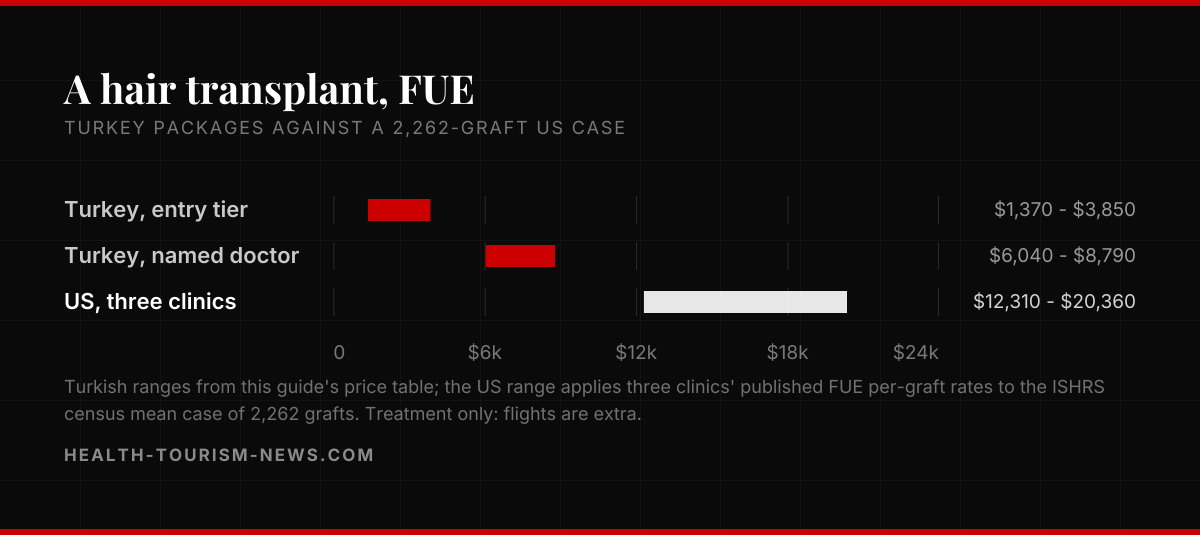
A hair transplant in Turkey costs $1,370 to $3,850 as an entry-tier package on a ten-provider panel of published 2026 prices, with $2,800 the median. The same 2,262-graft case costs $12,310 to $20,360 at three US clinics’ published per-graft rates. The cheaper package is often a different operation. At most of the panel’s clinics the entry price buys a team in which technicians harvest and place the grafts, and the tier in which a named doctor does more of the work costs 1.8 to 2.7 times as much. This guide sets out the per-graft arithmetic, the Turkish rules on who may do which step, the safety record and the checks before a deposit.
Health Tourism News is a trade publication and sells no treatment. Prices below are attributed to their publishers, and their limitations are stated where they matter.
How much is a hair transplant in Turkey?
Ten providers in Istanbul, Antalya and Izmir publish complete prices on their own websites, names on file. Every list was read on 21 November 2026. The entry-tier FUE or sapphire FUE package ran from $1,370 to $3,850 across the nine that publish one, with $2,800 the median. DHI packages, in which an implanter pen places the grafts, ran $2,630 to $3,850 at seven providers, median $3,520. At the top of most lists sits a tier sold on the involvement of a named doctor: six such tiers ran $6,040 to $8,790, median $6,480. One booking platform quotes $900 to $2,200, but platform floors often leave out the hotel.
No US survey publishes a national fee per graft, and the Practice Census of the International Society of Hair Restoration Surgery (ISHRS) records case sizes but not prices. The US anchor is built from three clinics’ fee pages in Virginia, Texas and Utah, names on file, whose FUE rates run from $5 to $9 per graft. At the census’s average FUE case of 2,262 grafts they produce $12,310, $15,830 and $20,360, four to seven times the Turkish median. A second US figure comes from Synchrony’s 2026 cost study of cosmetic practices, published by its CareCredit financing brand, which puts the average FUE transplant at $6,344, with a range of $4,417 to $10,640. The study states no graft count or sample size, which is why the two figures differ: the built range prices one 2,262-graft case, and if the survey average bought a case of that size it would imply about $2.80 per graft, below all three US clinics’ published per-graft rates. The NHS does not offer the procedure. One UK clinic that states all its surgery is surgeon-performed publishes £5,500 to £6,000 ($7,220 to $7,870) for 2,000 grafts and £6,500 to £7,000 ($8,530 to $9,190) for 3,000.
| Offer | Turkey panel | Panel median | Notes |
|---|---|---|---|
| Entry tier, FUE or sapphire FUE | $1,370 - $3,850 €1,250 - €3,500 | $2,800 | nine providers, mostly team-performed |
| DHI (implanter pen) | $2,630 - $3,850 €2,390 - €3,500 | $3,520 | seven providers |
| Named-doctor tier | $6,040 - $8,790 €5,500 - €8,000 | $6,480 | six providers |
| Surgeon implants, per graft | $3.30 €3 | - | one provider |
| US, 2,262-graft FUE case | $12,310 - $20,360 | $15,830 | three clinics’ per-graft rates |
| US, FUE survey average | $4,417 - $10,640 | $6,344 (average) | Synchrony 2026 study, case size not stated |
| UK, 2,000 to 3,000 grafts | $7,220 - $9,190 £5,500 - £7,000 | - | one surgeon-performed clinic |
Ten Turkish providers’ published prices, read 21 November 2026 and held on file. Full methodology under Sources.
Whether a home insurer will cover a complication traceable to treatment bought abroad is not settled, and is worth asking before booking rather than after.
Hair transplant Turkey price per graft: the arithmetic the packages hide
Half the panel sells a fixed package and says the graft count does not change the price. That makes the price per graft unknowable at booking, because the clinic sets the count after the price is fixed. One of them states that fixed pricing does not mean unlimited grafts. Its $3,180 sapphire package works out at $3.18 per graft if 1,000 grafts are placed and $0.64 per graft if 5,000 grafts are placed. The ISHRS lists promises of unlimited grafts among its red flags, on the plain ground that donor hair is finite.
Where providers publish graft bands, the arithmetic lands between $0.44 and $1.65 per graft for team-performed work. A package capped at up to 4,000 grafts gives only a floor of $0.70 to $0.90 at the cap, and the real rate rises as fewer grafts are placed. The surgeon-implanted plan at $3.30 per graft costs just over a third of the $9 US rate.
| Pricing model | Panel providers | Cost per graft |
|---|---|---|
| Fixed package, no graft count | 5 | not computable |
| Graft bands, team-performed | 3 | $0.44 - $1.65 |
| Up to 4,000 grafts | 2 | from $0.70 - $0.90 at the cap |
| Published per graft, surgeon implants | 1 | $3.30 €3 |
| US clinics, FUE | 3 | $5 - $9 |
| UK surgeon-performed clinic, bands | 1 | $2.84 - $3.94 £2.17 - £3.00 |
HTN calculations from published package prices and graft bands; one provider appears in two rows.
A graft is not a hair. An FUE graft is usually one follicular unit, the natural cluster in which scalp hair grows, which the definition used in ISHRS terminology puts at usually two to four terminal follicles. A clinic pricing per hair can look cheaper than one pricing per graft while charging more, so the unit belongs in writing beside the number.
Hair transplant Turkey vs USA
The like-for-like gap is narrower than the headline. The US clinic charging $9 per graft states that its surgeon personally performs every procedure from incision design to graft placement, which a Turkish entry package generally does not offer. Matched on that basis, the Turkish named-doctor median of $6,480 plus an average New York to Istanbul return fare of $951 comes to about $7,430, roughly half the $15,830 US median case. The entry package plus the same New York to Istanbul return fare comes to about $3,750, a bigger saving on a different product. Kayak puts typical New York returns at $770 to $1,227 over the past twelve months.
Insurance treats the operation as cosmetic on both sides of the Atlantic. One large Blue Cross plan’s 2026 policy counts a hair transplant as reconstructive only after a burn, trauma or tumour removal, and Medicare usually does not cover care outside the United States. What the US fee buys that the Turkish package does not is a surgeon in the patient’s own country across the 10 to 18 months it takes to judge the result.
What a hair transplant Turkey package includes, and what it leaves out
Published bundles carry two or three hotel nights, transfers, blood tests, medication, an aftercare kit and an interpreter, with platelet-rich plasma (PRP) injections at six of the ten providers. Every one excludes flights and a second session, though members responding to the 2025 ISHRS Practice Census report an average of 1.5 procedures per patient to reach the desired result. Guarantees are thin: five providers publish none, a sixth states that it issues no guarantee certificate for any surgery, and the other four promise a correction or revision session on conditions.
The most useful document is one the law already requires. Turkey’s hair transplant regulation obliges each unit to record on its Ek-4 patient form the technique, the number of grafts transplanted and the names of the staff who performed the procedure, with photographs before and within 72 hours after it. A copy shows any doctor at home what was done and by whom.
Who performs a hair transplant in Turkey?
Turkey regulates the procedure through a Ministry of Health regulation on hair transplant units, published in the Official Gazette on 6 May 2023 and amended in November 2023 and on 12 September 2025. A unit may open only inside a licensed hospital, medical centre or polyclinic, under an activity permit from the provincial health directorate. Opening the channels, the incisions that receive the grafts, is reserved to certified physicians, plastic surgeons, dermatologists and doctors holding a medical aesthetics certificate. Harvesting and placing the follicles may also be done by health professionals holding a hair transplant assistant certificate, under the supervision of a certified physician, who may oversee up to five procedure rooms. Harvesting was physician-only under the November 2023 text; the September 2025 amendment removed it from that sentence.
The ISHRS holds a stricter standard. Its position statement, revised in July 2024, lists donor harvesting, hairline design and recipient site creation as surgery that “must be performed by a properly trained and licensed physician”.
| Step | Turkish regulation since 12 September 2025 | ISHRS position | Typical panel entry tier |
|---|---|---|---|
| Graft harvesting | physician or certified assistant | physician scores; assistants may remove | technicians or medical team |
| Channel opening (incisions) | certified physician only | physician | doctor, with one exception |
| Graft placement | physician or certified assistant | may be delegated into premade sites | technicians or medical team |
Regulation on Hair Transplant Units as amended, Official Gazette No. 33015; ISHRS statements of July 2019 and July 2024; panel package descriptions on file.
The panel’s own descriptions show how the market prices the difference. Entry tiers at six providers give extraction, placement or both to technicians or an unnamed medical team, and one entry tier describes the incisions themselves as made by surgical technicians, the step the regulation reserves to physicians. The provider at the top of the entry range, $3,850, is the one that states the doctor performs the operation in its standard package. Enforcement surfaces in court rather than in statistics. In November 2025 an Istanbul court gave a self-described hair transplant coordinator a deferred sentence of one year and eight months for performing transplants without a doctor, Turkish press reported.
Is it safe to get a hair transplant in Turkey?
In experienced hands the operation rarely causes serious harm. A 2025 scoping review in Aesthetic Plastic Surgery, covering 43 publications, found two large series reporting overall complication rates of 1.2 and 4.7 per cent, with ceilings across the literature of 11 per cent for persistent numbness and for infection. The serious end is necrosis, the death of scalp tissue. An Istanbul plastic surgeon’s 2024 series of 18 patients with recipient-site necrosis found that every one had undergone a single-session FUE of about 3,900 grafts, and all were left with scarring and graft failure.
Turkey has no outcome registry for the procedure, and a 2025 review by Mayo Clinic authors called the industry’s reporting a data black hole. In the 2025 ISHRS Practice Census, 59.4 per cent of responding members reported black-market clinics, which the society describes as clinics where technicians illegally perform the surgery, in their own cities. Repairs of earlier black-market transplants made up a mean of 10 per cent of members’ cases, against 6 per cent in 2021. The census does not break out Turkey, though the society’s 2019 campaign launch named it among the countries where unscrupulous clinics were luring patients.
Deaths are rare and not counted by procedure. Britain’s Foreign, Commonwealth and Development Office (FCDO) says it is aware of seven British nationals who died in Turkey in 2025 following medical procedures of all kinds. In July 2025 a 38-year-old British man died after falling ill at an Istanbul hair clinic; the clinic said the transplant had not begun, and the provincial health directorate opened an investigation, according to Turkish press reports and the British Association of Aesthetic Plastic Surgeons.
FUE, DHI and sapphire: what the names mean
FUE, follicular unit excision, removes grafts one at a time with a small punch and accounted for 85.4 per cent of male procedures among ISHRS members in 2024. DHI is FUE with the grafts inserted by an implanter pen that makes the site and places the graft in one movement; sapphire FUE opens the channels with a sapphire blade instead of steel. No controlled trial located for this guide shows better growth with either. One non-randomised series of 1,000 patients, published in December 2025, reported 94.7 per cent graft survival with sapphire against 88.9 per cent with steel. The implanter matters for a different reason: ISHRS FUE guidelines say the surgeon should not delegate sharp implanters to unlicensed staff, because the pen creates the recipient site.
How many grafts, and the donor budget
The donor area at the back and sides of the scalp is a fixed supply; ISHRS says donor hair, once removed, is gone forever. In the 2025 ISHRS Practice Census, the members’ average first session was 2,347 grafts. A 2021 practice guideline from the Association of Hair Restoration Surgeons of India put the safe ceiling at 4,000 to 6,500 scalp grafts over a lifetime, graded as expert opinion rather than measurement, so a first-visit quote of 5,000 grafts uses most or all of that range at once. ISHRS guidelines advise against FUE under 25, when future loss cannot be predicted, and say finasteride must be continued to maintain a positive result.
The trip, and the 10 to 18 months after it
The package ends on day three, and the result is judged more than a year later. Nobody can assess the work during the trip, which is why the 2023 UK and Turkish guidelines ask the operating doctor to assess the interim progress and the final result.
| When | What happens | Source |
|---|---|---|
| Day 1, or days 1 - 2 | surgery; two days for very large sessions | panel packages |
| Days 2 - 3 | check, first wash, flight home | panel packages |
| Weeks 1 - 2 | scabs clear; 1 to 2 weeks off work | ISHRS; NHS |
| After a few weeks | transplanted hair often falls out | NHS |
| About 4 months | new hair usually starts to appear | NHS |
| 10 - 18 months | full result should be seen | NHS |
NHS hair transplant guidance (reviewed September 2023); ISHRS patient information; panel schedules on file.
Before flying, line up a named doctor at home who has agreed to see the scalp in the first weeks and again at the year mark.
How to check a Turkish hair transplant clinic
The Ministry of Health’s Health Tourism Department publishes four lists of facilities authorised to treat foreign patients. Its files dated 20 November 2026 run to 545 hospitals, 134 medical centres, 2,332 private practices and 1,542 other providers, by legal name, with no search function. Ask for the clinic’s exact registered name and find it on the list. A private practice cannot host a hair transplant unit under the 2023 regulation, so the right entry is a hospital, medical centre or polyclinic.
The tourism certificate is not the hair permit. A clinic on the list still needs a separate activity permit for its hair transplant unit, and asking to see it closes the gap. A doctor’s record sits in the Ministry’s Doctor Information Bank on the e-Devlet portal, which needs a Turkish login, so a patient abroad has to ask the clinic to show the entry for the doctor who will make the incisions.
Accreditation deserves a fair reading. The April 2025 health tourism regulation requires hospitals and medical centres in health tourism to hold TÜSKA accreditation, the Turkish national standard, by 31 December 2026. Joint Commission International accredits hospital-level systems, and standalone hair polyclinics generally sit outside its programmes, so a missing JCI badge at a hair clinic is normal. Each badge is one signal, and none replaces checking the clinic, the doctor and the permit.
The December 2023 UK and Turkish guidelines give the most practical test. They call for a consultation with the doctor who will perform the surgery, two weeks to consider the plan and consent form before paying anything, and disclosure at the first consultation if anyone other than a doctor will make the incisions. A good clinic can confirm all of it in writing.
When a Turkey hair transplant goes wrong
Repair works with whatever donor hair the first operation left, which makes overharvesting the failure hardest to undo: a depleted donor area does not regrow, and every graft used to correct a hairline comes from the same supply. The NHS does not provide hair transplants, the FCDO says it cannot usually help people who travelled abroad for medical treatment, and standard travel insurance does not normally cover elective surgery abroad. US patients face the same position under cosmetic exclusions.
Under the April 2025 regulation, authorised facilities must evaluate every complaint and take corrective action, so recourse starts with the clinic. Complaints can also go to the Ministry of Health contact line on 184 or the HealthTurkiye support line on +90 850 288 38 38. The Turkish courts remain open, but proceedings run in Turkish and need a local lawyer. Every route asks for the same evidence: the Ek-4 record and the written answers to the pre-deposit questions.
What this means for patients
The saving is real and smaller than the headline. A $2,800 entry package against $12,310 to $20,360 in the United States compares a team-performed package with US clinic fees; a named-doctor tier at $6,480 plus a $951 fare still comes to about half the US median case. The larger costs are time and donor hair: the result arrives 10 to 18 months after a three-night package ends, and a first session far above the census average of 2,347 grafts spends hair no later repair can replace. Two written answers settle most of the risk before any deposit: who will make the incisions and harvest the grafts, and how many grafts are planned and why.