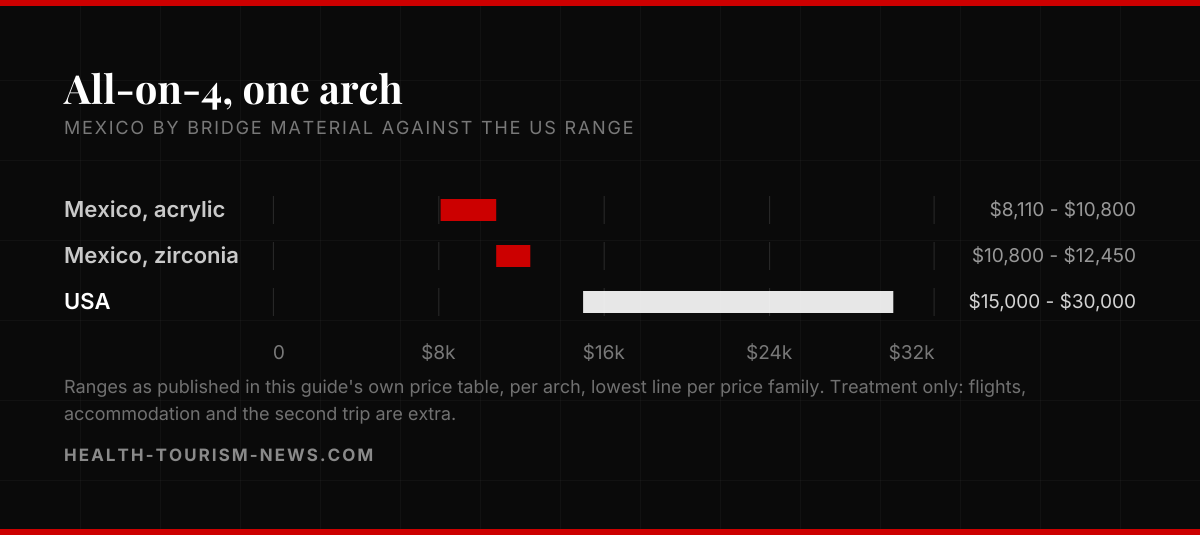
All-on-4 in Mexico costs $8,110 to $10,800 per arch with an acrylic bridge and $10,800 to $12,450 with zirconia, on the published lists of ten Mexican providers read in November 2026. American consumer guides put the same arch at $15,000 to $30,000. The headline figure answers only part of the question, because a full-arch price covers a surgery, a temporary bridge, a second trip for the permanent teeth and, years later, very likely a repair or a remake. This guide prices each of those parts, sets the material choice against the clinical record, and states who should not be having the treatment at all.
Health Tourism News is a trade publication and sells no treatment. The providers whose prices appear here are anonymised, their names held on file, and no clinic is recommended.
How much does All-on-4 cost in Mexico?
All-on-4 replaces every tooth in one jaw with a fixed bridge screwed onto four implants, the back two often set at an angle. The unit of sale is the arch. Across a panel of ten providers, names on file, the cheapest All-on-4 line on every list is an acrylic hybrid or a bridge whose material the list does not name. Two pairs of providers publish identical price templates, so the panel counts eight independent price points. On that basis the acrylic arch runs $8,110 to $10,800, with a median of $9,900. Zirconia appears on four of the eight, at $10,800 to $12,450 and a median of $11,400. The top of the market is a nano-ceramic arch at $13,500 in Cancun, and a Mexico City clinic pricing in pesos lists 193,499 pesos, or $10,148, without naming the material.
Brand moves the price inside a single list. One border template prices the same acrylic arch at $8,110, $8,950 or $9,710 depending on which of three implant brands goes in, a spread of $1,600 for the hardware alone.
| Offer | Price per arch | Notes |
|---|---|---|
| All-on-4, acrylic or hybrid | $8,110 - $10,800 | median $9,900; 7 price families |
| All-on-4, zirconia | $10,800 - $12,450 | median $11,400; 4 price families |
| All-on-4, nano ceramic or porcelain | $10,000 - $13,500 | 4 providers |
| All-on-6 | $10,000 - $14,000 | material varies by list |
| All-on-8 | $13,300 - $14,300 | 4 providers, 3 families |
| Both arches, 3-on-6 | $19,200 - $27,200 | one border list; acrylic to zirconia |
| US All-on-4 | $15,000 - $30,000 | consumer guides, 2026 |
| US both arches | $30,000 - $60,000 | consumer guides, 2026 |
Ten Mexican providers’ published prices, read 21 November 2026, names on file. Full methodology under Sources.
The size of the saving depends on which American figure sits beside it. A 2024 provider-cost study conducted for the healthcare credit card CareCredit put the national average for All-on-4, which it describes as replacing the teeth of one jaw, at $15,176 within a range of $11,640 to $27,500. Against that average the Mexican acrylic median is about 35 per cent cheaper. Against the $30,000 top of the consumer-guide range it is about a third of the price. The savings of 59 to 68 per cent printed on one border list are calculated against American figures of $25,000 to $30,000 an arch.
Acrylic or zirconia: what the material changes
The bridge is the part of All-on-4 that wears. Acrylic, sold as a hybrid when it is built on a metal framework, is the cheaper material; zirconia is a ceramic and costs more to make. In the United States the step between them is large. Consumer guides put the zirconia premium at $5,000 to $15,000 per arch. On the Mexican lists that print both materials for the same arch, the step is far smaller.
| Provider type | Acrylic arch | Zirconia arch | Premium |
|---|---|---|---|
| Los Algodones template, same implant brand | $8,950 | $12,450 | $3,500 |
| Cancun clinic A | $10,000 | $10,800 | $800 |
| Cancun clinic B | $10,800 | $11,000 | $200 |
| Cancun clinic C, phase-priced | $10,800 | $11,800 | $1,000 |
| US consumer guides | $5,000 - $15,000 |
Same-provider pairs from the panel, read 21 November 2026. Cancun clinic C prints its two trips separately; HTN added them.
The small Cancun premium has a plain explanation in the figures: the Cancun acrylic arch already costs $10,000 to $10,800, close to the border towns’ zirconia. A patient comparing a $8,110 border acrylic quote with an $11,000 Cancun zirconia quote is comparing two materials, not two cities.
The clinical case for paying the difference rests on wear. A Tufts University cohort of 71 fixed full-arch prostheses, followed for a mean of 5.2 years and published in the Journal of Prosthodontics in 2020, found the prosthetic material wearing at an annual rate of 19.4 per cent on metal-resin bridges against 7.3 per cent on porcelain ones. A 2026 meta-analysis of All-on-4 and All-on-6 in the International Journal of Oral and Maxillofacial Surgery noted that mechanical complications may be reduced with zirconia. Zirconia has its own failure mode. A 2017 systematic review of 285 one-piece zirconia full-arch prostheses found 1.4 per cent failing through fracture in the short term, and 16.1 per cent with complications, nearly all of them chipped porcelain layered over the zirconia. The same review pointed to monolithic zirconia, without the porcelain layer, as the more promising design, pending long-term studies.
What the arch price includes, and what it leaves out
Of the ten lists, one states that its arch price contains both phases: the surgery with four implants, bone graft, sinus lift, sedation and a temporary denture, then the final bridge four to six months later, with lodging and transport on both trips. A Cancun clinic prices the two trips apart, $5,400 for surgery, scans, extractions and the temporary, then $5,400 to $6,400 for the permanent bridge depending on material. Two Los Algodones lists sell a “final denture for All-on-X” as a separate line, at $4,000 and $4,500 in acrylic and $7,000 and $7,500 in zirconia, printed on the same page as an arch price that already names an acrylic bridge. Neither page says whether its arch price includes it, and the remaining six lists are silent on what theirs contains.
That leaves a written question for every quote. If the final prosthesis is not in the arch price, the $8,900 acrylic arch on one border list becomes $12,900 with a separately priced acrylic final, and $15,900 with zirconia.
The other add-ons are priced per unit and defined differently by each clinic. Bone grafts run $200 to $600 on most lists, quoted per unit, per site or per cubic centimetre, sinus lifts $300 to $1,500, and intravenous sedation $800 on one list. Where the bone is too thin for standard implants, zygomatic implants anchored in the cheekbone cost $2,500 each on one list and $13,950 as a package on another. Both-jaw prices need the same care. One border list’s $19,200 full-mouth figure is exactly twice its $9,600 per-arch price, and a quote that does not state the unit can be either. Whether a home insurer will cover a complication traceable to treatment bought abroad is not settled, and is worth asking before booking rather than after.
All-on-4, All-on-6 or single implants
More implants under the same bridge cost more. On the panel’s own lists the step from four implants to six is $1,500 to $4,120 per arch, and All-on-8 reaches $14,300. The evidence for paying it is weaker than the sales pages suggest. The 2026 meta-analysis pooled 55 studies and found long-term implant survival of 98.14 per cent for All-on-4 and 97.50 per cent for All-on-6 at five years or more, with mechanical complication rates of 5.91 and 6.64 per cent. Its authors judged the outcomes similar while warning of high heterogeneity among the studies. A smaller Sapienza University study of 28 patients followed for up to ten years, published in 2022, found the opposite gap: 89.7 per cent implant survival on four implants against 99.0 per cent on six, and seven of the eight implant failures on the four-implant arches. A study of that size cannot settle the question, and the six-implant arch is worth asking about where bone quality is borderline.
For a patient keeping some healthy teeth, single implants and bridges may be the better plan, and HTN’s guide to dental implants in Mexico covers those prices; All-on-4 assumes the remaining teeth in the arch are coming out.
Two trips, months apart
The temporary bridge is what makes All-on-4 marketable as teeth in a day. Implants are loaded on the day of surgery, which a 2017 consensus conference of implant surgeons in Spain, published in the Journal of Clinical and Experimental Dentistry, said requires each implant to reach an insertion torque above 35 Ncm. The provisional bridge must be rigid enough not to flex, and the consensus named fracture of these provisional acrylic bridges as a source of prosthetic complications. Where the implants fall short of that figure the consensus condition for loading them that day is not met, and the plan for that case belongs in the written quote.
The permanent bridge comes on the second trip, after the implants have fused with the jaw. Only one list times the gap, at four to six months. The Cancun list that prices by phase and the border lists that sell the final separately are built around the same two visits, and no pricing tier shortens the interval. A patient who cannot return should not start.
How long does All-on-4 last?
Implants placed this way last well; it is the bridge on top that needs maintenance, and the published record shows how much.
| Measure | Figure | Period and sample | Source |
|---|---|---|---|
| Implant survival, All-on-4 lower jaw | 93% | up to 18 years, 471 patients, 31.6% lost to follow-up | Malo et al., 2019 |
| Prosthesis survival, same cohort | 98.8% | up to 18 years | Malo et al., 2019 |
| Mechanical complications, same cohort | 36.7% | 10 to 18 years | Malo et al., 2019 |
| Implant survival, All-on-4 vs All-on-6 | 98.14% vs 97.50% | 5 years or more, 55 studies | Shao et al., 2026 |
| Fixed full-arch bridges free of any complication | 29.3% / 8.6% | 5 / 10 years, 281 prostheses | Papaspyridakos et al., 2012 |
| Chipping or fracture of the veneering material | 33.3% / 66.6% | 5 / 10 years | Papaspyridakos et al., 2012 |
| Bridges free of major technical complications | 85.5% / 30.1% | 5 / 10 years, 71 prostheses | Papaspyridakos et al., 2020 |
| Peri-implantitis, implant level | 20% | 10 years, 457 implants | Papaspyridakos et al., 2018 |
Peer-reviewed sources as listed. The Malo cohort is reported by the treating clinic’s own surgeons.
The longest All-on-4 cohort, 471 patients with lower-jaw bridges at a Lisbon clinic, reported by its own surgeons, lost nearly a third of its patients to follow-up, so its 93 per cent implant survival is an estimate rather than a count. A 2012 systematic review in the International Journal of Oral and Maxillofacial Implants pooled fixed full-arch prostheses followed for at least five years: 29.3 per cent were free of any complication at five years and 8.6 per cent at ten, and chipping or fracture of the veneering material reached 66.6 per cent at ten years. Those events need not mean losing the implants. Its authors described them as significant for the repair and maintenance they demand, in time and cost to both clinician and patient. For a patient whose dentist is a flight away, that sentence carries more weight than any survival rate.
The cost of keeping it
A full arch is bought once and maintained for life. None of the studies above gives a replacement schedule a patient can plan around, but they agree that by ten years most bridges have needed some repair, and the price lists put a figure on the largest item. Priced on its own by two border clinics, an acrylic final bridge for All-on-X implants costs $4,000 to $4,500 and a zirconia one $7,000 to $7,500, the nearest published guide to what remaking a bridge costs. On the panel median, an acrylic arch at $9,900 plus one replacement acrylic bridge comes to $13,900 to $14,400 before travel, against $11,400 for a zirconia arch at the outset. Neither path is free of repair; zirconia buys a different failure profile, not none.
In the 2020 Tufts study, bruxism and not wearing a night guard were associated with more chipping of the bridge, and a companion paper on the same patients found high plaque scores significantly linked to bone loss around the implants. A night guard and regular professional cleaning are recurring costs a patient pays at home. Repairs at home also need parts for the implant system used, so the implant brand and the system belong on the receipt.
Who is not a candidate
All-on-4 was designed for jaws that have lost bone. The 2017 consensus named an atrophic upper or lower jaw, with or without remaining hopeless teeth, as its main indication, in patients rated ASA I or II, the anaesthetists’ classes for healthy patients and those with mild systemic disease. Patients with more serious systemic disease sit outside it.
Smoking is the clearest measured risk. A 2015 Journal of Dentistry meta-analysis covering 107 studies and 80,300 implants found 6.35 per cent of implants failing in smokers against 3.18 per cent in non-smokers, and higher rates of postoperative infection and bone loss. In the 18-year All-on-4 cohort, smokers had 2.72 times the odds of losing more than 3 mm of bone around an implant. Diabetes is less clear-cut than its reputation. A 2014 systematic review in the Journal of Dental Research found no significant difference in implant failure between diabetic and non-diabetic patients, with a risk ratio of 1.07, but a small, statistically significant excess of bone loss in diabetic patients, and its authors cautioned that confounding factors in the included studies were uncontrolled. Heavy grinders carry the chipping risk above. Severe bone loss in the upper jaw is where clinics propose zygomatic implants, which add cost, and where a second opinion before travel is most worth having.
Los Algodones, Tijuana or Cancun for a full arch
The panel’s prices fall by corridor. The four Los Algodones lists price an acrylic arch at $8,110 to $9,900, and two of them sell the final bridge as a separate line. Tijuana’s two lists sit at $8,500 to $8,900. In Cancun, three clinics run $10,000 to $10,800 for acrylic and $10,800 to $11,800 for zirconia, and one of them bundles lodging and transport for both trips into its price. For a full arch, the cheaper corridor is the one a patient can reach twice: a walk across the border from Yuma can fit both trips into an Arizona winter, while a flight to Cancun has to be bought twice unless a package covers the second visit. HTN’s guide to dental implants in Mexico covers the crossings and the wider record for each town.
Checking the clinic
HTN’s guide to dental implants in Mexico sets out the licence checks in full. Every dentist holds a federal licence, the cedula profesional, which can be looked up on the education ministry’s public register of professionals. For the surgery itself a patient should ask to see a second, specialty registration in periodontics or maxillofacial surgery, since a general licence says nothing about implant training. A clinic’s own registration with the health authorities is a notice of operation, a sworn declaration that it meets the rules, rather than a sanitary authorisation. Mexico’s medical arbitration commission hears complaints, and its arbitration binds only where the clinic agrees. For a full arch, three more facts belong in writing: the implant brand, the material of the final bridge, and whether a replacement bridge is covered or priced.
What this means for patients
The useful comparison is not the Mexican arch against the American one. It is the whole cost of one arch over ten years: the surgery, the final bridge if it is priced separately, two trips, and, on the published complication rates, more likely than not a major repair or a remake. On those terms an acrylic arch in Los Algodones still costs less than most American quotes before travel, and the extra cost of zirconia is smaller in Mexico than at home. Patients who get the material, the final prosthesis and the replacement price on one signed page are buying what the panel’s lists describe. Patients who compare headline arch prices are buying the first trip.