Does insurance cover medical tourism? For most elective treatment abroad, it does not: the public and private cover that crosses a border is built around medical necessity, and patients who travel by choice usually pay themselves. The largest public scheme for planned care in another country, the EU’s cross-border healthcare directive, was used by about 200,000 patients a year, the European Court of Auditors reported in April 2019.
The payers that do fund treatment abroad are national health systems in Europe, Gulf governments sending citizens overseas, and a small number of private insurers contracting directly with destinations. US public and employer plans sit mostly outside this group.
Does US health insurance cover medical tourism?
Medicare, the federal programme for Americans aged 65 and over, usually does not pay for care outside the country. The Centers for Medicare & Medicaid Services lists narrow exceptions, among them rare cases of inpatient care in a foreign hospital and treatment on a cruise ship no more than six hours from a US port. Older Americans who travel for cheaper treatment abroad are therefore paying outside the programme.
Private plans carry no general promise either. Guidance from the Centers for Disease Control and Prevention, last reviewed in June 2023, warns that treating a complication once the patient is home may be costly and that a US health plan may refuse to pay for it, and it recommends a travel health policy with cover for medical evacuation home.
The employer figures most often cited on travel benefits count something else. In a survey of large US employers fielded in September and October 2022, Mercer found that 44 per cent offered, or planned to offer in 2023, a medical travel benefit. That benefit pays for travel to care not available in the member’s area or state, and 36 per cent of those employers said it would help with travel for abortion-related services; the survey does not measure cover for treatment outside the country.
Patients who pay for themselves can count some travel costs against tax. Publication 502 from the Internal Revenue Service, for tax year 2025, caps deductible lodging while away for medical care at $50 for each night for each person, and admits drugs bought and used abroad only where they are legal in both the other country and the United States.
How EU rules pay for planned treatment in another country
An EU resident can be treated in another member state under the social security regulation, with an S2 form, or under Directive 2011/24/EU on patients’ rights in cross-border healthcare. Reimbursement follows the rates of the home country or of the country of treatment, whichever is cheaper, and authorisation is approved only if the treatment cannot be obtained within a reasonable timeframe at home, according to the European Commission’s Your Europe portal, last checked in September 2026.
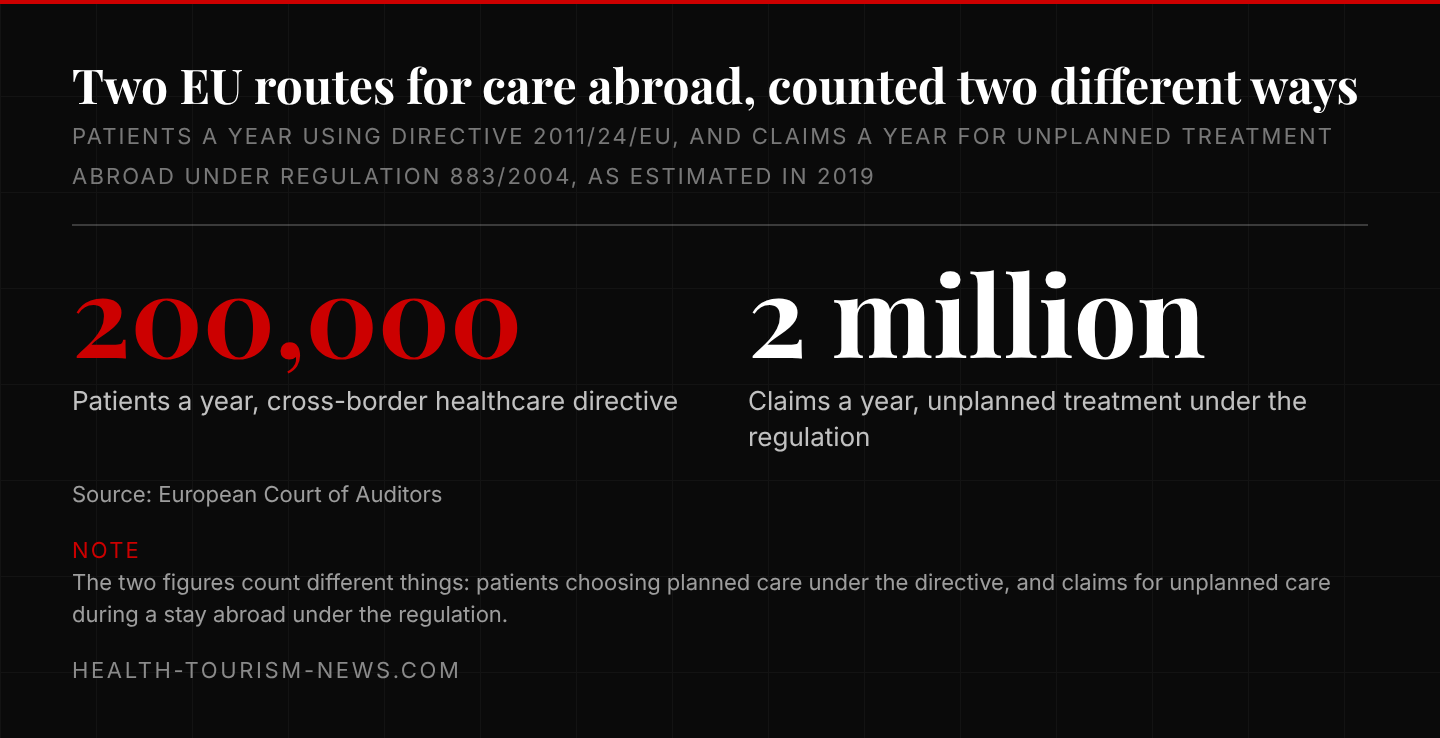
About 200,000 patients a year used the systems set up under the directive, the auditors found, against about 2 million claims a year for unplanned treatment abroad under the regulation, which are mostly care needed during a stay rather than trips made for treatment. France was the largest outgoing country in 2016, with close to 150,000 patients. Patient flows under the directive were estimated at 0.004 per cent of the EU-wide annual healthcare budget, and member states required prior authorisation in around 1 per cent of cases.
Figure one. Use of the EU’s two cross-border healthcare routes, European Court of Auditors, April 2019.
The NHS S2 route for UK patients
For residents of England, the S2 funding route covers planned treatment in the EU, Switzerland, Norway, Iceland and Liechtenstein, at public providers only and not in private clinics. The treatment has to be routinely available on the NHS in the patient’s circumstances, and guidance from NHS England, last reviewed on 16 January 2024, says it checks whether the treatment can be provided at home within a medically justifiable time, the test the scheme calls undue delay.
A patient on a long surgical waiting list can therefore qualify where a patient seeking a lower price cannot. Approval can still leave the patient with a co-payment, and NHS England does not reimburse travel or accommodation.
Gulf governments that send patients abroad
In the Gulf, the payer is often the state rather than an insurer. Dubai’s Administrative Resolution No. (14) of 2017, in force from 1 February 2017, sets the emirate’s bylaw for sending patients for overseas medical treatment. Each case starts with a medical report recommending treatment abroad, normally dated within 30 days, and an Overseas Medical Treatment Committee whose recommendation the director general approves.
Once approved, the government pays all costs of the treatment plan. The bylaw adds economy-class flights, interpreting, an air ambulance where the treating physician recommends one, up to four weeks of prescribed medicine on leaving the host country, and daily allowances for accommodation, food and transport. Adult patients travel with one escort and minors with two.
Insurers that contract with destinations directly
Some destination governments and hospital groups are signing billing agreements with insurers. The Egypt Healthcare Authority announced agreements with international health insurers, health maintenance organisations and third-party administrators at the eighth Sharm El-Sheikh Insurance and Reinsurance Forum, held from 15 to 17 November 2026, ITIJ reported. The authority’s earlier partnerships covered 25 international health insurers.
In China’s Greater Bay Area, a hospital group plans to explore direct billing arrangements for eligible commercial insurance claims with Manulife Indonesia and Allianz Partners Vietnam, ANTARA News reported on 16 November 2026. Neither announcement says which treatments the policies cover, or whether elective procedures are included.
Why travel insurance excludes treatment trips
The risk an insurer would take on sits mostly after the procedure. The Better Health Channel, run by the Department of Health in Victoria, Australia, says most facilities offer treatment to foreign patients without liability, so the patient carries the risk, and that Medicare Australia is unlikely to pay for treatment overseas or for some of the care needed back home afterwards. Australia has reciprocal healthcare agreements with only 11 countries, the channel says, mostly for emergency treatment.
That later care has a measured cost in the UK. A rapid review in BMJ Open, published by the BMJ on 13 January 2026, put the cost to the NHS of treating complications after elective surgery abroad at £1,058 to £19,549 per patient in 2024 prices. Its case series and case reports covered 655 patients treated by the NHS between 2011 and 2024, and Turkey was the most common destination, at 61 per cent.
Infection adds to the bill. Outbreaks caused by drug-resistant bacteria and fungi have been recorded among patients who travelled for treatment, the same CDC guidance says.
Where the line between elective and necessary care falls
Every public route above tests necessity before it pays. The NHS asks whether the treatment is routinely available at home and whether waiting would be medically unjustifiable; the EU portal asks whether it can be obtained within a reasonable timeframe; Dubai asks for a physician’s report recommending treatment abroad. Medicare pays abroad only in its listed exceptions.
The procedures patients most often travel for are a different list. The CDC’s list of the commonest procedures on such trips runs from dental work, cosmetic surgery and fertility care to transplants and cancer treatment. The NHS complication costs in the BMJ Open review all arose from elective surgery abroad.
What is still not counted, and who would know
The auditors’ figure of 200,000 directive patients a year comes from their April 2019 report, and the French figure of close to 150,000 from 2016.
Mercer’s 44 per cent counts domestic travel, and no employer survey giving a current share for cover of treatment abroad was found. In the UK, the BMJ Open authors describe data on the use, frequency and consequences of treatment abroad for the NHS as incomplete and haphazard. In Egypt, the National Council for Health Tourism is drafting national standards for clinical care, infection control and patient safety, ITIJ reported, with no publication date given.