The best countries for medical tourism depend on which ranking is read, and the lists do not agree with each other or, in one case, with themselves. Travel And Tour World put Türkiye first in an editorial Top 50 for 2026, published on 20 June 2026, while the introduction on the same page names Thailand as the world’s leading destination.
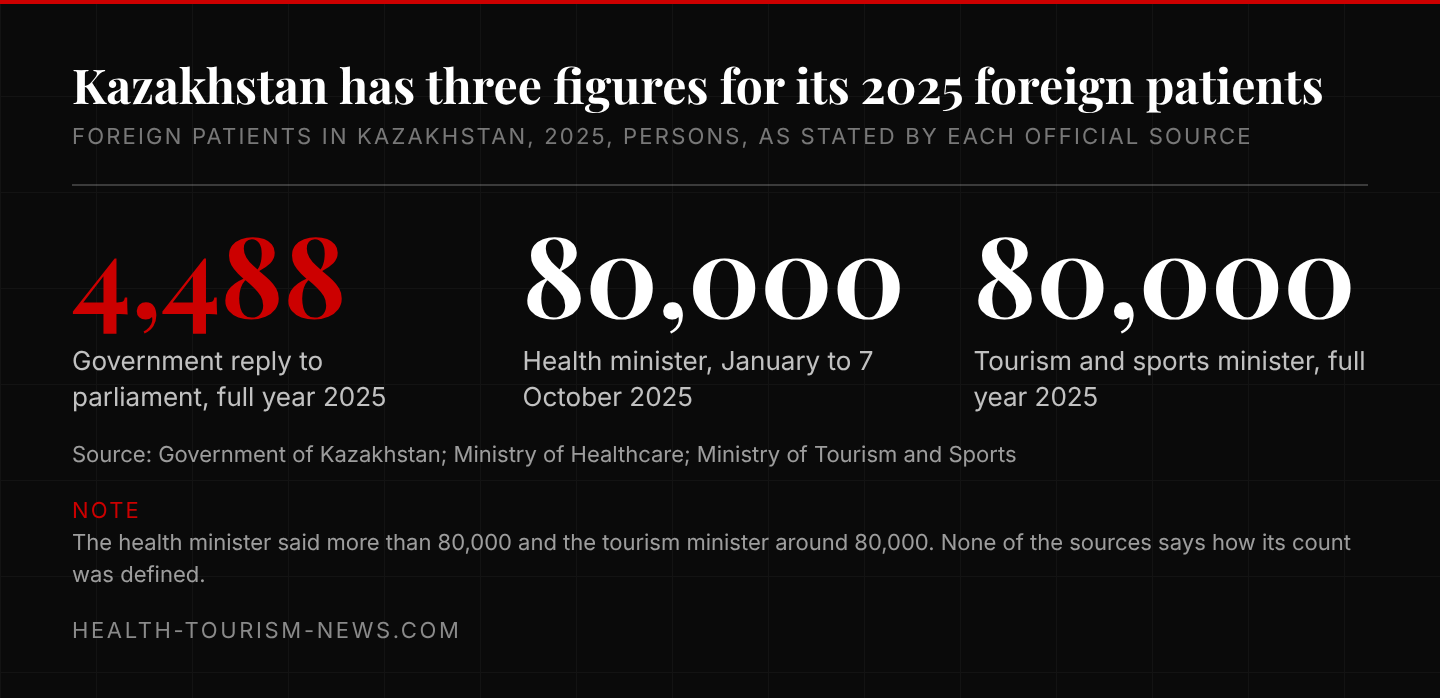
None of these lists is a count of patients. The figures that can be checked are the ones governments publish: South Korea’s Ministry of Health and Welfare counted 2,011,822 foreign patients in 2025. In Kazakhstan, the government and two ministers have given figures for 2025 that differ by a factor of almost 18.
Editorial lists of the best countries for medical tourism
Travel And Tour World’s list is the work of its editors. Its methodology section names health authorities, tourism boards and hospital networks among its inputs and refers to a scoring framework, but the Travel And Tour World page publishes no weights, no scores and no statement on sponsorship. Each of the 50 countries is paired with a list of ten cities, and the page was updated on 3 September 2026.
Thailand is second in the table, and India, Mexico and South Korea take third to fifth place, ahead of Malaysia, Costa Rica, Singapore, the United Arab Emirates and Colombia. Hungary is 26th and Peru 50th.
Facilitators, which arrange treatment abroad for patients, publish lists of their own. A guide to the safest countries from PlacidWay, dated 4 August 2025, names 14 countries, from Mexico to the UAE, and attaches no statistics, outcome data or cited source to any of them. The guide treats international accreditation as the main marker of safety and lists political stability, crime and patients’ legal rights among the other factors. PlacidWay describes itself on the same page as a marketplace connecting patients with providers, and the guide invites providers to register for its network.
Hospital rankings and the best medical service
Newsweek’s first ranking for this market rates hospitals and clinics, not countries. Its inaugural 2027 edition evaluated nine specialties and recognised 31 hospitals in the United Arab Emirates and 20 in Saudi Arabia, according to a UAE hospital group’s release on Zawya dated 16 November 2026. Ratings are expressed in airplanes, and the release reports four-airplane and three-airplane ratings by specialty. The group that issued it has seven of the 31 UAE hospitals on the list and 37 of the 113 specialty listings in the UAE.
Saudi Arabia is not in the Travel And Tour World top ten. The release does not say how hospitals were chosen for evaluation, or how many were assessed and left off the list.
Patient counts that can be checked
South Korea publishes a national count each year. The Ministry of Health and Welfare announced on 24 April 2026 a 2025 figure of 2,011,822 patients who sought treatment at domestic medical facilities, the first above two million and the third annual record in a row since 2023. The total was 1.17 million in 2024, and patients came from 201 countries, Korea JoongAng Daily reported from the ministry’s figures.
Patients from China made up 30.8 per cent of South Korea’s 2025 foreign-patient total, and around 1.31 million were treated at dermatology clinics. Those from the United States rose 70.4 per cent to 173,000, according to the same report. The series dates from 2009, when South Korea’s tracking of foreign patients began.
Türkiye, first in the 2026 editorial list, has an annual figure whose producer goes unnamed in coverage of it. Hürriyet Daily News reported on 20 April 2026 that, on official figures, 1.39 million foreign patients came to Türkiye for treatment in 2025 and generated US$3.02 billion, against 1.5 million patients in 2024. The report did not say which body produced either year’s figure, and it gave a target of 2.5 million health tourists and US$10 billion in revenue for 2026, a goal rather than a count.
Malaysia counts healthcare travellers by region through the Malaysian Healthcare Travel Council. The council’s data for January to November 2024 put the Klang Valley at roughly 560,700 international patients and about RM886 million in revenue, according to the Malaysian Investment Development Authority, which republished a Malay Mail report on 17 February 2025. Penang had about 453,600 patients and RM866 million in revenue over the same months, and the eastern region about 66,700 patients and RM123.5 million. Patients from Indonesia form the steady base of the foreign trade of Malaysia’s private hospitals, and Malaysia is sixth in the Travel And Tour World table.
The three countries count under different terms: patients treated at domestic medical facilities in South Korea, foreign patients travelling for medical services in Türkiye and healthcare travellers in Malaysia. None of the pages cited here defines its term.
Kazakhstan’s two figures for 2025
Kazakhstan’s government counted 4,488 foreign patients in 2025, in information attached to Prime Minister Olzhas Bektenov’s response to a parliamentary inquiry, The Astana Times reported in November 2026. Almaty treated 2,685 of them, Astana 1,396 and Shymkent 300.
The figure of 80,000 has been given for two different periods. Health Minister Akmaral Alnazarova cited more than 80,000 foreign citizens seeking treatment since the start of 2025 at a government briefing on 7 October 2025, The Astana Times reported. Tourism and Sports Minister Yerbol Myrzabosynov gave around 80,000 foreign patients for the whole of 2025 at a government meeting, Tengrinews reported on 10 June 2026.
Figure one. Three official statements of Kazakhstan’s foreign patients for 2025.
The 80,000 covers January to 7 October in one statement and the full year in the other, and the 4,488 covers the full year. None of the three sources says how its count was defined.
Accreditation and price data
Kazakhstan’s prime minister’s response listed 10 medical organisations in the country holding international accreditation, seven in Astana and three in Almaty, according to The Astana Times. The same response named cardiac surgery, oncology, transplantation, reproductive medicine, orthopaedics, ophthalmology, dentistry and medical rehabilitation as the fields in demand among foreign patients.
The packages the government has developed for foreign patients bundle the choice of facility, transfers, accommodation, meals and interpreters, and include price lists. The prime minister said treatment costs are significantly lower than in Europe, North America, South Korea and the Gulf, without giving figures. The PlacidWay guide advises patients to obtain written cost estimates and publishes no prices itself, and the Travel And Tour World page lists treatment costs among its criteria without giving one.
What happens next
Kazakhstan’s government has drafted an interagency plan for medical tourism for 2027 to 2030 that covers statistical reporting and service standards, and has prepared legislative amendments to define the sector’s key terms, The Astana Times reported from the prime minister’s response. The response also describes work on a unified Central Asian medical hub built on the country’s existing high-tech medical care.
Whether the 2025 figures of 4,488 and 80,000 rest on different definitions is not stated in any of the three reports. Kazakhstan’s Ministry of Healthcare, whose minister gave the October figure, holds the records that would settle it. The body behind Türkiye’s 1.39 million is not named in the Hürriyet Daily News report.