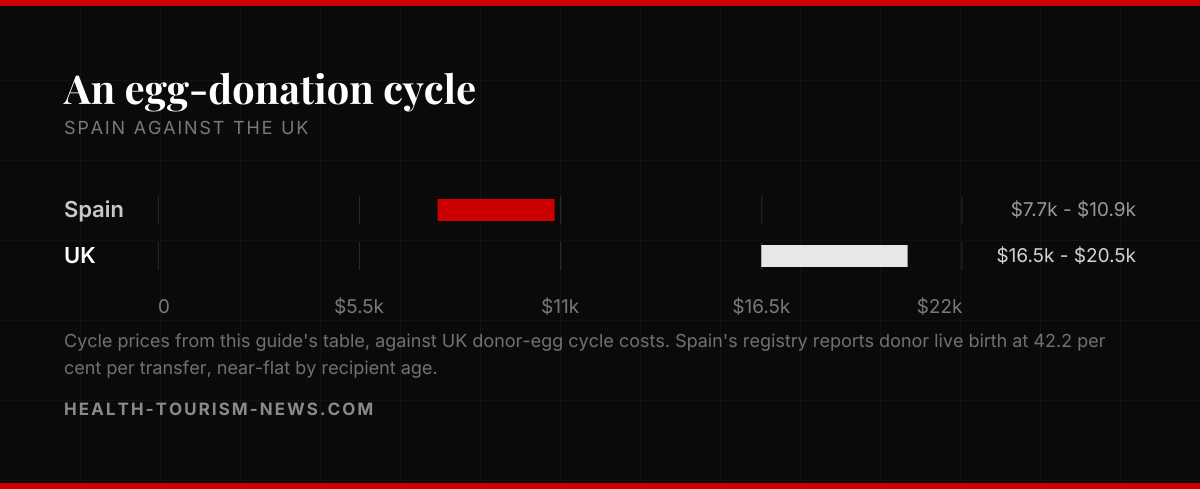
A donor-egg IVF cycle in Spain is published at $7,650 to $10,850, against $16,500 to $20,500 on a named London clinic’s list. Behind the price sits the largest fertility sector in Europe: 167,195 IVF cycles in 2022 by the national registry’s count, and more egg donation than any other country in Europe manages. Spain’s registry also settles the question clinics dodge, putting donor-egg live birth at 42.2 per cent per fresh transfer, a figure recipient age barely moves. The gap between the two countries is not success rates. It is law, donor supply and a trap involving frozen embryos that almost nobody prices before flying. This guide sets out all four.
Health Tourism News is a trade publication and sells no treatment. Prices below are attributed to their publishers, and their limitations are stated where they matter.
How much does IVF in Spain cost?
A standard own-egg cycle ran $5,600 to $6,650 (4,900 to 5,800 euros) across seven Spanish clinics publishing prices in mid-2026, names on file, with a median of $6,050. Six of the seven fold ICSI, the sperm-microinjection technique UK clinics sell separately, into that headline. What no Spanish clinic folds in is the patient’s gonadotrophin medication, self-injected daily and bought at a pharmacy on the clinic’s prescription for a further $1,150 to $1,700, so the realistic all-in figure is $6,750 to $8,350 before flights. The exclusion is universal enough to treat as the market’s convention rather than a trick, and it has a UK twin. A British market analysis found the average advertised cycle at £3,898 and the true all-in cost at £5,310 once screening, drugs and storage were added.
Advertised UK cycles run £3,795 to £7,590 ($5,100 to $10,200) at three named clinics, with ICSI a further $1,850 to $1,950 (£1,375 to £1,450). Set against the Spanish all-in figure, a single own-egg cycle prices out roughly level with the cheaper end of London and clearly under its centre. The decisive gaps open elsewhere: donation, eligibility and waiting time rather than the base cycle.
| Treatment | Spain, published | UK reference |
|---|---|---|
| Own-egg IVF cycle | $5,600 - $6,650 (ICSI included) | $5,100 - $10,200 (ICSI $1,850 - $1,950 extra) |
| Patient medication | + $1,150 - $1,700 | + comparable; UK true-cost average $7,150 all-in |
| Egg-donation cycle | $7,650 - $10,850 | $16,500 - $20,500 (named London list) |
| Frozen embryo transfer | $1,350 - $1,950 | $3,700 - $4,650 |
| Embryo adoption | $3,300 - $5,200 | rarely offered |
| Egg freezing | $2,500 - $3,300 (2 - 4 years’ storage) | $4,300 - $5,450 plus $510 - $570 yearly |
Nine Spanish clinics’ published price lists, held on file. Full methodology under Sources.
Whether a home insurer will cover a complication traceable to treatment bought abroad is not settled, and is worth asking before booking rather than after.
Egg donation prices and the guarantee tiers
Donation is the product Spain actually exports. Published cycles run $7,650 to $10,850, and the spread is mostly definitional: the floor buys four donated eggs and a culture, the middle guarantees one or two blastocysts, and a $14,750 tier guarantees a chromosome-screened euploid blastocyst. Comparing clinics means comparing guarantees, not headlines. Above the single cycle sit the refund programmes, three-cycle packages at $18,400 to $21,550 that return 70 to 100 per cent of the fee if no pregnancy or birth results, with age caps and small print that deserve as much scrutiny as the percentage.
The UK contrast is supply, not ethics of payment. Donor compensation is close to parity, £985 per cycle in the UK against roughly 800 to 1,000 euros in Spain, yet Britain imports more than half of its newly registered sperm donors while Spanish clinics match most patients in weeks. Spain’s registry counted 12,590 donor stimulation cycles in 2022, each yielding just over twenty oocytes on average. A named London clinic prices a donor-egg cycle at £12,290 to £15,290, roughly double the Spanish band, when a match is available at all.
What are the real success rates?
Spain publishes national numbers, which is more than its marketing does. The registry’s 2022 tables put own-egg live birth per fresh transfer at 34.0 per cent under 35, 24.7 per cent at 35 to 39 and 12.2 per cent at 40 and over. Those are per-transfer figures; counted per cycle started, the honest denominator, the same registry shows 9.3 per cent overall. Britain’s regulator reports 25 per cent births per embryo transferred against Spain’s 25.0 per cent per transfer, and the two national registries land within a rounding error of each other. Spain does not win on own-egg success, whatever a brochure implies, and clinics quoting 60 or 70 per cent are describing selected good-prognosis patients or cumulative attempts.
Donor eggs are where the numbers change shape. Live birth per fresh donor transfer holds at 47.0 per cent under 35, 46.5 per cent at 35 to 39 and 40.7 per cent at 40 and over, because embryo aneuploidy follows the donor’s age, not the recipient’s. Cumulative clinical pregnancy per donation cycle reaches 64.2 per cent, against 31.9 per cent with a patient’s own eggs, and the pregnancy-loss curve flattens near 20 per cent at every recipient age where own-egg miscarriage climbs past 40 per cent after 40. For the British patient in her mid-forties, that table, not the price list, is the argument for Spain.
The law that makes Spain different
Spain’s 2006 assisted-reproduction law settled questions Britain answers differently. Donation is anonymous by statute, the clinic chooses the donor by phenotype and immunological match, and a child born from it will never be able to trace the donor. Britain abolished that anonymity in 2005; a donor-conceived Briton can request identifying details at 18, and the first cohort became eligible in October 2023. Neither regime is costless. Spain’s rule fills its donor banks and empties its waiting lists, and it forecloses a question the child may one day ask. Reform is debated in Spain and no change had been enacted by mid-2026.
Access is the law’s other export. Any woman over 18 can be treated regardless of marital status or orientation, which covers single women and female couples, and the statute sets no numeric ceiling at all; the figure of 50 that circulates is professional guidance and clinic practice rather than law. Surrogacy contracts are void in Spain, and sex selection outside serious sex-linked hereditary disease is an offence carrying fines up to a million euros. Anyone promised either is being promised an illegal service.
The frozen-embryo trap
One consequence of anonymity surfaces years later and rarely appears in any quote. Spare embryos from a Spanish cycle stay cryopreserved in Spanish storage, and whether they can follow the patient home depends on who provided the gametes. Embryos made from a couple’s own egg and sperm can be imported for treatment at a British clinic, subject to an import certificate and paperwork between the two clinics. Embryos made with an anonymous donor generally cannot, because the donor fails Britain’s identifiability requirement, and the regulator’s discretion is the exception rather than the plan. The feature that brought the patient to Spain is the feature that strands the embryos there: storage fees run indefinitely, and every future transfer means another flight. The time to decide where all transfers will happen is before the first cycle creates a surplus, in writing, with both clinics.
Trips, scans and monitoring from the UK
Donor-egg treatment is built for travellers. The recipient’s drugs are endometrial preparation rather than stimulation, so scans and bloods happen at a satellite clinic in Britain, results go to Spain, and the patient flies for a transfer visit of about five days; published pathways run one to two trips per cycle, with the first consultation routinely on video. An own-egg cycle is heavier, either ten to fourteen days in Spain around a sedated egg collection or the same satellite model with a shorter flight window. The satellite arrangement is legal and common, with one caveat worth knowing: the British provider scanning you takes no clinical responsibility for the Spanish cycle, and the regulator’s writ stops at the border. Its own guidance is blunt about that: “We have no powers overseas so can’t help if something goes wrong.”
How to check a Spanish clinic
Spain has no single fertility regulator to call. Licensing sits with the seventeen regional health authorities, the national commission in Madrid advises rather than polices, and the working check is the health ministry’s public register of assisted-reproduction centres, an interactive map listing each licensed centre’s name, ownership and authorised techniques. It works, in Spanish, at the level of technique categories rather than programmes. Beyond the licence, two numbers separate a careful clinic from a volume operation. One is the multiple-birth rate, which the national registry puts at roughly five to nine per cent in Spain against 3.4 per cent in Britain, where an expert group convened by the regulator called multiple pregnancy the single biggest health risk in fertility treatment; a clinic pushing double transfers is answering a question the data has closed. The other is ovarian hyperstimulation policy. Severe cases reach hospital in one cycle per two thousand by the registry’s count, moderate cases run a few per hundred in the wider literature, and a donor-egg recipient carries none of that risk herself; the donor does. A clinic that cannot say how it prevents hyperstimulation in its donors has answered the ethics question too.
Two financial notes close the checklist. The UK global health card covers emergencies on holiday, not treatment you travelled for, and standard travel insurance excludes elective care and its complications. Both facts belong in the budget next to the medication line.
What this means for patients
Spain’s registry earns the trust its clinics ask for, and its numbers draw a clear map. An own-egg cycle costs and succeeds at roughly British rates once medication is priced in; the case for the flight is donor eggs, matched in weeks at half the London price, with live birth rates the recipient’s age barely moves. The costs that matter sit off the invoice: a donor the child can never trace, embryos that may never leave Spain, and a multiple-birth culture converging on Britain’s only slowly. Patients who compare guarantees rather than headlines, decide the fate of spare embryos before the first cycle and hold the clinic to single transfers are buying what the registry describes. The brochure version costs the same and explains less.