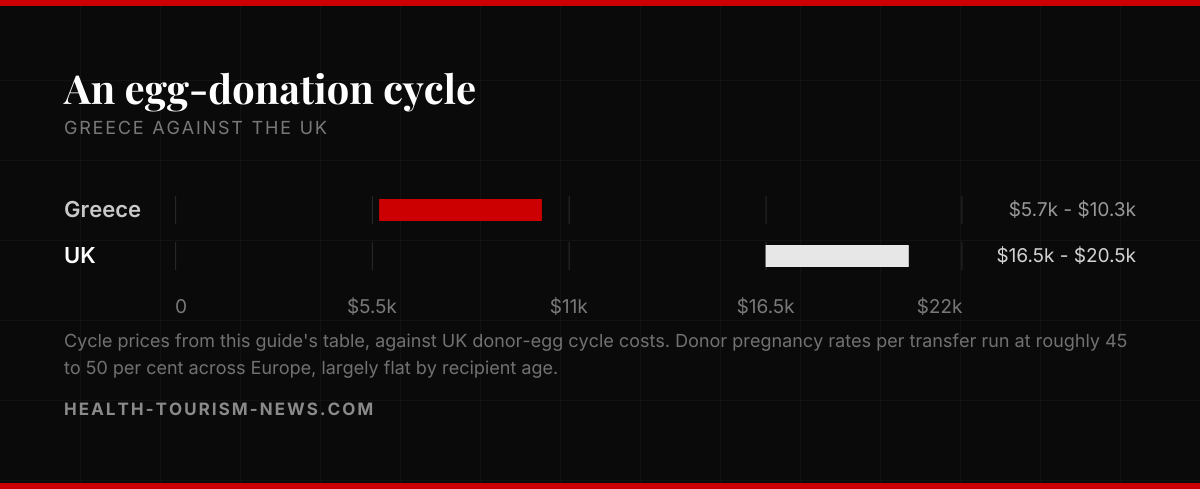
A donor-egg IVF cycle in Greece is published at $5,700 to $10,250, against $16,500 to $20,500 on a named London clinic’s list, and an own-egg cycle runs from about $3,400 before medication. Greece has quietly become one of Europe’s busier fertility destinations on three things Britain cannot match on price: anonymous donation that keeps waiting lists short, a legal treatment age of 54, and euro prices roughly half the London ones. Two of those advantages carry a cost that never appears on the invoice, and the country publishes far less outcome data than Spain, so the headline success figures need reading with care. This guide sets out the prices, the law that separates Greece from Britain, and the number clinics quote instead of the one that matters.
Health Tourism News is a trade publication and sells no treatment. Prices below are the figures clinics and platforms publish, converted and attributed, and their limits are flagged where they matter.
How much does IVF in Greece cost?
A standard own-egg cycle ran about $3,400 to $5,100 (3,000 to 4,500 euros) across Greek clinics publishing prices in mid-2026, with ICSI, the sperm-microinjection step UK clinics bill separately, usually folded in. Patient medication sits outside that figure, bought on prescription for a further $1,140 to $1,710, so the realistic all-in cost is around $4,500 to $6,800 before flights. Set against advertised UK cycles of $5,100 to $10,200 before their own drug and ICSI extras, a single own-egg cycle in Greece prices out below London without the gap being dramatic. A decisive difference opens on donation.
| Treatment | Greece, published | UK reference |
|---|---|---|
| Own-egg IVF cycle | $3,400 - $5,100 €3,000 - €4,500, ICSI usually included | $5,100 - $10,200 ICSI often extra |
| Patient medication | + $1,140 - $1,710 €1,000 - €1,500 | + comparable |
| Egg-donation cycle | $5,700 - $10,250 €5,000 - €9,000 | $16,500 - $20,500 named London list |
Greek clinics’ published prices, held on file. Full methodology under Sources.
Whether a home insurer will cover a complication traceable to treatment bought abroad is not settled, and is worth asking before booking rather than after.
Egg donation prices and what the packages guarantee
Donation is what Greece exports, and the price spread is mostly a matter of what the package promises. Published donor cycles run $5,700 to $10,250, with a common mid-market package near $8,400 guaranteeing one or two blastocysts if the sperm parameters are normal. The floor buys a set number of donated eggs and a culture; the higher tiers add blastocyst guarantees or chromosome screening. Comparing clinics therefore means comparing the guarantee rather than the headline, and the same discipline applies to the multi-cycle refund programmes some clinics run, where the age cap and the small print deserve as much attention as the refund percentage. Against a named London donor-egg price of $16,500 to $20,500, the Greek package is roughly half, and it comes with a match measured in weeks rather than the wait that sends UK patients abroad in the first place.
What are the real success rates?
Here Greece asks for more trust than Spain does, because it publishes less. Spain runs a mandatory national activity registry; Greece does not publish detailed national outcome tables on the same model, so the honest figures are the European ones. In the pan-European data, donor-egg clinical pregnancy runs around 45 to 50 per cent per transfer across recipient ages, with live birth somewhat lower, because embryo quality follows the donor’s age and Greek donors are young and screened. That near-flat curve is the genuine case for donor treatment in the mid-forties, where own-egg live birth per transfer falls into the low teens. A figure to distrust is the brochure’s. Clinics commonly advertise clinical-pregnancy rates of 60 or 70 per cent, and clinical pregnancy is an earlier and higher measure than a baby: it counts a heartbeat on a scan, not a birth, and the two diverge by the miscarriage rate. A patient comparing clinics should ask for live birth per transfer and treat any figure above the European donor band as a selected-patient number rather than a promise.
The law that makes Greece different
Greek assisted-reproduction law settles several questions Britain answers the other way. Donation is predominantly anonymous: the clinic matches the donor by physical characteristics and blood group, and where donation is anonymous a child born from the treatment cannot trace the donor. A 2022 reform made open, identifiable donation legally optional at the donor’s choice, but anonymous donation remains the norm in practice and the open route is reportedly little used. Britain works the other way by default, having abolished donor anonymity in 2005, so a donor-conceived Briton can request identifying details at 18, with the first cohort reaching that age from October 2023. Anonymity is what keeps Greek donor banks stocked and waiting lists short, and where it applies it forecloses a question the resulting child may one day ask. That trade is real in both directions, and it belongs in the decision rather than the footnotes.
Two further features draw patients specifically. Its legal treatment age runs to 54, raised from 50 by the 2022 reform and higher than most of Europe, with the national authority assessing the 50-to-54 cases. Greece also permits altruistic, court-authorised surrogacy, and commercial arrangements are prohibited. It was long one of the few European routes open to foreign patients, and that changed in 2025. Article 46 of Law 5197/2025, published in Government Gazette A’ 76 on 16 May 2025, amended Article 1458 of the Civil Code and Article 8 of Law 3089/2002 to require that both the applicant and the surrogate hold permanent residence in Greece before a court will authorise an arrangement. For a patient travelling from abroad, that closes the route.
Two details of the same article matter to anyone who was already part-way through. It clarified that an inability to carry a pregnancy does not include an inability arising from a person’s gender, which bars single men and male same-sex couples from the route. And it carries a transitional rule: applications a court had already heard before the amendment took effect are exempt, even where the decision was not yet irrevocable, while an application filed but not yet heard falls under the new requirement. Anyone offered a commercial or accelerated surrogacy arrangement is being offered something the law does not sanction.
The frozen-embryo trap
The consequence of anonymity that surfaces years later, and rarely appears in any quote, is the fate of spare embryos. Embryos left frozen after a Greek cycle stay in Greek storage, and whether they can follow the patient home turns on who provided the eggs and sperm. Embryos made from a couple’s own gametes can be imported for treatment at a UK clinic that holds the right certificate, with paperwork between both clinics. Embryos made with an anonymous donor generally cannot, because the donor does not meet Britain’s identifiability requirement, though an embryo from an open, identifiable donor could in principle qualify, and open donation has been legally available in Greece since 2022. The feature that brought the patient to Greece is the feature that can strand the embryos there, with storage fees running on and every future transfer meaning another flight. Deciding where all transfers will happen, before the first cycle creates a surplus, is the step that prevents it.
Trips, scans and monitoring from the UK
Donor-egg treatment is built for travellers. The recipient’s medication prepares the womb lining rather than stimulating ovaries, so scans and bloods can be done at a satellite clinic in Britain, the results sent to Greece, and the patient flies only for a transfer visit of about five days, with the first consultation routinely on video. An own-egg cycle is heavier, needing either about two weeks in Greece around a sedated egg collection or the same satellite arrangement with a tighter travel window. Satellite monitoring is legal and common, with one caveat that matters: the UK clinic scanning the patient takes no clinical responsibility for the Greek cycle, and the British regulator’s authority stops at the border. Its guidance to patients treated abroad is plain about the limit of the help it can give if something goes wrong.
How to check a Greek clinic
Greek clinics are licensed under national law and overseen by the National Authority of Medically Assisted Reproduction, which is the body a patient should expect a clinic to be authorised by. The gap against Spain is transparency rather than regulation: without published national outcome tables, a patient leans harder on the clinic’s own numbers, which is exactly why the live-birth-not-clinical-pregnancy question does more work here than anywhere. Two other numbers separate a careful clinic from a volume one. The first is the single-embryo transfer rate and the twin rate behind it, because multiple pregnancy is the biggest avoidable risk in fertility treatment and a clinic pushing double transfers to lift its headline is trading the patient’s safety for its marketing. The second is how the clinic prevents ovarian hyperstimulation in its egg donors, who carry that risk on the recipient’s behalf and whose welfare a responsible programme can account for. A clinic that answers all three plainly is the one to shortlist.
What this means for patients
Greece offers a genuine saving and two genuine advantages, and it asks for more trust than Spain in return. A donor cycle at half the London price, an age ceiling of 54 and a short donor wait are real reasons to travel, and the European data behind donor treatment is strong enough to stand without a brochure’s inflation. Costs that sit off the invoice are the ones to price honestly: a donor the child can never trace, embryos that may never leave Greek storage, and outcome figures a patient must interrogate because the country does not publish its own. Patients who ask for live birth rather than clinical pregnancy, decide the fate of spare embryos before the first cycle, and hold the clinic to single transfers are buying what the European data describes. The version sold on a 70 per cent headline costs the same and tells them less.